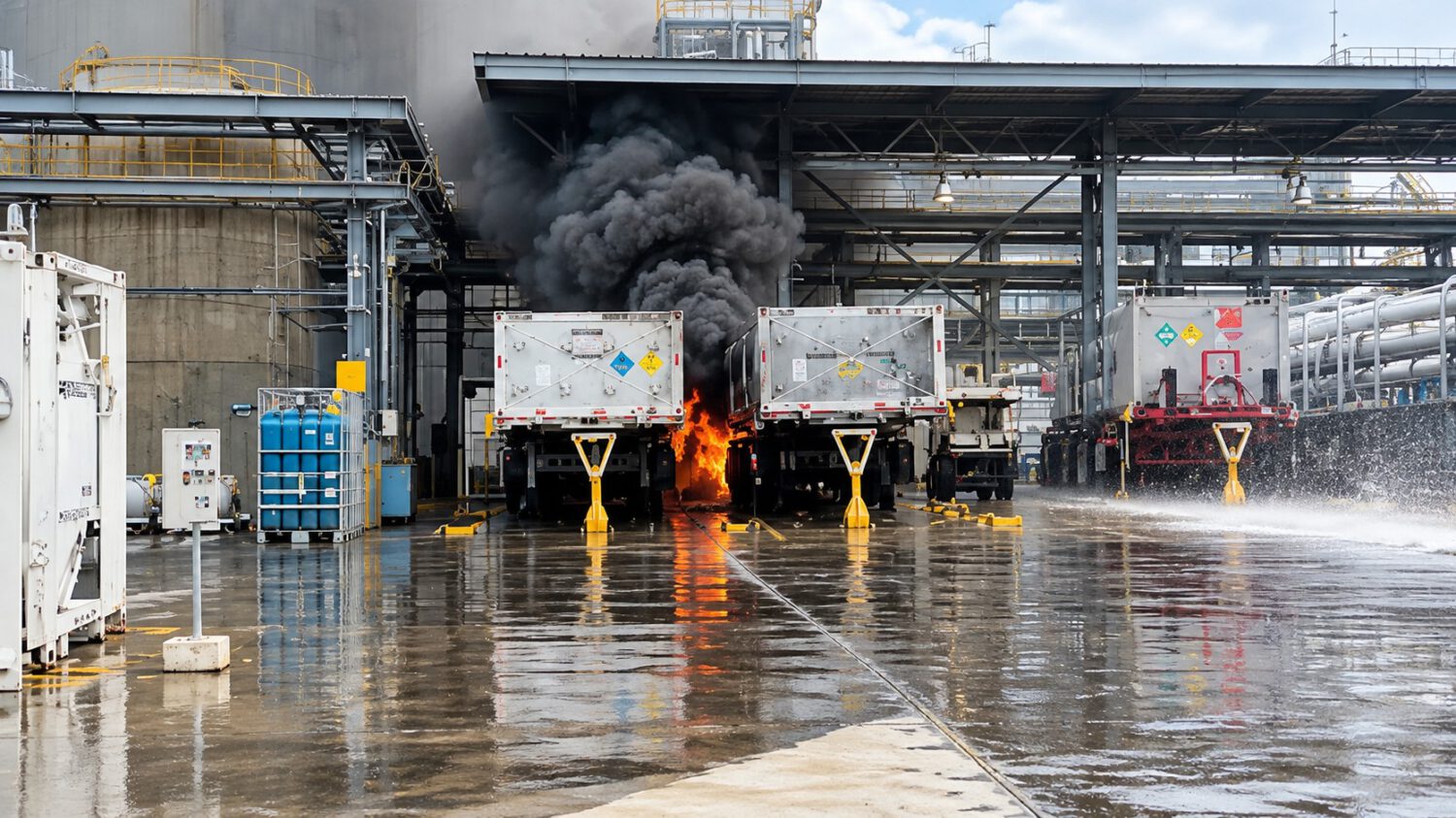
Two workers are dead and a third remains hospitalized in serious condition after an explosion struck Intel’s semiconductor facility in Kiryat Gat, Israel, on Wednesday, October 14, 2026. The incident has raised fresh questions about workplace safety in high-hazard industrial environments.
Police suspect a gas cylinder malfunction during an industrial transfer operation caused the blast. The fire involved nitrogen trifluoride, a toxic gas used in chipmaking, prompting a hazardous-materials response at the site.
Intel had not publicly commented on the victims or disclosed any disruption to production at the time of reporting.
What Happened
An explosion during a truck-to-tank material handoff killed two workers and left a third in intensive care.
According to the Kiryat Gat police commander, one truck had disconnected after unloading material into factory tanks when the explosion occurred as a second truck was being connected.
The first worker died at the scene; the second died later at Soroka Medical Center in Beersheba. Magen David Adom reported all three victims suffered severe burns, and two required resuscitation efforts at the site.
The third worker remained hospitalized in intensive care in serious condition at the time of reporting. Police said they had not identified suspected criminal activity or negligence at that stage, while the investigation continued.
The Chemical Hazard
Nitrogen trifluoride is nonflammable but hazardous by inhalation, and its presence required a sustained specialist response.
Israel’s Fire and Rescue Services, as reported by Israeli outlets, said the incident involved nitrogen trifluoride, known by its chemical formula NF3. The gas is used in semiconductor fabs to clean process chambers and related manufacturing equipment. It is nonflammable but carries oxidizing properties and poses an inhalation hazard.
Available reporting does not confirm whether NF3 was the substance being delivered by the trucks or whether it directly caused the explosion. Its presence was cited by authorities as a reason for hazmat monitoring at the site.
At least eight firefighting and rescue teams, including hazmat specialists, worked to contain the fire and search for trapped workers. Crews also cooled the site to prevent a secondary incident.
Authorities later reported no indication of an additional leak and said there was no danger to nearby residents. The mayor of Kiryat Gat urged the public to avoid the area while crews completed their work.
Intel’s Facility and the Production Question
Intel has not disclosed whether the explosion interrupted production at one of its strategically significant manufacturing sites.
Fab 28 operates on Intel’s Intel 7 process. It produces processors alongside products tied to 5G and AI applications, according to Intel facility information cited by Tom’s Hardware.
An adjacent expansion, Fab 38, was announced with a reported $3.25 billion Israeli government grant but has been paused since mid-2024.
Intel had released no statement on the victims or on the operational status of Fab 28 at the time of reporting. Any effect on wafer output or delivery schedules remained unknown. Incidents at critical industrial facilities have drawn comparisons to cases where a power plant offline scenario underscored vulnerabilities in complex manufacturing infrastructure.
Intel 7 manufacturing capacity had previously been described as constrained, with server-related wafers prioritized and supply shortages expected to persist into 2026. That context is relevant background, not evidence that the explosion caused a supply disruption.
What Remains Unknown
The final cause, potential safety violations, and production consequences all await further official disclosure.
The investigation into the precise cause of the explosion is ongoing. The surviving worker’s subsequent condition and prognosis had not been reported, and whether safety violations contributed to the incident has not been publicly established.
The duration of any operational suspension at Fab 28 also remains unknown pending statements from Intel or findings from relevant Israeli authorities.