Forklifts require trained operators and wide aisles, consuming floor space that most warehouse operators would rather dedicate to storage. Filics GmbH, a Munich-based robotics startup founded in 2019, has built a system aimed at the repetitive, ground-level pallet moves that tie up equipment and space in dense facilities. The technology is not a universal forklift replacement; it targets the specific subset of transport work that happens entirely at floor level.
Two Robots, One Pallet, No Driver Required
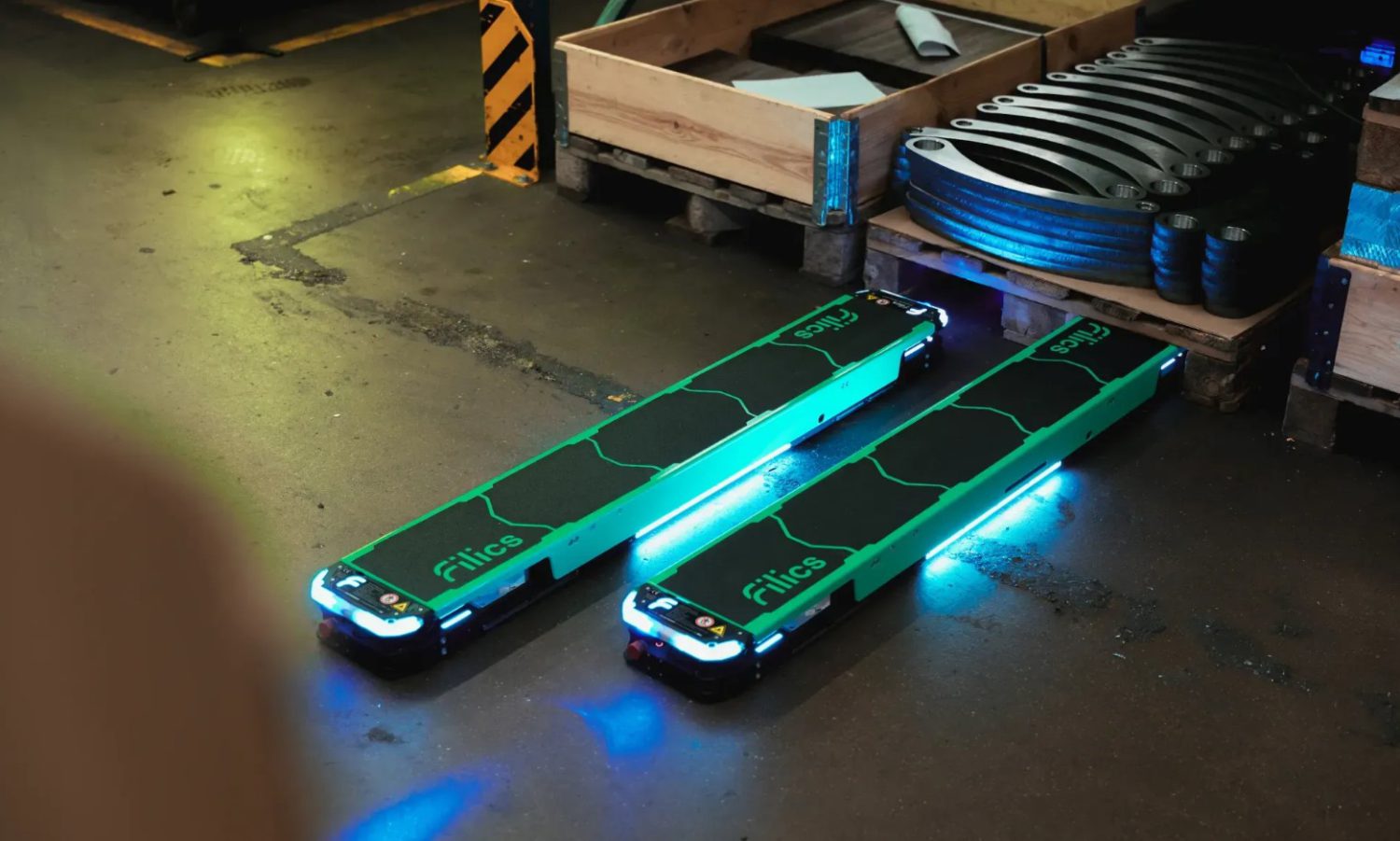
Filics Units operate as synchronized pairs, lifting and moving pallets from below without a transfer station or a human operator.
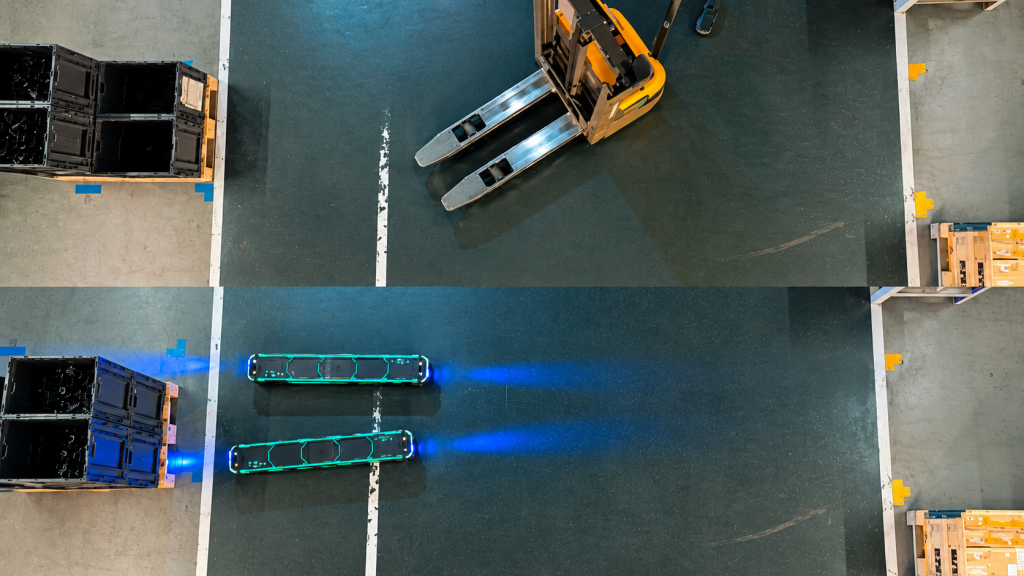
A Filics Unit consists of two mechanically independent robots that work in synchronization, driving beneath a pallet, lifting it from below, and transporting it without a transfer station. The system moves omnidirectionally and, according to Filics, can operate in aisles as narrow as 1.2 meters, with a turning radius of approximately 1.7 meters.
The current Streamliner platform lists a payload of up to 800 kilograms; earlier configurations reached 1.2 tons, and those figures vary by generation and should not be treated as interchangeable. Speed reaches up to 1.2 meters per second, and Filics reports that approximately 30 minutes of charging delivers up to six hours of operation on the current Streamliner, though an earlier product datasheet cited approximately four hours for the same charge time.
Compact robots with no driver and no conventional turning arc allow warehouses to tighten aisle widths without repositioning loads manually. Filics also says the system can enter beneath pallets to retrieve loads from dense floor-block storage, a configuration where conventional vehicles have limited access.
Where Forklifts Stay Essential
The 90-millimeter lift height defines a hard boundary between what Filics Units do and what conventional forklifts must continue to handle.
Vertical reach remains beyond the system’s design. A Filics Unit lifts a pallet roughly 90 millimeters off the ground, which means high-bay racking, load stacking, and most fixed-height operations still require a conventional forklift or reach truck. Filics’ own product positioning describes the technology as a floor-level transport solution, not a universal industrial truck replacement.
Real-world testing has moved beyond controlled environments, though it remains at the pilot stage. Nagel-Group began testing the autonomous system at its Schweitenkirchen site near Munich in September 2021, progressing from manual control through pallet and zone detection to autonomous transport between warehouse zones. Bosch and DHL Group are also identified in Filics’ company materials as having tested the technology, though the available information does not provide the same level of operational detail for each.
Filics raised a €13.5 million investment round, with Amazon’s Industrial Innovation Fund named among those associated with the financing. The company announced a new Unit generation at LogiMAT in March 2026, with VDA 5050 fleet integration supported via external partners. According to Filics product documentation, a specified Unit configuration carries CE certification and meets DIN EN ISO 3691-4 at Performance Level D; those certifications apply to that configuration and should not be assumed universal across all generations or installations.
For operators weighing adoption, the near-term model is a mixed fleet. Filics Units handle repetitive floor transport in high-throughput facilities with block-floor storage and narrow aisles, while forklifts manage everything requiring height, flexibility, or loading-dock access. Pallet compatibility, site-level workplace safety certification, and warehouse-management integration will each shape the pace of broader deployment.