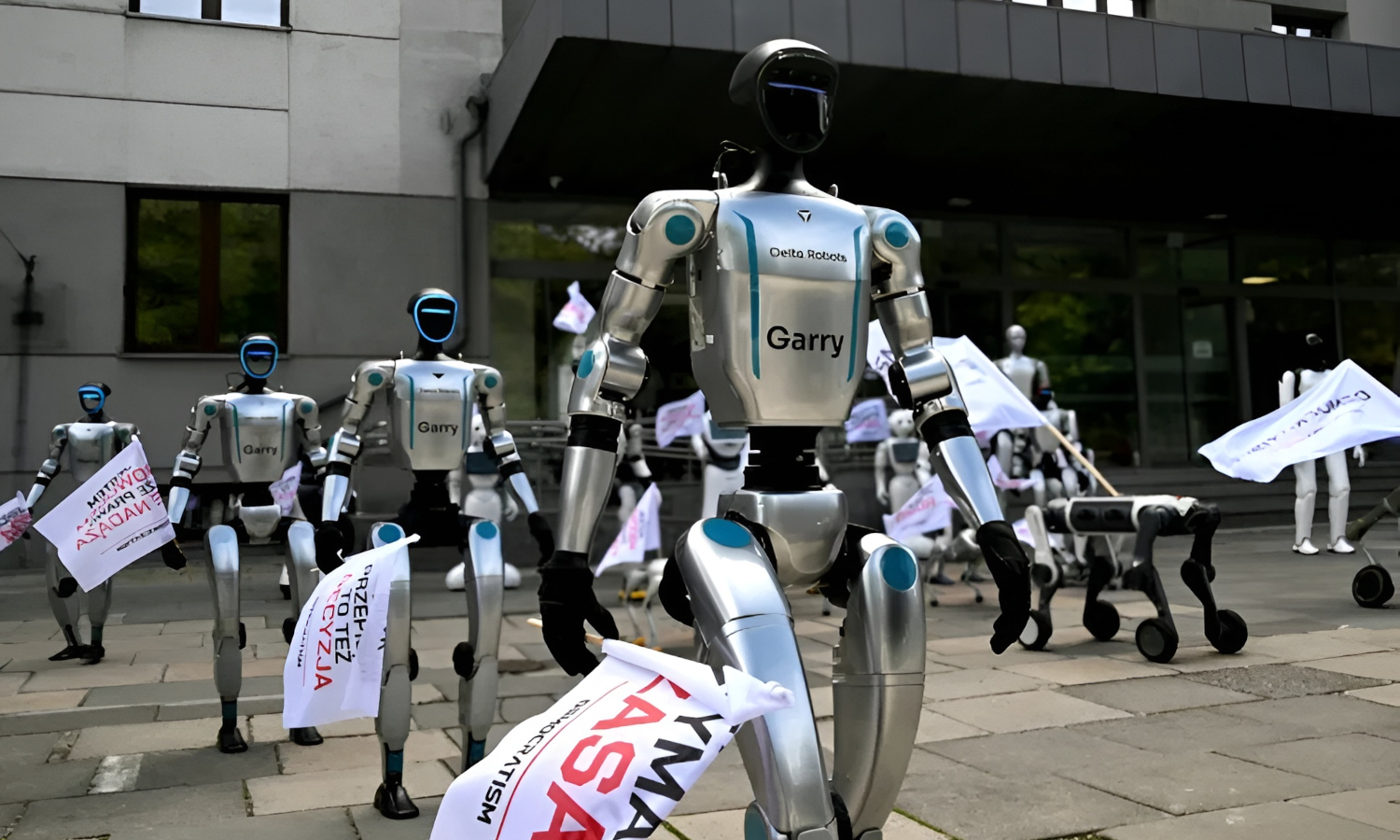
Thirty robots marched outside Poland’s Ministry of Digital Affairs demanding AI regulation. The company that built them organized the whole thing. This is either the future of labor activism or the most elaborate product demo ever staged — and the answer might genuinely be both.
What Actually Happened on the Streets of Warsaw
A robotics firm deployed its own machines to warn the government about robotics firms.
On September 7, 2026, around 30 humanoid and quadruped robots circled Warsaw’s Ministry of Digital Affairs, waving flags while loudspeakers broadcast:
- “Defend workplaces”
- “Time for rules”
- “Don’t wait, regulate”
Then the Agibot A3 — a conversational humanoid — fielded journalists’ questions live, announcing: “The robots present here are meant to show that this technology is already a reality.” That single sentence did more to complicate the protest’s message than any critic could manage.
Worth noting upfront: slogans were pre-recorded and broadcast via speakers — the robots generated nothing autonomously. The machines were supplied by Delta Robots, an Opole-based firm that has built and rented humanoids for over a decade. Grzegorz Kuliś, founder of organizing group Democratism, is also a Delta Robots executive, president of recruitment agency Weegree, and a former member of Poland’s Labour Market Council. Digital Affairs Minister Krzysztof Gawkowski walked outside to meet the organizers.
The Man Selling the Fire Extinguisher and the Matches
The protest’s organizer runs the company that built the robots demanding robot regulation.
Kuliś is wearing three hats simultaneously, and none of them cancel each other out. He sells robots. He places human workers in jobs. And he just staged a protest using automation to demand rules governing automation. That’s not hypocrisy — it’s actually the most lucid version of this debate available anywhere. The people closest to the technology understand the stakes better than anyone else in the room.
Kuliś warned, according to Euronews, that “if we don’t react now, we may soon have a problem,” and called for “rules and regulations that would serve as a shield protecting workers.” He framed Democratism as pro-consequence rather than anti-technology — a push for accountability before disruption fully arrives. He also wants the movement to go international. Whether that unfolds as genuine labor activism or a very effective global tour for Delta Robots’ product catalog remains an open question.
Poland Already Moved – Here’s What That Actually Means
Warsaw’s political theater landed on the doorstep of Europe’s most prepared AI regulator.
The protest didn’t happen in a vacuum. Poland is one of the first EU member states to operationalize the AI Act domestically, with national legislation creating KRiBSI — the Commission for the Development and Security of Artificial Intelligence — a single national authority empowered to supervise AI deployments, impose penalties, and run regulatory sandboxes (supervised environments where companies test AI systems before wider rollout).
Gawkowski, standing outside his own ministry negotiating with robots, stated that “uncontrolled AI models, implemented into humanoids that will also keep evolving as robotisation moves forward, are a major problem,” and insisted that “human beings come first,” according to Notes from Poland.
The Robots Weren’t Protesting. Humans Were.
The real message wasn’t in the slogans — it was in who chose to broadcast them.
The machines didn’t protest anything. They executed instructions written by people genuinely worried that the rules governing this technology are arriving slower than the technology itself. It’s a very Black Mirror move: using the thing you fear to demand someone regulate the thing you fear. The spectacle works precisely because the irony is real. Whether Warsaw’s robot march becomes a template for public AI advocacy — or just a very photogenic press release — depends entirely on whether governments treat the message more seriously than the messenger.