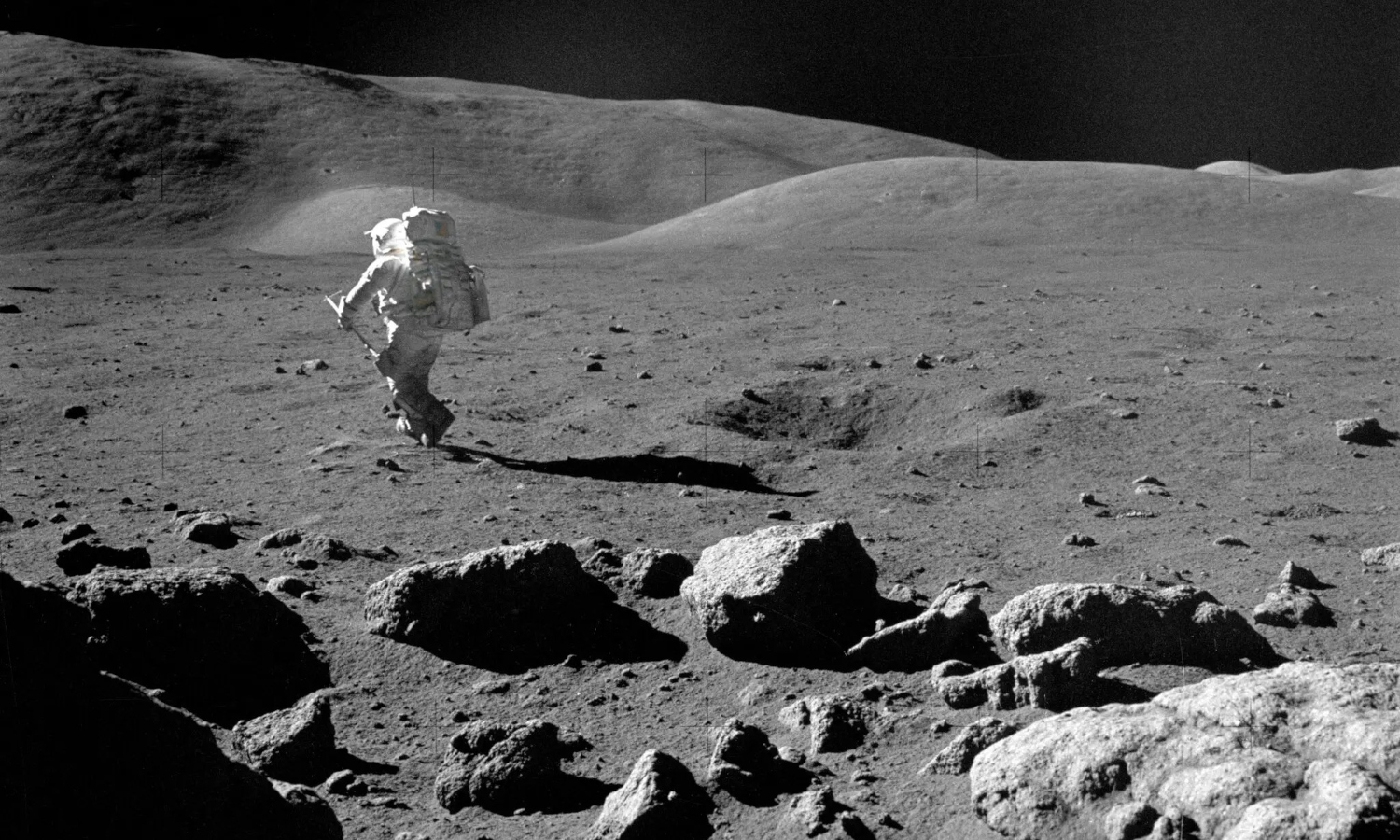
For roughly four billion years, the Moon has been collecting things. No weather to scrub the surface. No plate tectonics grinding the record into magma. Just an airless, geologically quiet body accumulating whatever drifts its way — micrometeorites, cosmic dust, and now, according to researchers at the SETI Institute and Birkbeck College, possibly microscopic debris from alien civilizations. The proposal isn’t a thought experiment. It’s a preprint, submitted to the International Journal of Astrobiology, with quantitative models and a specific plan: dig up roughly one cubic metre of lunar regolith and look.
The Microplastics of Deep Space
Micron-scale particles from alien civilizations may have been drifting toward the Moon for billions of years — and the Moon has been keeping every single one.
Think of the Moon as humanity’s attic — the place where things accumulate undisturbed for so long you forget what’s up there. Lead researcher Lewis J. Pinault and colleagues argue that micron-scale particles shed by alien infrastructure could travel thousands of light-years via stellar winds and radiation pressure, surviving 0.1 to 1 billion years in transit. They call unintentional debris “Arkhipov particles” — the space equivalent of microplastics flaking off a city-sized starship — and deliberately engineered microscopic probes “Bracewell particles,” after Ronald Bracewell’s concept of autonomous alien messengers.
The proposed search is methodical:
- Excavate approximately one cubic metre of lunar regolith
- Screen for metals, alloys, or manufactured materials inconsistent with natural lunar geology
- Apply machine-vision tools to flag grains with atypical shapes or impact morphologies
- Run high-resolution spectroscopy, micro-tomography, and isotopic analysis on any suspect particles
SETI scientist Sofia Sheikh calls it “a creative and worthwhile avenue,” particularly given NASA’s Artemis program returning hardware to the lunar surface.
What Finding Nothing Still Tells You
A null result isn’t failure — it’s the Fermi paradox with actual math attached.
A null result sounds like failure. It is not. Skeptics aren’t wrong to be cautious — Apollo samples have been examined “in excruciating detail” with no alien technology found, and Penn State’s Jason Wright, who calls the preprint “impressive” and “extremely thorough,” still acknowledges this is a needle-in-a-haystack exercise.
But haystacks have measurable dimensions. Pinault’s modeling shows that finding zero artificial grains in one cubic metre would rule out scenarios where civilizations typically disperse more than roughly 0.09 Earth-mass equivalents of artificial particulate across galactic history. That’s a real constraint on the Fermi paradox — not an answer, but math where previously there was only silence.
Flip it, and the stakes get vertiginous. Finding even one confirmed alien grain, co-author Ian Crawford notes, would be “a very, very important discovery,” implying either civilizations are far more common than conservative models assume, or at least one deliberately targeted the inner Solar System. Any candidate must survive brutal scrutiny: comparison against known aerospace alloys, Earth-like isotopic ratios, and every contamination pathway from decades of human lunar missions. The burden of proof is enormous.
Lost Civilization research on Earth has shown how much can hide in plain sight; similarly, Artemis is already heading back. Adding technosignature-focused instruments to existing missions costs relatively little. Whether the dust comes back clean or not, the answer reshapes what we know about who has ever existed in this galaxy.