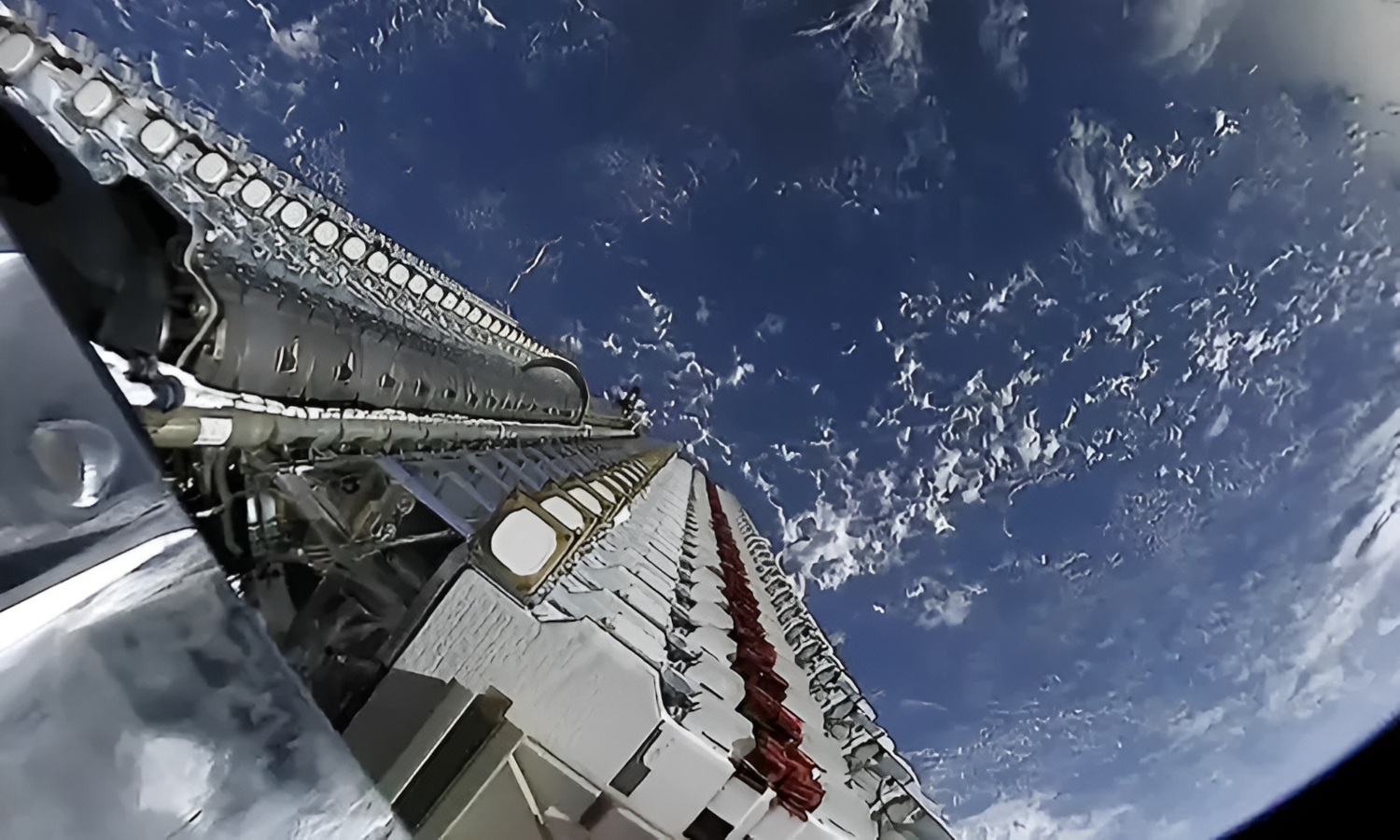
Astronomers spent decades designing the Square Kilometre Array Low (SKA-Low) to hear the faintest whisper in the observable universe — neutral hydrogen signals from the cosmic dawn, when the first stars flickered on roughly 13 billion years ago. What they’re picking up instead is electronic leakage from SpaceX satellites. Not the broadband beams Starlink intentionally transmits. The accidental static bleeding from onboard hardware, coupling through satellite structures and radiating across frequencies nobody authorized.
A Curtin University team using the Engineering Development Array 2 — a prototype SKA-Low station in Australia — analyzed approximately 76 million radio images over 29 days. The results, published in Astronomy & Astrophysics, are uncomfortable reading. Researchers catalogued 112,534 individual radio emissions from 1,806 unique Starlink satellites across 73–235 MHz, the exact frequency range SKA-Low needs. Some satellites emit periodic 13-kHz tones at roughly 137 MHz every 100 seconds. These aren’t scheduled downlinks that operators can plan around. They’re unpredictable hardware leakage — and researchers cannot subtract a signal they cannot model.
The numbers tell the story bluntly:
- 112,534 emissions detected from 1,806 unique Starlink satellites
- Leakage reaching up to 10⁶ Jy/beam; early-universe hydrogen signals require sensitivity near 10⁻⁵ Jy
- Starlink signals reportedly around 10,000 times stronger than the cosmic signals SKA-Low is built to detect
- Up to 30% of images at some frequencies contained Starlink interference
- Emissions found inside two ITU-protected bands — 73–74.6 MHz and 150.05–153 MHz — where signals aren’t supposed to exist at all
“Comparable to the brightest natural radio sources in the sky.” — Steven Tingay, Curtin University, on Starlink’s leaked emissions
What SKA-Low is hunting demands almost incomprehensible sensitivity. Trying to detect those ancient hydrogen signals with Starlink overhead is like attempting to hear a conversation from 13 billion years ago while your neighbor runs a subwoofer at full volume. The contamination doesn’t just degrade data quality — it risks rendering entire frequency bands scientifically unusable.
The Rules Don’t Cover This
Current international frameworks leave unintended satellite emissions in a regulatory gray zone, even when those emissions land inside protected astronomy bands.
Here’s the structural problem: nobody is technically breaking any rules. The International Telecommunication Union (ITU) protects certain radio astronomy bands from intentional transmissions. Unintended electromagnetic radiation — hardware leakage — sits largely outside that framework, legally invisible even when it bleeds into protected spectrum. Think of it as the radio equivalent of noise ordinances that cover deliberate sound but ignore a neighbor’s HVAC system, no matter how loud it runs at 3 a.m.
SpaceX has engaged constructively before — satellite visors reduced optical brightness, and an NSF coordination agreement addressed higher-frequency radio bands. But beam management doesn’t fix low-frequency hardware leakage. The ITU is reportedly discussing the issue, though discussion isn’t regulation, and the constellation already exceeds 6,000 satellites. Researchers shared their findings with SpaceX, who are reportedly open to dialogue on future hardware changes. Algorithmic mitigation is being explored, but scientists describe it as “embryonic” — potentially demanding computing power that rivals the science processing itself.
Engineering fixes are the real answer, the same way design changes addressed optical brightness. The question isn’t just what’s happening to astronomers — it’s who decides what the radio sky is worth protecting, and whether that decision gets made before the window closes.