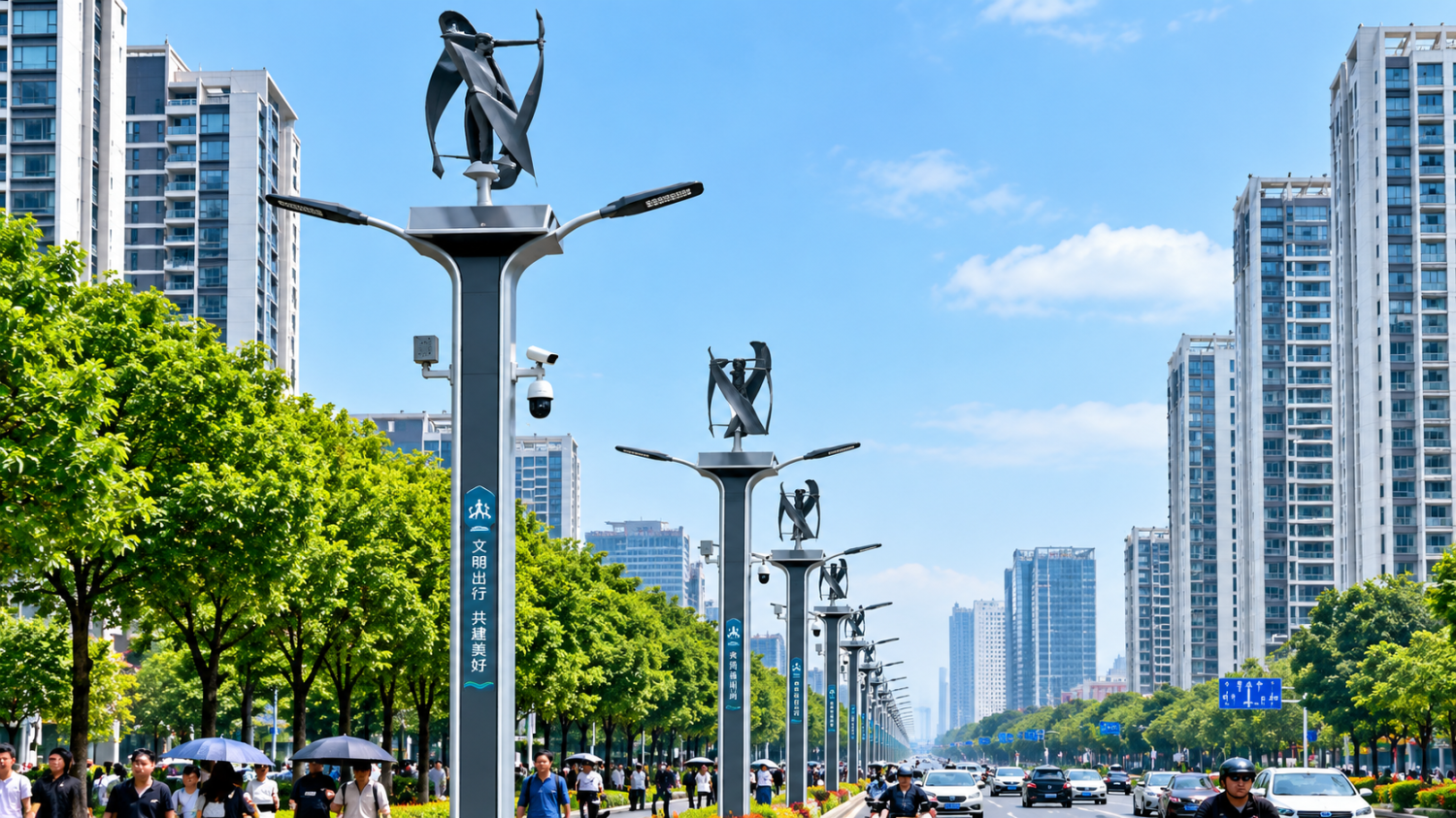
Chinese manufacturers are selling streetlight poles that pair compact vertical-axis wind turbines with solar panels, battery storage, and LED controls, all on a single mast. Supplier listings describe systems rated between 100 and 400 watts of wind output, with cut-in speeds starting around 2 meters per second. What you’re actually buying, though, is a manufacturer claim, not a field-verified number.
How the System Works
Turbine and panel feed a controller, which charges the battery, which powers the LEDs after dark.
The vertical-axis design means the rotor spins on a vertical shaft, so the turbine does not require mechanical orientation toward the wind source in the way many conventional horizontal-axis turbines do. That trait makes VAWTs theoretically better suited to the shifting, turbulent airflow common near roads and buildings, though research confirms that turbulence and building placement can substantially alter performance, with some studies reporting that turbine positioning alone changes measured power output by as much as 84 percent.
One H-style system listed by a Chinese supplier specifies a 240-watt rated wind output at 10 meters per second, a 2.2-meter-per-second cut-in speed, a 300-watt solar panel limit, and an IP53 enclosure rating. Rated output at a specific wind speed is not average output, and 10 meters per second is faster than the typical airflow most urban and suburban streets actually see.
What the Evidence Actually Shows
Pilot shipments and supplier pages are not the same as a verified national rollout.
The most concrete deployment detail in available sources is a reported shipment of 10 sets of 2-kilowatt vertical-axis wind systems to a project in Miluo City, Hunan Province, described by the supplier as a grid-connected demonstration. That report does not independently verify commissioning, measured energy generation, or whether the systems powered streetlights. Named suppliers in the market include Yangzhou Shenzhou Wind Power and Shenzhen Taima Fengguang Energy Technology, among others listed on Chinese B2B marketplaces.
Claims circulating online that Chinese cities are broadly deploying these systems at scale come largely from supplier pages and social commentary. Government project documents, peer-reviewed studies, and audited field reports do not support that picture. A credible performance evaluation would require a local wind-speed assessment, a measured capacity factor across seasons, and battery-cycle data. It would also need a direct comparison against a solar-only alternative at the same site.
Where These Systems Make Sense
Remote roads and off-grid corridors are a stronger fit than dense city centers.
Urban wind is often weak, obstructed by buildings, and irregular in ways that suppress average turbine output well below nameplate ratings. The strongest commercial case for hybrid wind-solar streetlights is remote roads, rural corridors, parks, industrial perimeters, and surveillance points where extending a grid connection is expensive or unreliable.
The “smart” layer in these systems may include remote battery monitoring, LED scheduling, and grid-switching capability. Based on available evidence, no standardized national software platform or unified communications protocol has been established across Chinese deployments.
The Road to Broader Adoption
Promising niche infrastructure, with real performance questions still unanswered at scale.
Wider adoption will require independently measured field data on annual energy yield, transparent lifecycle-cost comparisons, and documented noise and safety testing from operating installations. Until that evidence exists, wind-solar hybrid streetlights are best understood as a credible solution for specific off-grid applications, not a proven replacement for grid-connected street lighting at any meaningful scale.