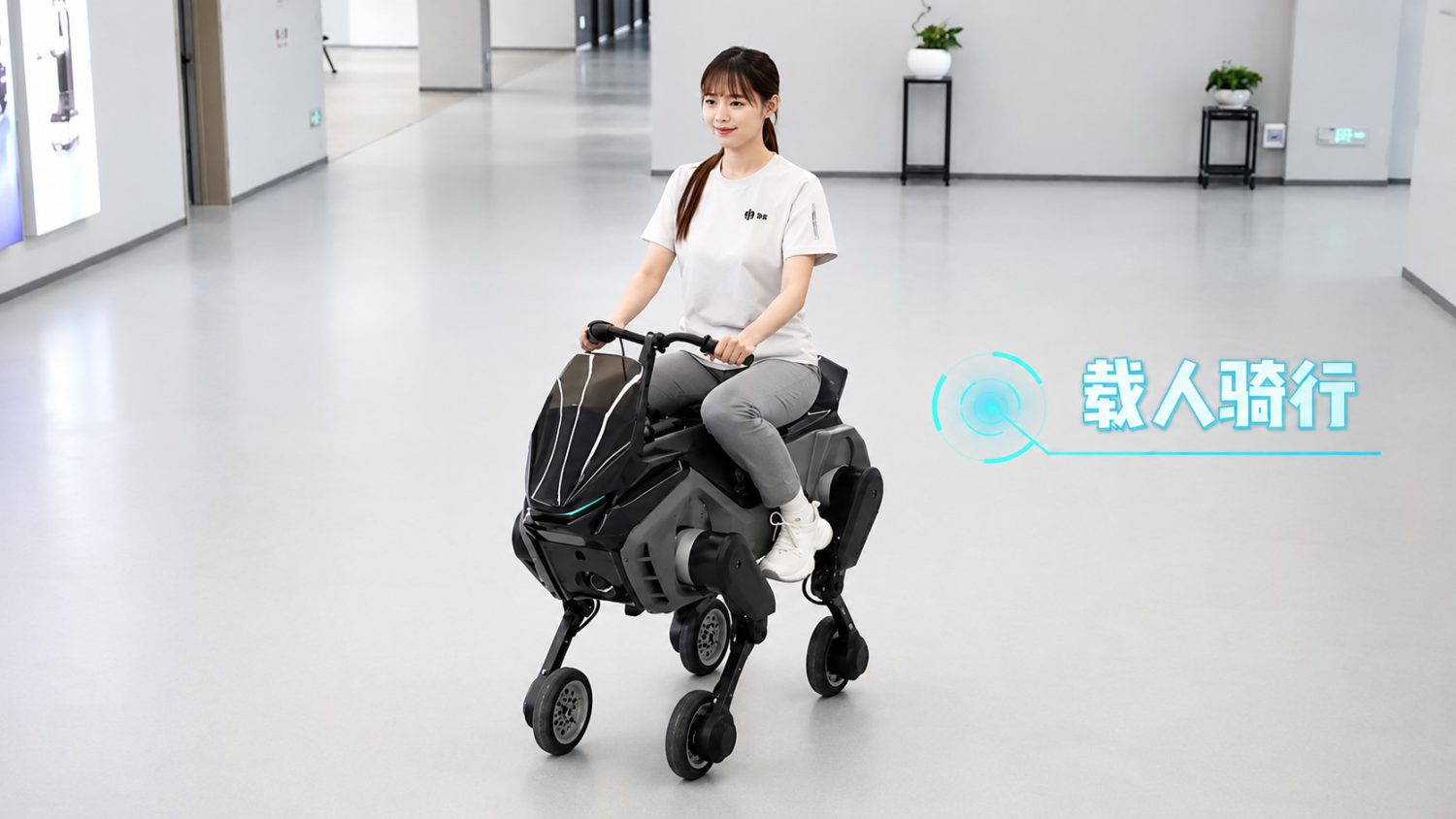
Riding a quadruped robot is nothing like riding a motorcycle, a scooter, or even one of those self-balancing boards that sent a thousand people to urgent care in 2015. Chongqing Haochen Embodied Intelligence Technology is presenting that distinction as a selling point with its VOGEBOT 3.0, an AI-powered, wheeled-legged humanoid robot designed to carry a human passenger across varied terrain.
What VOGEBOT 3.0 Is and What It Reportedly Does
The robot combines wheeled and legged movement, with capabilities reported by event staff at the World Artificial Intelligence Conference in Shanghai.
Haochen developed the robot with reported technical support from AGIQUAD, an AgiBot subsidiary based in Shanghai. The machine belongs to a relatively new product category: wheeled-legged quadrupeds that alternate between rolling and stepping depending on the surface.
Demonstrated or described capabilities, according to event staff quoted in Global Times coverage, include voice interaction, autonomous driving, obstacle avoidance, dynamic self-balancing, stair climbing and descent, crab-like lateral movement, body-form switching, and millisecond-level emergency stabilization. These are event-report claims, not independently tested performance results.
The company reports a top speed of 15 kilometers per hour, a payload capacity of 75 kilograms, a maximum range of 20 kilometers per charge, and a slope capability of up to 25 degrees. All four figures come from on-site staff statements at the Shanghai conference, not from independent laboratory testing or consumer trials.
Real-world performance would likely vary with rider weight, terrain conditions, temperature, speed selection, and battery state, as is typical for vehicles of this type.
What Remains Unverified and What Buyers Should Know
Key specifications are unvalidated, regulatory approval is unresolved, and several technical details have not been publicly confirmed.
No third-party validation of the performance figures was identified in the available reporting. No safety certifications, crash-test results, braking-distance data, or formal rider-protection standards were identified either. For context on how robotics developers are approaching safety in adjacent fields, the robotic knee exoskeleton developed at the University of Michigan offers a contrast in documented safety standards.
Battery chemistry, charging time, sensor configuration, connectivity options, and operating temperature limits are also unconfirmed. Those gaps matter because they determine whether a rideable robot is a practical machine or a controlled-demonstration vehicle.
Regulatory status presents a separate complication. The available reporting does not establish that the VOGEBOT 3.0 is approved for public-road use; requirements would depend on the relevant jurisdiction. The company has stated a goal of obtaining a motorcycle or four-wheel-vehicle license within three years, which signals commercial ambition toward road-legal status. That goal is not the same as achieving it.
Global pre-orders opened at the Shanghai conference, with small-batch delivery reportedly planned for September. The source does not confirm the delivery year, a retail price, or which markets will receive units first.
Autonomous driving is among the most significant reported features and carries the most unanswered questions. Available reporting does not document geofencing limits, remote-supervision requirements, obstacle classification, or the robot’s behavior after a sensor failure or power interruption during a ride.
What exists right now is a conference demonstration with open pre-orders and reported claims that lack independently verified data to support them. The test results, when they arrive, will say more than any product reveal.