Out of 103 submitted proposals, the U.S. Army selected five winners from its xTechHumanoid competition to advance military exploration of humanoid robot technology. This is a structured technology evaluation, not a deployment announcement.
The program sits inside the Army’s FUZE xTech initiative and is coordinated through the Humanoid Community of Collaboration, a Joint Force body established in 2023 to develop and integrate humanoid capabilities across the Department of Defense.
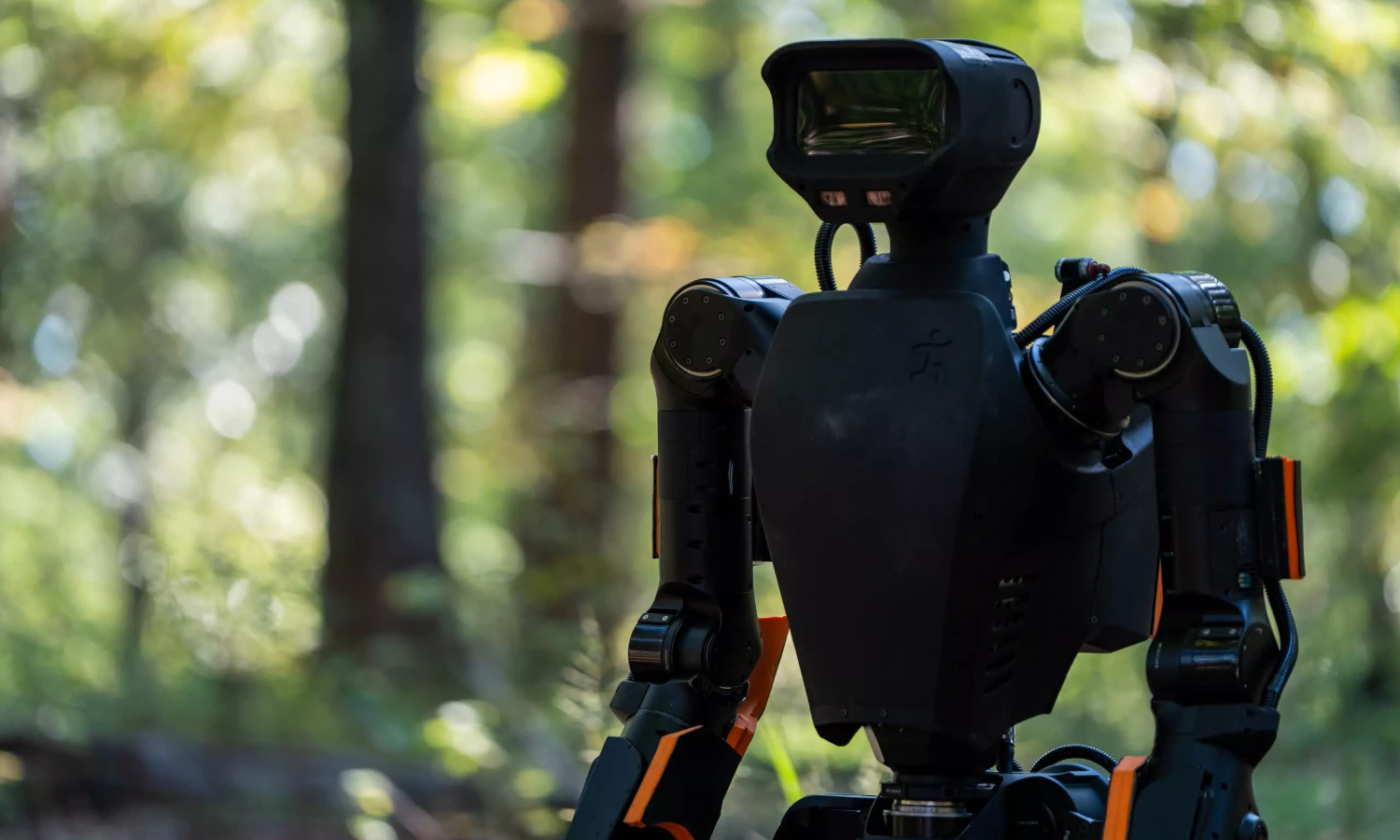
Meet Alex: 29 Joints, Ballistic Protection, Human in the Loop
Alex, built by a Florida nonprofit research institute, is the competition’s most fully realized humanoid platform, though key specifications remain unconfirmed.
The standout platform among the five winners is Alex, built by the Florida Institute for Human and Machine Cognition, a nonprofit research institute. The Army describes Alex as featuring impact-resilient actuators and ballistic protection. It also integrates hybrid autonomy, combining artificial intelligence with human operator control for complex and dangerous missions.
Alex uses 29 joints and custom quasi-direct-drive actuators designed for efficient motion and physical interaction. The Army has not specified the protection standard, material, or coverage area behind the ballistic protection description. No live-fire testing data appears in available sources.
Hybrid autonomy is a meaningful detail. Alex is not being presented as an independent battlefield decision-maker; human operators remain central to the system, particularly where tasks carry the most risk.
Why the Army Wants a Robot That Looks Like a Person
Humanoid form factors offer a practical advantage: they can potentially navigate the stairs, doorways, and tools that human environments were built around.
The case for humanoid form factors comes down to infrastructure. Human-built environments, including stairs, doorways, ladders, and indoor spaces, were designed for human bodies, and a humanoid robot can potentially operate inside those spaces without requiring significant modification.
The Army’s competition materials identify specific mission areas: reconnaissance, security, obstacle clearing, hazardous-material operations, and urban missions. Think forward surveillance and hazardous-material handling before soldiers move in, not an autonomous weapons platform.
Dr. Alex Miller, U.S. Army Chief Technology Officer, explained the rationale directly. “Humanoid robots are part of a broader autonomy push to increase the depth and breadth of robotic platforms and components industry can provide for a range of missions,” according to the xtech.army.mil announcement.
The International Context Is Real, but Measured
China is accelerating humanoid robot research, but Reuters found no evidence of armed humanoid deployment with any operational People’s Liberation Army unit.
China’s defense establishment is also accelerating humanoid robot research, according to Reuters, which reviewed more than 100 Chinese military procurement notices, academic studies, patents, and official publications. That review surfaced procurement tenders and perception system requests. It also identified a 2026 budget of roughly $300,000 for collecting and labeling camera, radar, motion, and terrain data for humanoid systems. Hypersonic Missiles represent another area where U.S. military advanced-weapons investment has drawn parallel attention alongside humanoid robot programs.
Reuters found no evidence that China has deployed an armed humanoid robot with an operational People’s Liberation Army unit. Both countries remain in experimental territory, and neither has crossed from research into routine battlefield use.
Miller’s second quote captures the U.S. posture accurately. “We are identifying the problems, mission needs, and opportunities to enable our formations with the right mix of tools,” per the xtech.army.mil announcement.
The Open Questions Outweigh the Confirmed Details
Contract values, procurement timelines, and comparative performance data are not established in available sources, leaving the program’s operational future genuinely uncertain.
The five xTechHumanoid winners covered multiple technology areas beyond complete robot platforms, including power systems, tactile sensing, and autonomy software. Contract values, production commitments, and procurement timelines are not established in available sources.
Whether humanoid platforms can outperform wheeled, tracked, or quadruped robots under real operational conditions remains an open and consequential question. The Army has moved from general curiosity to a structured, competitive evaluation process. The harder test, whether these machines can earn a battlefield role on merit, is still ahead.