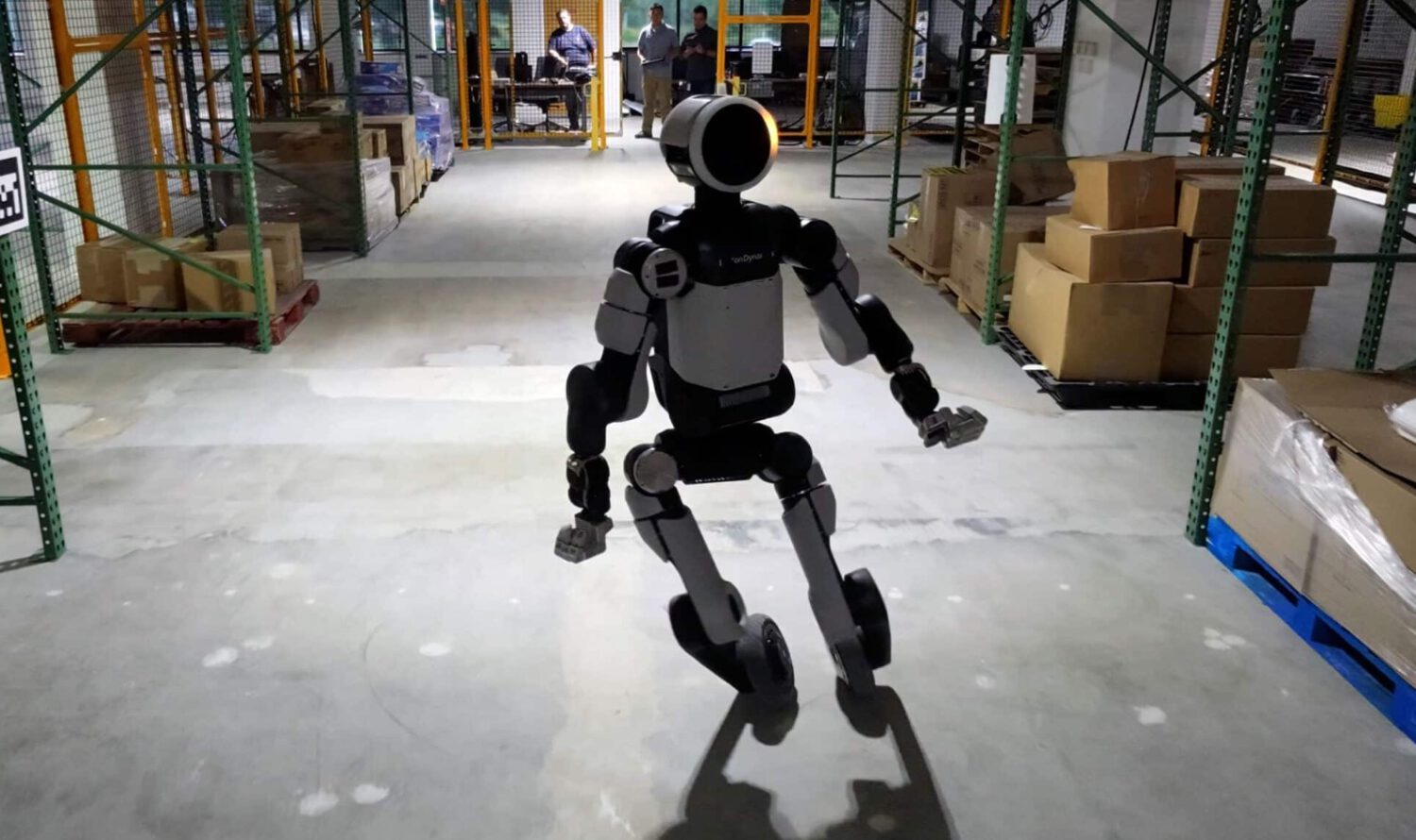
Boston Dynamics swapped its humanoid robot’s feet for scooter wheels, not to build a wheeled product, but to stress-test its actuators and learned control system under demands that walking simply cannot replicate. The wheeled Atlas is a research testbed, the company says, built to reveal how faithfully a learned whole-body controller transfers to real hardware when motors are pushed near their limits.
One Adapter, One Radical Change
Boston Dynamics replaced Atlas’s feet with scooter wheels using a custom adapter mounted directly to each existing ankle actuator. According to the company’s blog, that adapter was the only new part in the entire build.
Why Wheels Break What Walking Hides
Walking distributes mechanical load through brief, repeated ground contacts. Wheels remove that intermittent relief. Every launch, turn, and stop forces Atlas’s motors to operate across wide portions of their torque-speed range while supporting the robot’s full body weight. That unrelenting demand turns the wheeled configuration into a live diagnostic, exposing discrepancies between simulated and real-world actuator behavior that might otherwise go undetected in a walking robot.
Same Control Framework, Targeted Adjustments
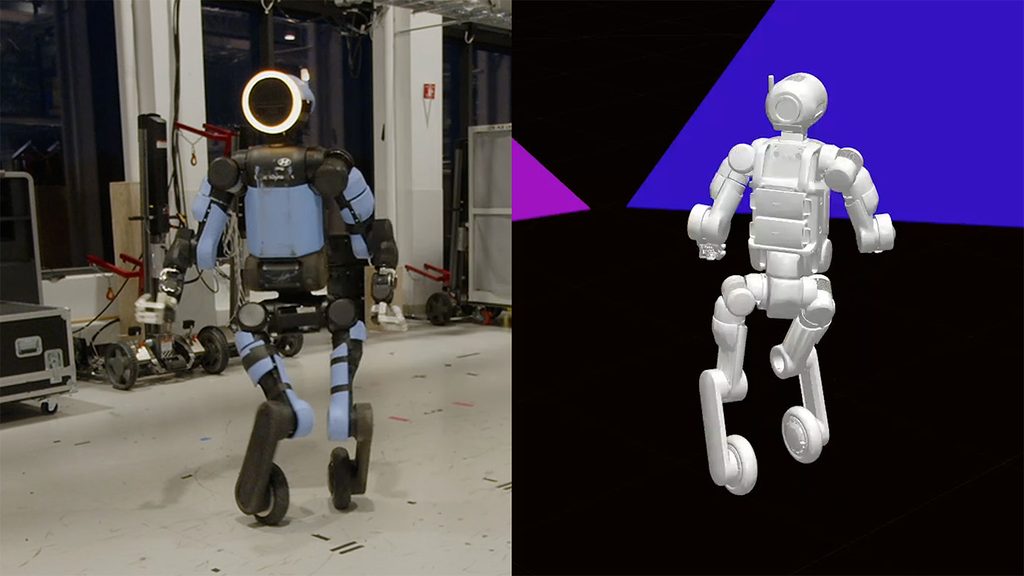
The team did not write a separate control architecture for the wheeled robot. Instead, they treated each wheel as a continuously rotating ankle joint and adapted the same whole-body control framework used for the walking Atlas. Getting from simulation to hardware required adjustments to reward composition, command ranges, and posture control, according to Boston Dynamics, rather than a ground-up redesign.
What the Robot Actually Does on Wheels
The trained controller produced a side-dash maneuver drawn from a pipeline built on human motion trajectories. Where a person would slide their feet, the robot found a rolling equivalent that achieves a comparable result.
A 360-degree jump, also derived from a recorded human trajectory, succeeded on its first physical attempt. The policy learned to position Atlas’s lower body and use the wheels to generate upward momentum, Boston Dynamics reported.
This Is Not a Product (For the Wheeled Configuration)
The company’s own framing stops well short of any product announcement for the wheeled variant. The wheeled configuration exists to study how learned whole-body controllers perform when real actuators operate near their limits, not to put Atlas on a warehouse floor. Nothing in the available material establishes payload performance, operational costs, or regulatory clearance for the wheeled experiment. It is worth noting that Boston Dynamics has separately described a production version of Atlas in other 2026 materials, referencing work also seen in the Robotic Knee Exoskeleton domain of actuator and control-system research; that is a distinct effort from this research work.
The Real Return May Flow Back to the Walking Robot
The engineering value here may travel upstream. What Boston Dynamics learns about actuator modeling and control transfer under sustained mechanical stress could help sharpen disturbance recovery and limit-aware operation on the standard walking configuration. The company frames the wheeled experiment as a research exercise rather than a finished capability, and that framing reflects where learned whole-body control is headed: not toward a novelty product, but toward a more reliable and better-understood robot, much like the work done by Snake Robots operating under demanding real-world conditions.