Concrete stops light cold. X-rays can penetrate many materials, but dense shielding such as thick lead remains difficult to image. Researchers at the Extreme Light Infrastructure–Nuclear Physics facility in Măgurele, Romania have now demonstrated a laser-generated muon beam that produced a low-resolution image of dense objects through two meters of solid concrete. Posted as a preprint on September 23, 2026, the work represents what the authors describe as, to their knowledge, the first imaging demonstration dominated by laser-produced muons, though the paper has not yet undergone peer review.
What Muons Are and Why They Matter
These elementary particles pass through dense matter in ways that reveal hidden structure, making them a powerful tool for imaging objects that block light and challenge X-ray systems.
Muons are elementary particles roughly 200 times heavier than electrons, and their greater mass and high energies allow them to penetrate concrete, rock, and metal. As they travel through matter, they lose energy and deflect in ways that reveal differences in density on the other side. They are, in practical terms, a muography system capable of producing transmission images of objects too thick for conventional methods to inspect usefully.
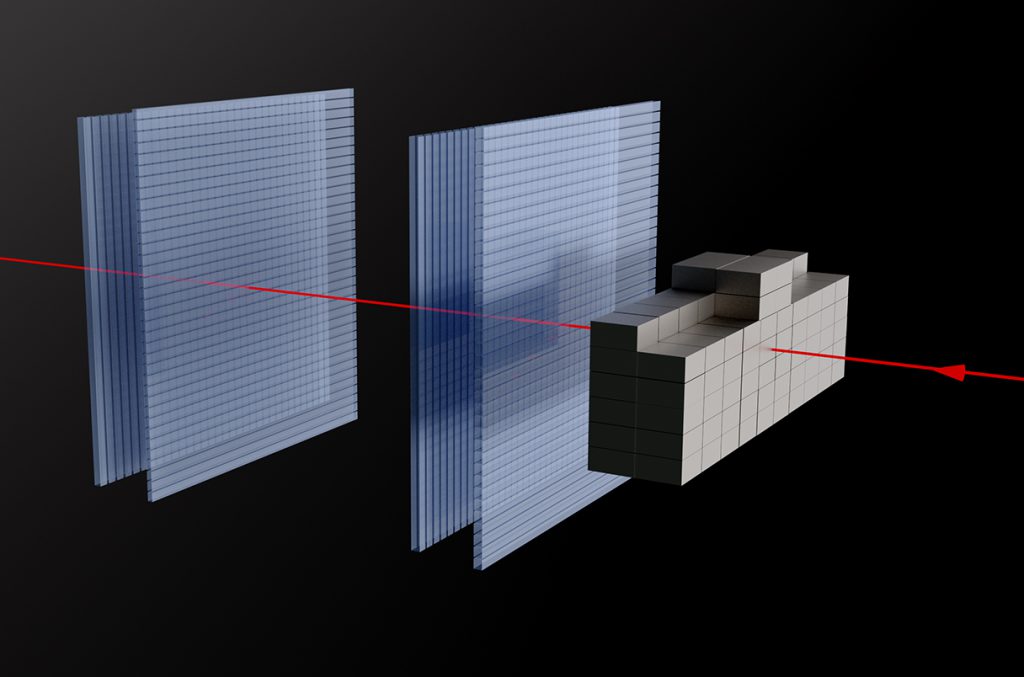
Image: Alexandra Saftoiu
Natural muons rain down constantly from the atmosphere, produced when cosmic rays collide with air molecules above Earth. Scientists have used that natural flux to do remarkable things: in 2017, detectors placed around Egypt’s Great Pyramid revealed evidence of a previously unknown void buried inside. Collecting enough cosmic-ray muons to form a usable image took months, which is where an artificial, on-demand source becomes significant.
How the Experiment Actually Worked
A 10-petawatt laser set off a chain of particle interactions that produced a directed muon beam, sent it through a concrete wall, and captured a shadow image of lead bricks on the other side.
ELI-NP’s 10-petawatt laser delivered roughly 230 joules of energy in a 23-femtosecond pulse, accelerating electrons through a gas-filled chamber. Those electrons struck a lead converter target, producing high-energy photons that generated muon pairs through a process called Bethe-Heitler pair production. A filter made of plastic and paraffin substantially attenuated background particles before the beam continued forward.
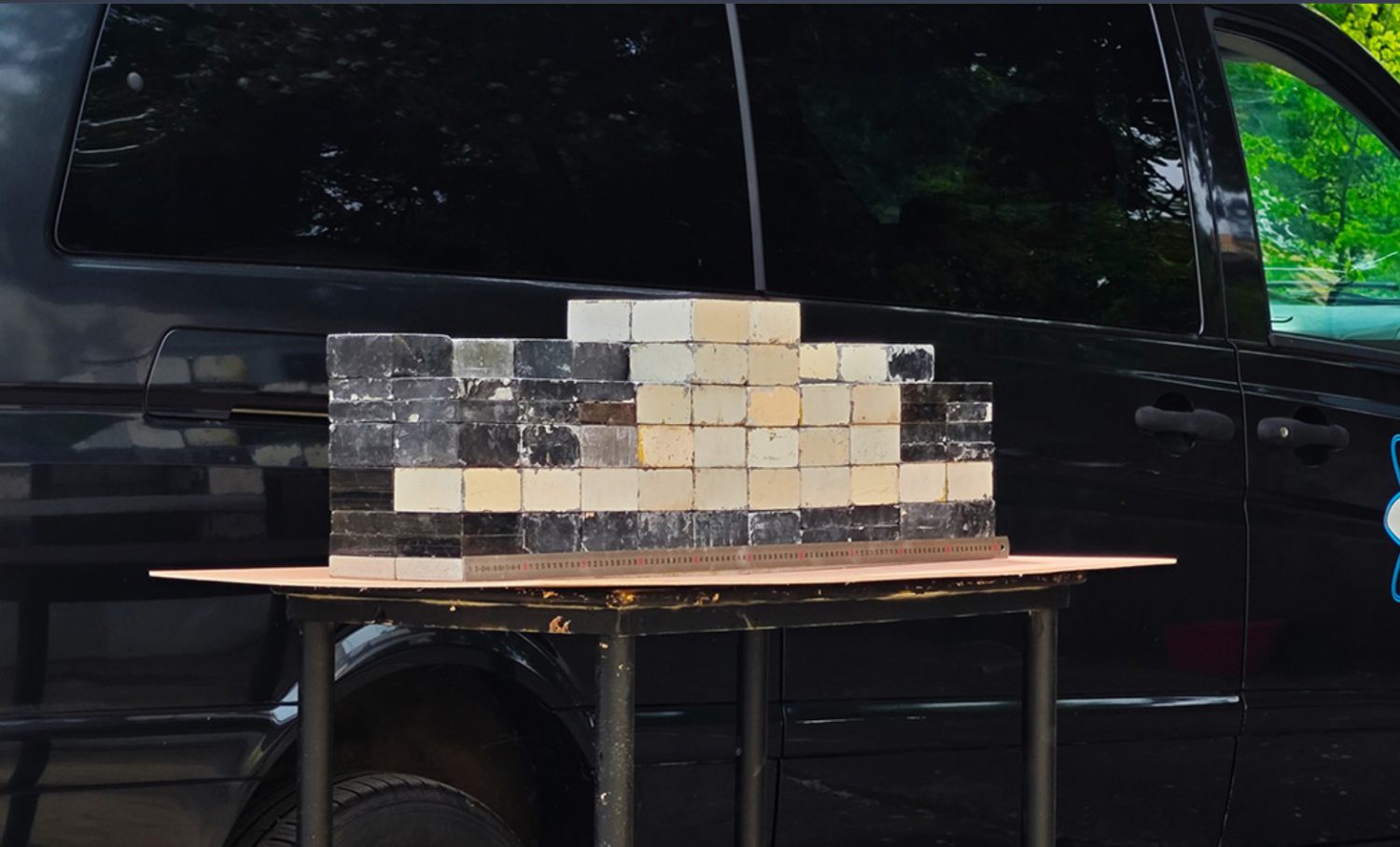
What remained crossed 2 meters of concrete wall and reached portable detectors mounted inside a black van parked up to 42 meters from the source. Using Monte Carlo simulations to cross-check the measurements, the team estimated roughly 90 percent of detected particles were muons. That signal was enough to produce a shadow image of lead bricks positioned between the wall and the van.
“This is the first imaging, so there’s not a very high resolution of course. But we’re going to improve,” said Domenico Doria, the ELI-NP physicist who led the project, according to Science.
What This Could Eventually Mean
Prospective applications range from cargo security to archaeology, but substantial technical hurdles separate this laboratory demonstration from any deployed system.
Border security agencies, archaeological teams, and industrial inspectors all face versions of the same problem: dense, opaque materials hide information they need. Laser-driven muography could eventually help customs authorities scan lead-shielded containers without opening them, and it could assist archaeologists imaging buried tunnels while supporting non-destructive testing of thick industrial components that are difficult for conventional X-ray systems to inspect. These remain prospective applications, not deployed capabilities.
“To have the first muographs coming from artificial muons proves that the approach is feasible,” said Sarah Barnes, a physicist at the German Aerospace Center, according to Science. That qualifier matters. The ELI-NP laser fires at roughly one shot per minute, the facility itself is large-scale research infrastructure, and image resolution remains limited by the project leader’s own account.
Improved detectors, faster and smaller laser systems, and peer review all stand between this result and anything approaching a commercial product. What the experiment does establish is that muography need not depend entirely on waiting for cosmic rays: a laser-generated, experimentally directed muon source has now produced its first image. That is a meaningful first step, even if commercial readiness still depends on laser miniaturization, higher repetition rates, better detectors, and the full peer-review process. Techniques like airborne lidar have similarly demonstrated how non-invasive imaging can uncover hidden structures at scale, offering a useful parallel for what muography may one day achieve.