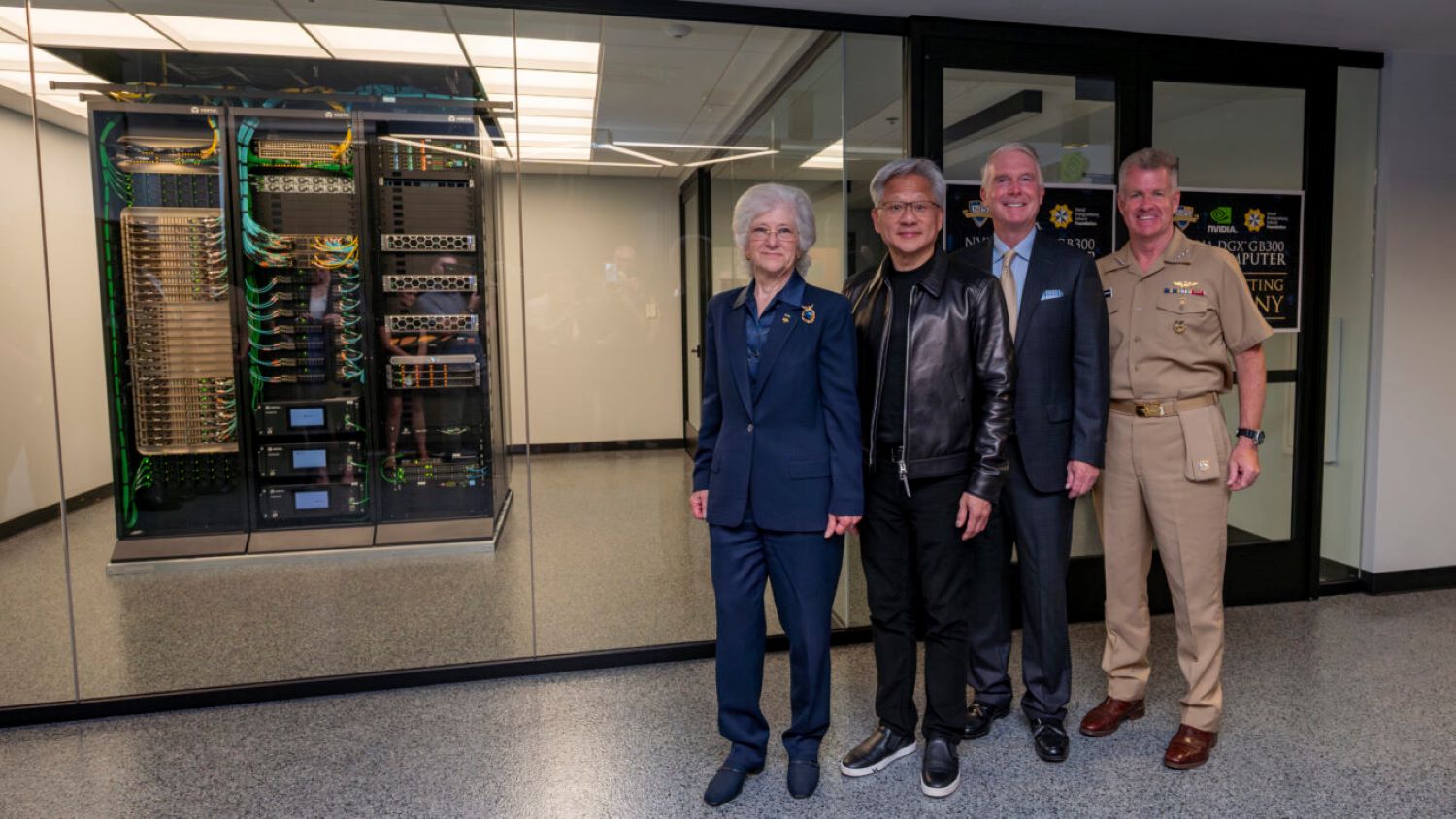
The CEO of the world’s most valuable chipmaker stood next to the commander of U.S. Indo-Pacific Command at a Navy school in coastal California. That happened when NVIDIA’s Jensen Huang — tech’s closest equivalent to a stadium-touring rock star — joined Adm. Samuel Paparo to launch the Pentagon’s most powerful AI-focused supercomputer at Naval Support Activity Monterey. The system, an NVIDIA DGX GB300 built on “Grace Blackwell” architecture, pairs 36 Grace CPUs with 72 Blackwell Ultra GPUs. It sits on the NPS.edu network, running within existing base power and water infrastructure — no new data center required. NVIDIA donated the DGX GB300 to the NPS Foundation, which installed it at NPS along with funding for research projects that require its high compute and memory capacity.
Built for AI, Not Just Number-Crunching
This machine is designed to build new models, not simply run the ones the military already has.
Traditional Pentagon supercomputers run known simulations at scale, but the Monterey system’s parallel architecture processes massive workloads simultaneously — think 72 video streams rendering at once rather than buffering one at a time — making it purpose-built for training AI models from scratch. Capt. Michael Owen, NPS’s vice provost for warfare studies, outlined what that unlocks:
- logistics optimization for distributing “beans, bullets and all of the standard defense logistics things” across theaters
- cybersecurity models trained to detect threats in military network traffic
- weather prediction pushed far beyond the 50-kilometer resolution grids behind your evening forecast
“When you start talking about defense operations, your general weather modeling that you would see at your evening weather news or in the morning for your commute is just not adequate,” Owen told Military Times.
The goal at Monterey is explicitly research and innovation — changing and improving models, not maintaining them. That distinction separates this system from the Pentagon’s Defense Supercomputing Resource Centers in Mississippi and Ohio, which are configured primarily for operational use.
A Classroom With an IMAX Studio
Eleven students in NPS’s new AI master’s program now have access to hardware most defense institutions can only dream about.
NPS launched a master’s program in artificial intelligence in December 2024, with its first cohort of 11 students drawn from across the joint force and allied militaries now underway. It’s the AI equivalent of a film school suddenly getting a full IMAX studio on campus — the hardware changes what’s even possible to attempt. Honest context still matters here. The Pentagon’s Defense Supercomputing Resource Centers already run petascale systems topping 17.6 petaflops, and civilian machines like El Capitan at Lawrence Livermore hit 1.742 exaflops. The Monterey system’s claim to distinction is specificity: it is the most advanced AI models hardware directly embedded in a military academic environment, optimized for research rather than raw benchmark numbers.
NVIDIA’s strategic interest in defense AI procurement is real — donations like this build long-term relationships that influence future government acquisitions. Whether NPS becomes what Huang called “the premier U.S. defense institution for artificial intelligence” depends entirely on what students and researchers build with it. The hardware is extraordinary. Now the work starts.
Update: July 27 2026: Edted to clarify language on the NVIDIA donation.