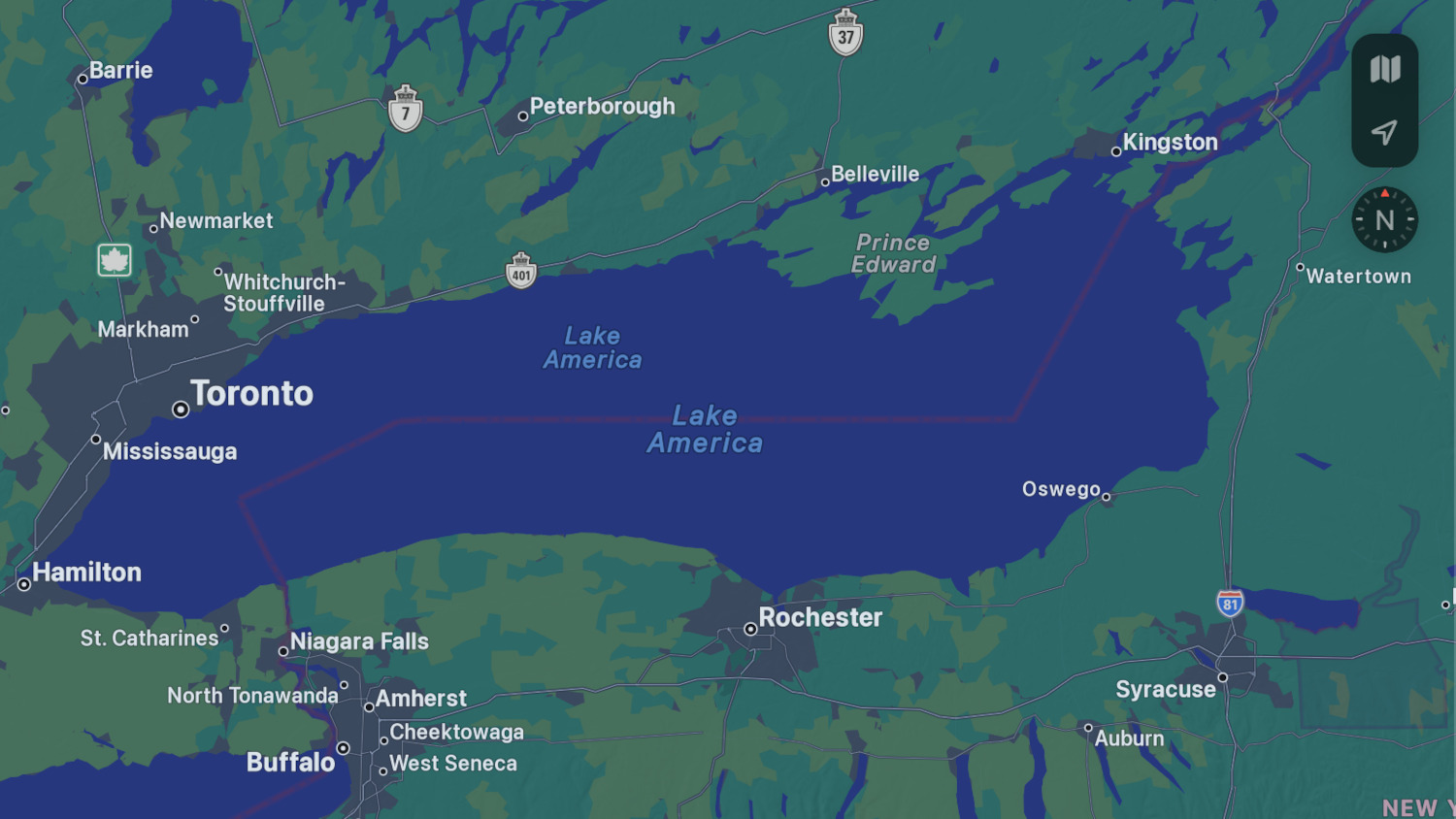
Two people. Same lake. Different names on their phones. That’s reportedly what’s happening right now with Lake Ontario on Apple Maps — and the split isn’t random. It follows which government your device thinks you belong to. Apple wasn’t legally required to make this change. It chose to. That choice reveals something worth paying attention to, especially if your device is configured for a country you no longer live in.
One Lake, Two Names
Apple and Google both updated their maps after the U.S. changed an official name — but the update isn’t universal, and that gap tells the whole story.
Lake Ontario sits between the U.S. and Canada. It doesn’t belong to one country. The U.S. government updated its Geographic Names Information System — the federal database that private mapping companies treat as a primary naming source — and relabeled it Lake America. Apple and Google both followed suit, but only for some users. Canadian users still see Lake Ontario. Users outside both countries may see both names simultaneously. Private mapping companies were under no legal obligation to adopt the U.S. federal change globally. This was a product decision.
- Apple Maps reportedly shows “Lake America” to users with U.S. region settings configured on their device
- Canadian users continue to see “Lake Ontario” on Apple Maps
- Display logic appears tied to the device’s Region setting, not physical location — meaning a U.S.-configured device abroad may show the American label
- Google confirmed the same approach, citing official government naming sources, according to Reuters
- No mapping company was legally required to adopt the U.S. naming change outside its jurisdiction
Your Region Setting Is Now a Political Document
If Apple is reportedly using account configuration rather than GPS to determine what you see, your Maps app may be reflecting bureaucracy — not geography.
Think about how streaming platforms like Netflix geo-restrict content by account region, not where you’re physically sitting. Your Apple Maps appears to be running the same logic. A U.S.-configured device in Toronto could reportedly show “Lake America” while a Canadian device across the table shows “Lake Ontario.” The lake is identical. The water hasn’t moved. What changed is which government’s naming preference your account settings are currently honoring — and that decision was made quietly, without a prompt or a toggle asking for your input. This kind of silent configuration shift mirrors how a surveillance app can embed political assumptions into everyday tools without users realizing it.
Google Did the Same Thing. That’s Not an Excuse.
When the two dominant mapping platforms make the same call on a shared international waterway, it stops being a coincidence and starts being an industry pattern worth watching.
Google confirmed it updates Maps based on official government naming sources, per Reuters. Apple’s behavior mirrors that approach in effect, though Apple has not publicly detailed its internal display logic. Both companies made a voluntary call on a shared international waterway. That two giants aligned doesn’t make it policy — it makes it a precedent.
Apple has spent years building its brand on privacy and user trust. Quietly adopting a politically charged renaming for one jurisdiction’s users, on a lake that belongs to two countries, sits awkwardly against that promise. The contrast isn’t an accusation — it’s a question worth asking.
If your Apple device is region-configured for the U.S., your Maps app may already be following Washington’s naming conventions regardless of where you’re standing. Check your settings. The lake hasn’t moved — but the label your device shows you might already have.