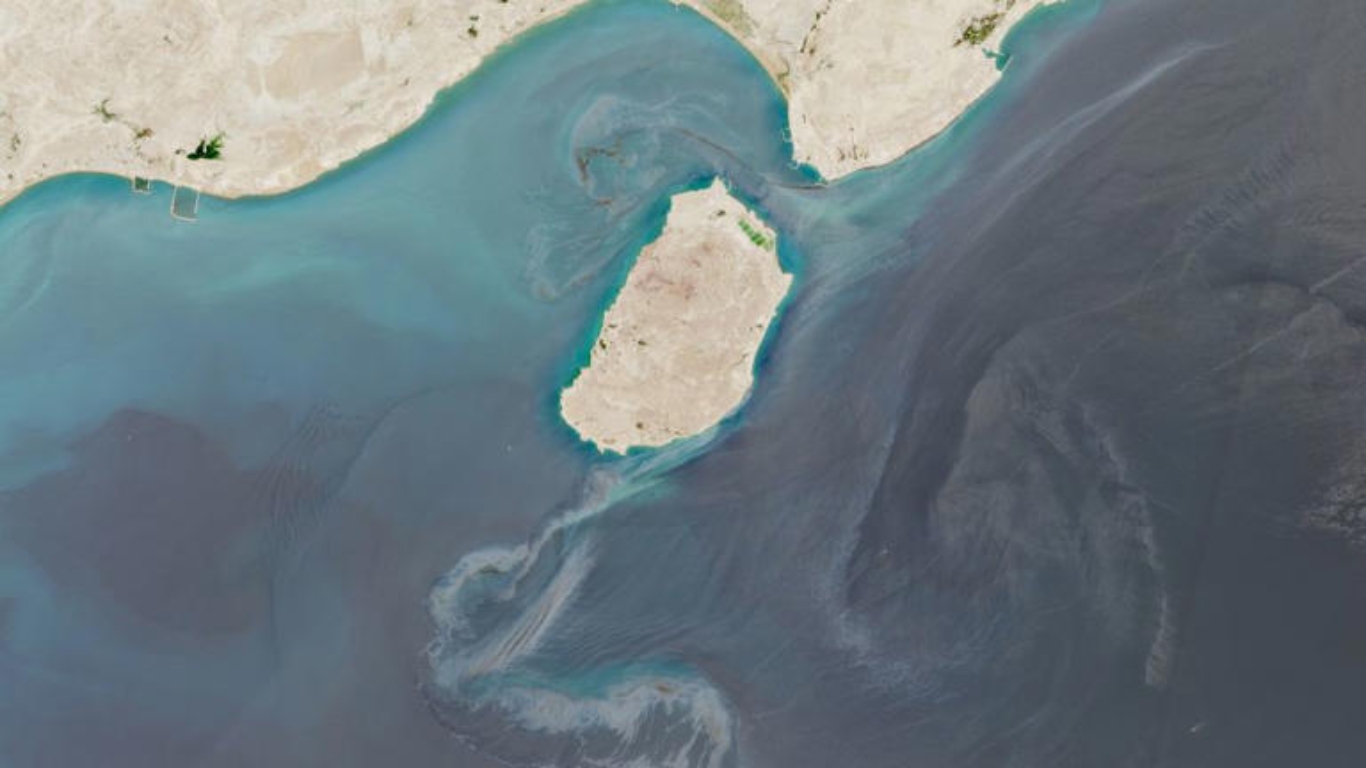
A sanctioned Russian tanker sits grounded off Oman’s southern coast, leaking what may be one of the worst oil spills the Arabian Sea has seen in years. The Caroline Bezengi reportedly carried roughly 800,000 to nearly one million barrels of Russian oil when it ran into trouble near Al-Qibliyyah Island in late June. Below the spreading slick: coral reefs, seagrass beds, turtle nesting beaches, and habitat for the Arabian Sea humpback whale — one of the rarest cetaceans on earth. Monsoon winds are making containment nearly impossible, and the spill keeps growing.
Shadow Fleet, Real Damage: What the Satellite Images Show
Estimates of the spill’s size vary dramatically by source, but every version of the number is alarming.
The Caroline Bezengi reportedly ran into difficulties around June 6–8 before grounding near Al-Qibliyyah Island sometime in late June, according to Reuters and AP. It was moving Russian oil under murky ownership — part of a broader effort to keep that oil flowing despite Western sanctions.
What happened next is a story best told in numbers that refuse to agree with each other:
- Greenpeace’s satellite analysis tracked the spill expanding from approximately 45 square kilometers in late July to around 150 square kilometers by August 2 — then to roughly 600 square kilometers by August 4.
- Oman’s Environment Authority offered an official estimate of 390–400 square kilometers.
- Greenpeace separately told CNN the figure had reached 500 square miles, or about 1,300 square kilometers.
- By August 12, one independent expert reviewing satellite imagery put the slick at more than 2,000 square kilometers — dwarfing every earlier estimate.
Greenpeace campaigner Hanen Keskes noted the spill appears “in fragmented patches,” spread across multiple areas rather than one continuous slick, which makes it harder to contain and easier to undercount.
The oil has already reached the Omani mainland near Ras Madrakah, affecting roughly 40 kilometers of coastline. Masirah Island — a protected zone with coral reefs, seabird breeding sites, and turtle nesting beaches — sits in the spill’s path. Omani authorities have advised residents to avoid fishing and confirmed seafood market testing is underway. More than 100 tons of response equipment has been deployed, according to salvage firm Ambrey, but the Khareef monsoon is actively working against every containment effort.
A Ghost Ship With Very Real Consequences
Almost everything the public knows came from independent monitors, not governments — and that gap is itself part of the story.
Reuters reported that nearly all public information about this incident has come from independent monitors rather than official government sources. Ownership, the insurance chain, and the exact cause of damage all remain unconfirmed. The Caroline Bezengi is part of Russia’s sanctioned shadow fleet — aging tankers operating under deliberately obscure arrangements to keep Russian oil moving despite Western pressure. The accountability structures that normally exist around a maritime disaster of this scale are, in this case, largely absent.
A separate, unrelated spill near Qeshm Island in the Strait of Hormuz adds to a troubling regional picture, according to Reuters, though its cause is also unknown.
Greenpeace has warned that oil damage to sediment and shoreline can persist long after the visible slick disappears — meaning the ecological cost will outlast the headlines.
Monsoon conditions won’t ease soon. The spill’s true scale remains genuinely contested across every source that has attempted to measure it. And the Arabian Sea humpback whale — a population so isolated it has effectively evolved apart from every other humpback on earth — has nowhere else to go.