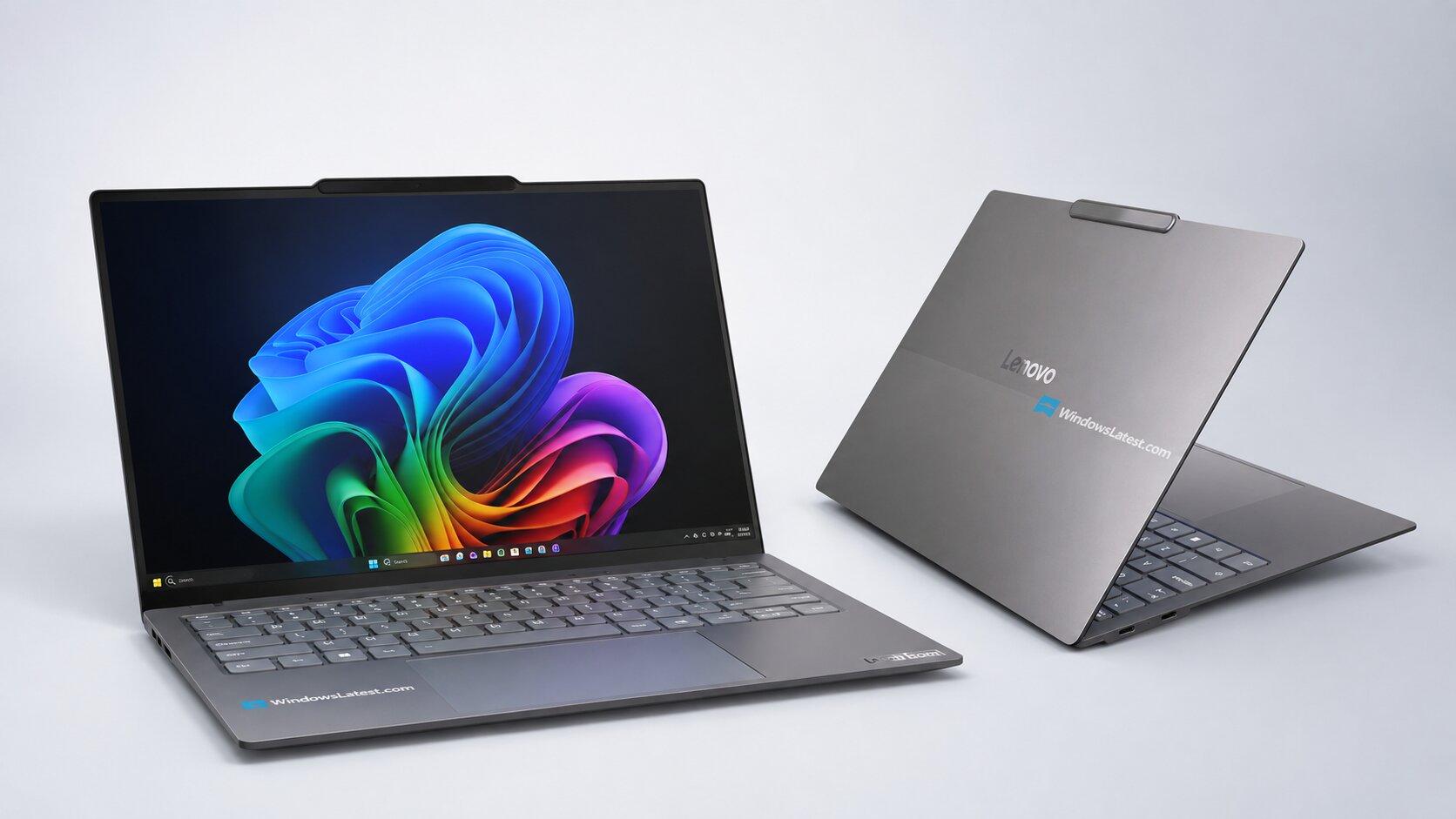
When a laptop’s front edge is reportedly thinner than the USB-C ports it needs to function, you’re witnessing either obsessive engineering or a design team that got carried away. Leaked marketing images obtained by Windows Latest reveal an unannounced Lenovo ThinkBook branded “Aeroblade” — a machine so aggressively thin it had to grow a bump just to fit its connectors. Lenovo hasn’t confirmed the product exists. No specs, no price, no launch date. The renders, however, tell a sharp story about where ultra-thin design is headed and exactly what it costs to get there — raising some familiar computer problems around connectivity and usability.
A Blade-Thin Profile With a Visible Compromise
The Aeroblade’s most striking design move creates its most obvious trade-off.
Here’s what the leak actually shows:
- The chassis front edge appears thinner than a standard USB-C plug, forcing Lenovo to engineer a raised “port hump” on the left side — a localized bulge housing two USB-C ports and possibly a microphone hole.
- The keyboard sits visibly flatter than typical ThinkBook designs, suggesting reduced key travel to fit the compressed chassis.
- Only two USB-C ports are visible on the left side; the right side remains unseen, leaving total port selection unknown.
- A dedicated Copilot key confirms Windows 11. Processor, RAM, storage, battery, and display specs? Completely absent from the leak.
Ports may be “the only thing” preventing laptops from being uniformly a few millimeters thin, according to PCMag. Aeroblade’s answer — concentrate the thickness where connectors live, shave everything else — feels like a Tetris solution to a physics problem. Whether that raised module feels elegant or awkward in your hand remains anyone’s guess.
ThinkBooks have historically offered above-average key travel for business laptops, making them a staple among the most productive desk gadgets in any professional setup. Flattening the keyboard here signals Lenovo chose silhouette over typing comfort — a real departure for a line that professionals actually type on for hours at a stretch. Videocardz speculates that Snapdragon X2 or Intel Panther Lake could power the machine, which would help offset the thermal and battery constraints a wafer-thin chassis typically creates. That remains unconfirmed speculation.
What the Leak Actually Confirms
Strip away the hype, and the verified details are thinner than the chassis.
No numerical dimensions exist in the leaked materials — so any “3mm chassis” claim you’ve seen floating around is reading more into renders than the images support. “Aeroblade” appears in marketing files, not on the chassis itself. It could be a product name, a sub-brand, or a campaign label that never reaches retail. The choice of processor matters enormously here, as advances in AI chips from both Qualcomm and Intel are reshaping what ultra-thin machines can actually deliver. IFA 2026 is speculated as a possible reveal venue, according to Videocardz, but Lenovo hasn’t confirmed participation.
Ultra-thin laptops keep shaving millimeters. The ports, the keys, and the cooling don’t shrink as gracefully as the aluminum around them. If Aeroblade ships, you’ll get to decide whether the thinnest possible laptop is actually the one you want to live with.