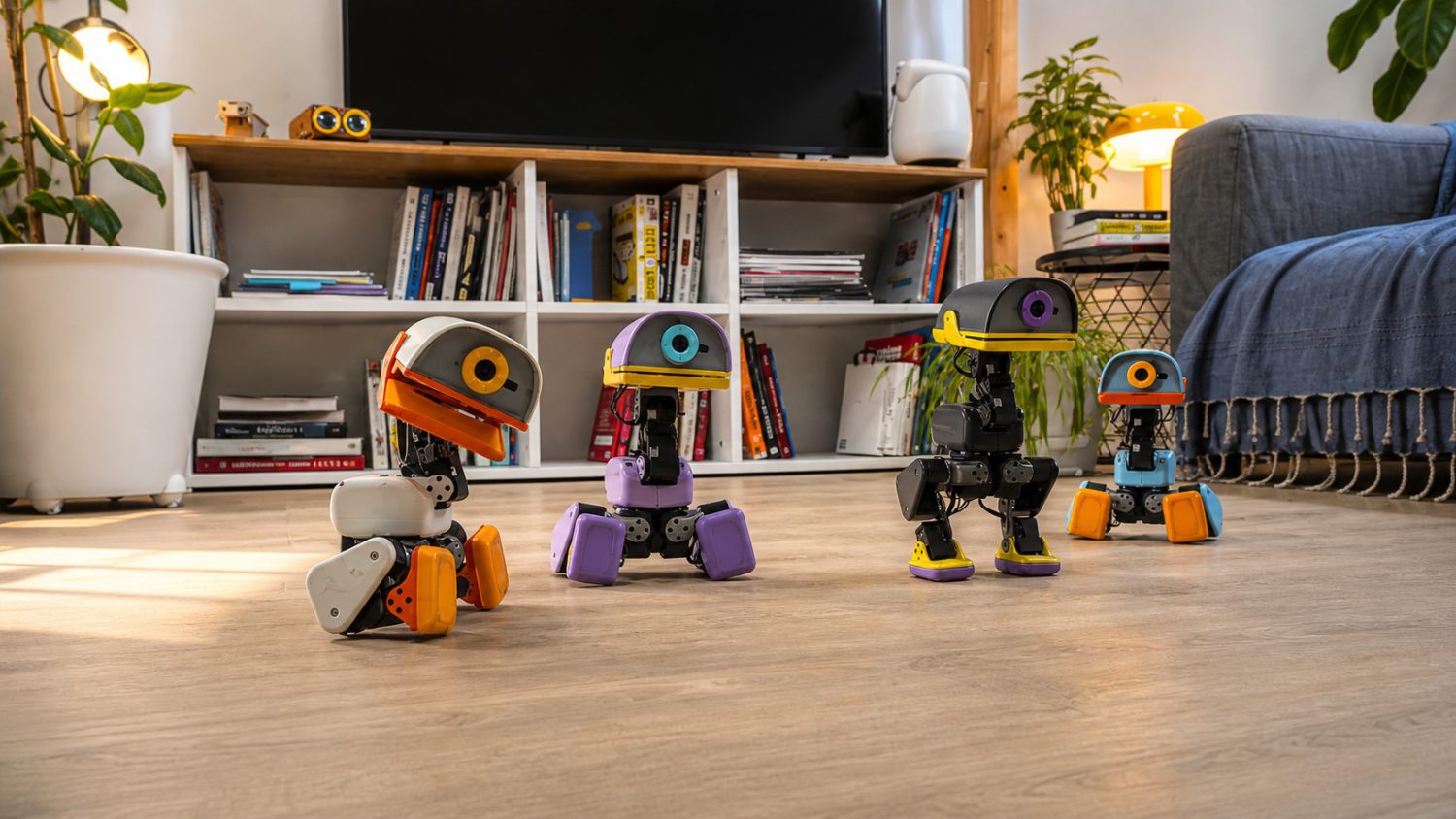
Somewhere in Bordeaux, engineers built a duck the size of a water bottle that roller-skates, grips markers with its beak, and runs reinforcement learning policies at 50 Hz. That duck costs $399. It’s called Microduck — the first mass-market product from Pollen Robotics, the French startup Hugging Face acquired in April 2025 to plant its flag in physical AI hardware. The launch lands against an unresolved backdrop: Bloomberg, Reuters, and Business Insider all report Nvidia in talks to acquire humanoid robot maker Hugging Face for roughly $12.9–13 billion. Neither company has confirmed or denied anything.
What You’re Actually Getting
Bipedal locomotion, LiDAR, and a full reinforcement learning pipeline — all for less than a decent office chair.
- Size and mobility: 25 cm tall, roughly 800 g — genuinely bipedal; walks, waddles, crouches, and gets back up when knocked over
- Sensors and accessories: Front camera, LiDAR for depth sensing, and IMUs (motion sensors that detect tilt and acceleration) for balance recovery; the accessory kit adds roller-skating feet, NFC tags, a ball, and a laser pointer the duck tracks with its camera eye
- Compute and connectivity: Rockchip RK3566, 1 GB RAM, 32 GB storage, 50 Hz onboard policy loop; Wi-Fi, Bluetooth, NFC; roughly one hour per charge from a 2,600 mAh battery
- Gripper reality check: The beak picks up socks and markers — practical lifting capacity around 100 g. Don’t expect it to fetch your coffee.
The entire software stack — robot control, physics simulation, reinforcement learning training, and sim-to-real deployment — is open-source. Sim-to-real means exactly what it sounds like: train a behavior in a virtual environment, push it to real hardware. Pollen’s stated ambition is “making building AI on real hardware as approachable as running a model.” The catch: the physical hardware design stays proprietary, which will irritate open-hardware purists but won’t surprise anyone familiar with consumer robotics economics.
The Bigger Bet
Hugging Face’s real gamble isn’t the duck — it’s whether a community will teach it to think.
Think of Microduck as a Tamagotchi where, instead of feeding it, you train it with reinforcement learning — and then share those behaviors with strangers on the internet. That’s the actual play. Hugging Face wants to do for robot skills what GitHub did for code: crowdsource voice recognition, SLAM navigation (the robot’s ability to map and locate itself in an unfamiliar space), and grasping behaviors into a shared community library. Ambitious. Also entirely dependent on community participation that doesn’t yet exist.
Your framing of the price matters here. Pollen’s own Reachy 2 humanoid runs around $70,000. Typical STEM coding robots offer wheels and basic sensors. Microduck sits between them — a bipedal platform with LiDAR and a full RL pipeline for under $500 — which is a genuinely unusual value proposition at this price point.
The Nvidia acquisition reports remain unconfirmed as of this writing, with no comment from either company even when asked directly at Microduck’s launch. For anyone pre-ordering an ecosystem-dependent educational robot, that uncertainty is worth sitting with. Pre-orders are open now; shipping before Christmas 2026, in cream, graphite, lavender, and sky blue.
At $399, Microduck is one of the most accessible entry points into real embodied AI experimentation currently available. Whether Hugging Face’s open-source community shows up — and whether Nvidia’s lawyers do first — determines everything this duck eventually becomes.