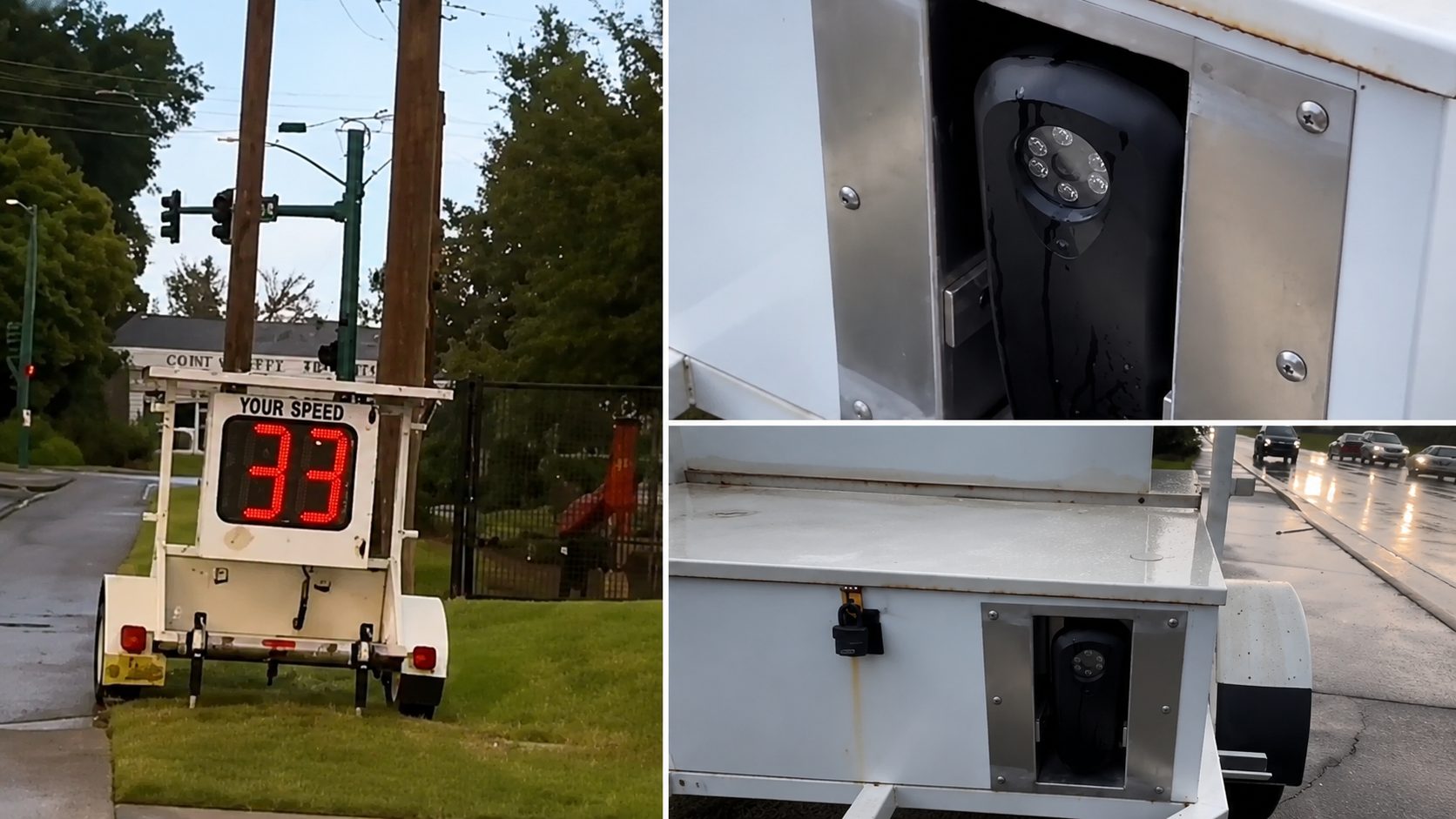
Most drivers pass that digital speed sign every morning, tap the brakes at the flashing number, and forget it exists. But a video posted by the account OrwellDay on X shows someone opening the housing of one such radar box to reveal a Flock Safety ALPR camera tucked inside. Not a speed trap. A surveillance node, logging your plate, your car’s profile, and your exact location — dressed up as something you’ve been conditioned to ignore. The radar-box finding is documented for at least one location, though it has not been confirmed as a standard Flock deployment model.
What That Camera Actually Records
Flock cameras build a detailed profile of every vehicle that passes — and none of it involves your speed.
Flock’s standard cameras don’t clock your speed and won’t generate a ticket, according to both Flock Safety and municipal partners like the City of Leander, Texas. What they do is build a “vehicle fingerprint” for every passing car:
- License plate number
- Vehicle make, model, and color
- Distinctive markings: decals, bumper stickers, roof racks
- Timestamp and GPS coordinates on every capture
- Data shared across law enforcement agencies, sometimes without individualized warrants
Default retention is 30 days, per Flock’s own documentation. No speeding citation. Just a searchable, time-stamped record of everywhere your car has been.
The Backlash Made Them Disappear
Growing public awareness of visible Flock units has pushed deployments toward concealment — inside radar boxes and other roadside hardware.
Visible Flock units — black poles, tilted solar panels, small camera box — have become targets. Public awareness turned into public destruction. The concealment follows the same logic as the ad-blocker arms race: the more people resist, the deeper the technology embeds itself into the background. Flock encourages local agencies to be transparent about deployments, but real-world reporting shows many installations remain poorly publicized.
The ACLU of Oregon warns that Flock data “can reveal very private details about a person’s life, including what meetings a person attends, what doctors’ offices and religious institutions they visit, who a person associates with, and even where they sleep at night.”
Eighty Thousand Cameras and Counting
The scale of Flock’s network — and documented misuse of its data — makes the concealment question more than academic.
Investigative reporting puts Flock’s network at roughly 80,000 to 90,000 cameras across most U.S. states, capturing billions of vehicle images monthly. Officers have used ALPR records to stalk ex-partners and track people seeking out-of-state abortion services, according to Jalopnik. Separately, around 60 Flock Condor cameras were found streaming live to the open internet without password protection.
Flock maintains its cameras capture “what is already visible from public roads, in plain view.” That framing gets harder to square with hardware hidden inside devices most people assume are routine traffic signs.
Courts have generally upheld ALPR as constitutional partly because vehicles are observed in public — but those rulings didn’t contemplate cameras disguised as speed-display boxes. Privacy advocates recommend asking your city council, HOA, or police department directly about local deployments. Spotting them visually just became a lot less reliable.
The radar box isn’t new infrastructure. It’s camouflage. And if the cameras disappear entirely into the streetscape, the public debate disappears with them — which may be exactly the point.