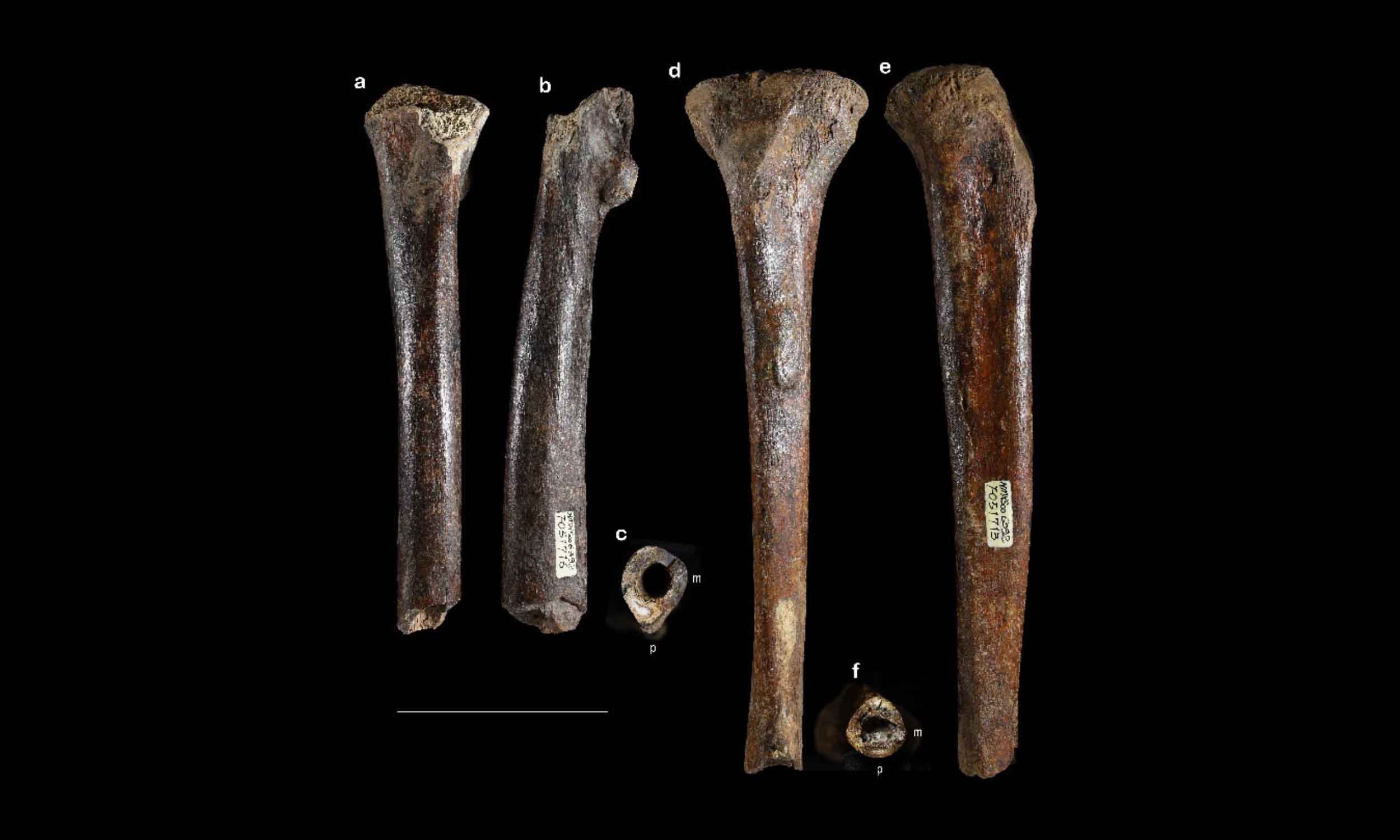
Researchers have identified the first-ever Denisovan leg bones — a femur and tibia dredged from the Penghu Channel off Taiwan — and the individuals they belonged to were legitimately large by ancient human standards. Denisovans were previously known almost entirely from teeth, jaw fragments, and a single finger bone. Postcranial remains change everything about reconstructing who they actually were. Then commentator Jimmy Corsetti posted his take connecting the find to the biblical Nephilim, and the internet did what the internet does. Stories like this echo other moments when science reveals lost civilization details that upend long-held assumptions.
What the Bones Actually Show
Protein analysis confirmed the Denisovan lineage — and the size estimates are striking enough without any mythology attached.
Two individuals are represented in the find. One stood roughly 180 cm tall and weighed around 83 kg; the other approximately 190 cm and 91 kg. Both were larger than earlier Homo erectus and Late Pleistocene Homo sapiens in eastern Asia, according to researchers cited by the European Research Council. The study also suggests robust bodies and large brains for the Denisovan lineage broadly — a finding that sits alongside other cutting-edge biological science, such as recent work on frozen brain tissue. Worth flagging: the research is not yet peer-reviewed, and the biological sex of both individuals was inferred rather than directly determined.
Key facts to keep straight:
- Bones recovered from seafloor sediment in the Penghu Channel off Taiwan
- Protein analysis confirmed Denisovan lineage
- Seafloor location reflects lower sea levels during glacial periods — not geological evidence of a flood event
- Study not yet peer-reviewed; biological sex inferred, not proven
“The Denisovans were a group of archaic humans that lived across a vast area of Asia,” according to researchers cited by the European Research Council — with this find significantly expanding what’s known about their physical anatomy and eastern range.
The Nephilim Connection – and Why It Doesn’t Hold
Corsetti’s speculation is culturally interesting; it just isn’t what the study found.
Corsetti advanced the Nephilim interpretation — the study’s authors did not. The Nephilim appear in Genesis 6:4 and Numbers 13:33, described as giant figures born of divine and human unions, later elaborated in 1 Enoch. Mainstream scholarship treats them as mythological. The seafloor recovery location, which sounds dramatic in a headline, has a straightforward explanation: glacial periods dropped sea levels significantly, exposing land that is now underwater. That’s climate history and geology — not flood geology.
Here’s what’s genuinely worth acknowledging: the speculation does touch on something real about how mythology forms. Ancient communities encountering unusually large bones may well have constructed stories around them — essentially the prehistoric version of a Reddit thread spiraling into lore. But “may have inspired myths” is categorically different from “proves myths.”
These bones are remarkable enough on their own terms.
The Denisovan find matters because this species interbred with Homo sapiens and left genetic traces still detectable across Asia and the Pacific today. More fossils are needed to determine whether these size estimates represent Denisovans broadly or just two unusually large individuals. Your actual ancient history is embedded in that seafloor sediment — and it turns out to be fascinating enough without any mythology required.