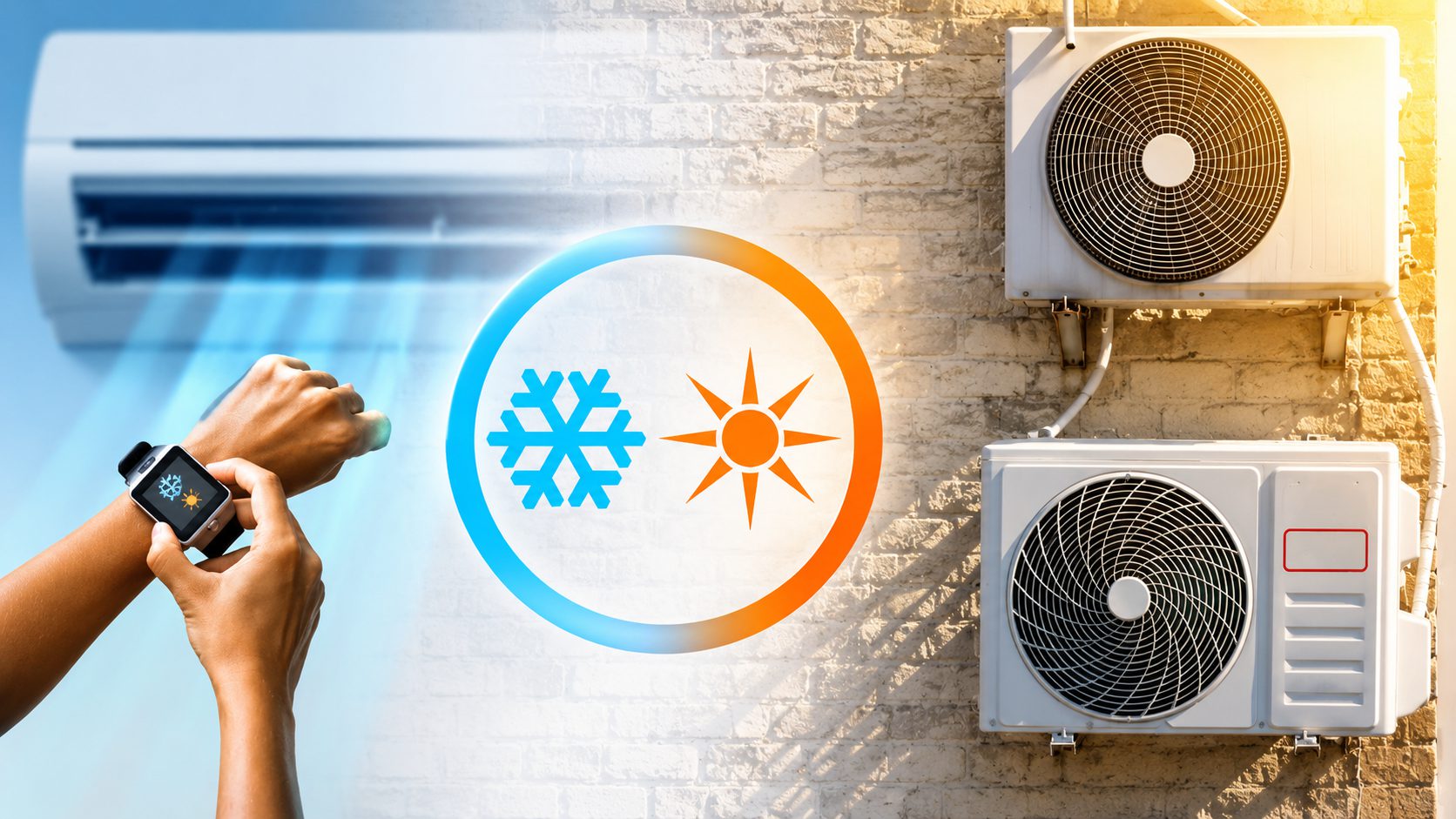
While conventional AC has relied on the same basic gas-compression trick for nearly a century, a handful of European labs are testing something radically different: air conditioners that use no refrigerant at all. Only 20% of European homes have AC, yet temperatures now regularly crack 40°C across the continent. The EU is phasing out high-GWP fluorinated refrigerants starting in 2025, and cooling already drives roughly 3% of global greenhouse gas emissions — with electricity demand for cooling expected to triple by 2050. What your AC unit looks like in ten years may depend on what these researchers prove right now.
A Continent That Wasn’t Built for This Heat
Europe spent decades treating mechanical cooling as a luxury; climate change has turned it into a public health emergency — and the old solutions carry a dirty secret.
Compare that 20% AC penetration to roughly 90% in the United States, according to Wired. For generations, Europe leaned on building design and natural ventilation. That approach is no longer enough. Traditional AC units run on fluorinated refrigerant gases with global warming potentials thousands of times higher than CO₂. Starting in 2025, EU F-gas regulations ban high-GWP refrigerants in new single-split AC units. By 2035, broader bans extend to split systems up to 12kW. As IEA analyst Fabian Voswinkel told Wired, “in the next few years, air conditioners and heat pumps using these Gas vs Diesel gases won’t even be able to be sold here.” Industry needs an alternative, and fast.
Stretching Metal Wires to Cool Your Living Room
Solid-state cooling replaces gas compression with raw physics — and the most advanced version uses nickel-titanium wires that absorb heat when pulled.
Think of it like the jump from incandescent bulbs to LEDs. Same job, completely different mechanism. Solid-state cooling exploits materials that change temperature under mechanical stress, electric fields, magnetic fields, or pressure — no volatile gas required, and some designs use only water as a heat-transfer fluid. The four main families being developed are:
- Elastocaloric systems
- Electrocaloric systems
- Magnetocaloric systems
- Barocaloric systems
At Saarland University in Germany, researchers repeatedly stretch and release bundles of ultrathin nickel-titanium wires, moving heat from indoor air to an external sink. Their elastocaloric system reportedly cools rooms by 5–10°C and could potentially outperform conventional compressor-based AC in efficiency, according to Wired. Saarland researcher Paul Motzki told Wired this “could lead to disruption, even a paradigm shift, because the technology is so different from established cooling systems.” Backed by a €4 million EIC Pathfinder grant and partnered with Irish startup Exergyn, the team targets a building-scale demonstrator within roughly three years. The World Economic Forum has already placed elastocaloric cooling among its Top Ten Emerging Technologies, per EurekAlert.
Promising, But Not Ready for Your Wall Yet
Multiple solid-state approaches are racing forward, but none has beaten conventional AC on cost or efficiency in mainstream European applications.
Fraunhofer’s ElKaWe project is building electrocaloric heat pumps that use water instead of refrigerant gas, targeting a demonstrator capable of 100W output across a 30K temperature span. German startup Magnotherm is testing magnetocaloric systems in supermarket refrigeration. Cambridge spin-out Barocal, armed with around $10 million in seed funding according to Wired, squeezes plastic crystals to pump heat without any refrigerant at all. Every one of these approaches sits at prototype or early-demonstrator stage, and no alternative currently outperforms vapor-compression AC on both efficiency and cost in mainstream European markets.
Lindsay Rasmussen of climate-tech accelerator Third Derivative called the field “promising, but unproven at scale,” according to Wired. That honest assessment matters. The regulatory clock, however, is not waiting. LEDs took decades to displace the incandescent bulb — and then they were everywhere, almost overnight. The question here is whether the physics gets cheap before the next heatwave gets deadly.