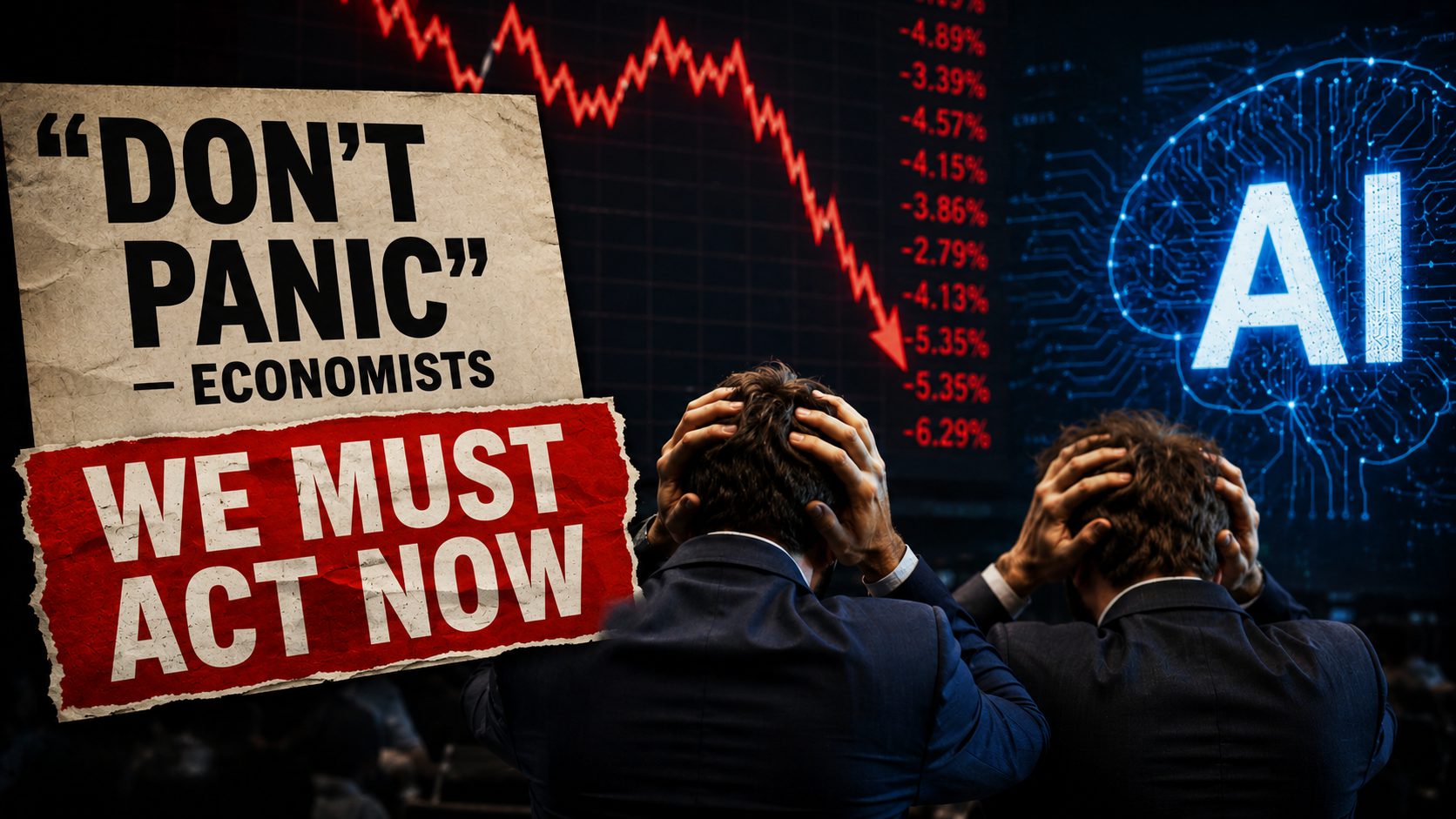
For years, economists had a reliable answer whenever Silicon Valley screamed about AI destroying jobs: relax. Every automation wave from steam engines to spreadsheets ended with net job growth. That script just got torn up. Over 200 economists and tech leaders — including 16 Nobel laureates and chief economists from OpenAI and Anthropic — released a joint statement titled “We Must Act Now,” warning that AI could trigger an economic transformation larger than the Industrial Revolution, compressed into a decade instead of a century. Among the signatories: Eric Schmidt, Reid Hoffman, and Anthropic co-founder Jack Clark. Coordinated by Stanford economist Erik Brynjolfsson, the letter landed July 13, 2026, per reporting from the New York Times and Fortune.
The Skeptics Changed Their Minds. That’s the Story.
The professionals whose careers were built on debunking tech panic have now joined it.
MIT’s Daron Acemoglu and Simon Johnson — 2024 Nobel laureates who spent years pushing back on AI hype — signed the letter. Acemoglu told the New York Times that if AI does to white-collar services what robots did to manufacturing, but faster, the results would be “really disruptive, really costly for people’s livelihoods.” He still doubts Silicon Valley’s wildest timelines. He signed anyway. That shift in position may be the most consequential data point in the entire document.
What the statement actually demands:
- AI may become “radically more powerful over the next 10 years,” potentially the largest economic shift in modern history
- White-collar and cognitive jobs face the sharpest near-term displacement risk — not factory floors
- Policymakers are “flying blind,” lacking reliable data on which tasks AI is replacing or who’s being displaced
- The letter calls for better measurement tools, stronger safety nets, and incentives steering AI toward augmenting workers rather than replacing them
- It endorses zero specific policies — the entire point is that nobody knows enough yet, and that’s the problem
“I’m kind of worried that we’re not going to be ready for the tsunami that’s coming.” — Erik Brynjolfsson, Stanford economist, who organized the statement
Think about how streaming gutted the music industry in under a decade. Now apply that speed to legal work, coding, and customer service — except governments can’t build lifeboats for a flood they can’t measure. When robots hit factory floors, adjustment was slow and painful, unfolding over decades. The letter describes the current equivalent as “driving in fog,” with displacement potentially compressed into years rather than generations.
This Isn’t Just About Paychecks
Beyond job counts lies a deeper danger: who ends up holding all the power.
Brynjolfsson warns of what he calls the “Turing Trap” — a scenario where AI is deployed primarily to replace workers rather than amplify them, concentrating economic and political power in a small number of firms. The Stargate Project and investments of that scale underscore exactly how rapidly that concentration is accelerating. The economists’ letter sits alongside a separate warning from the Five Eyes intelligence alliance, which cautioned in June 2026 that frontier AI could enable major cyberattacks on a timeline of “not years, it is months,” according to NSA reporting. Across both economic and security domains, expert consensus is converging on the same conclusion: voluntary self-regulation isn’t enough.
For workers in knowledge-intensive fields — law, finance, writing, software — the letter carries an unsettling signal. That the economists whose careers were built on debunking tech panic are now sounding the alarm may be the most consequential data point in the entire letter. Concrete cases like the receptionist obsolete scenario illustrate precisely the kind of white-collar displacement the letter warns is already arriving.