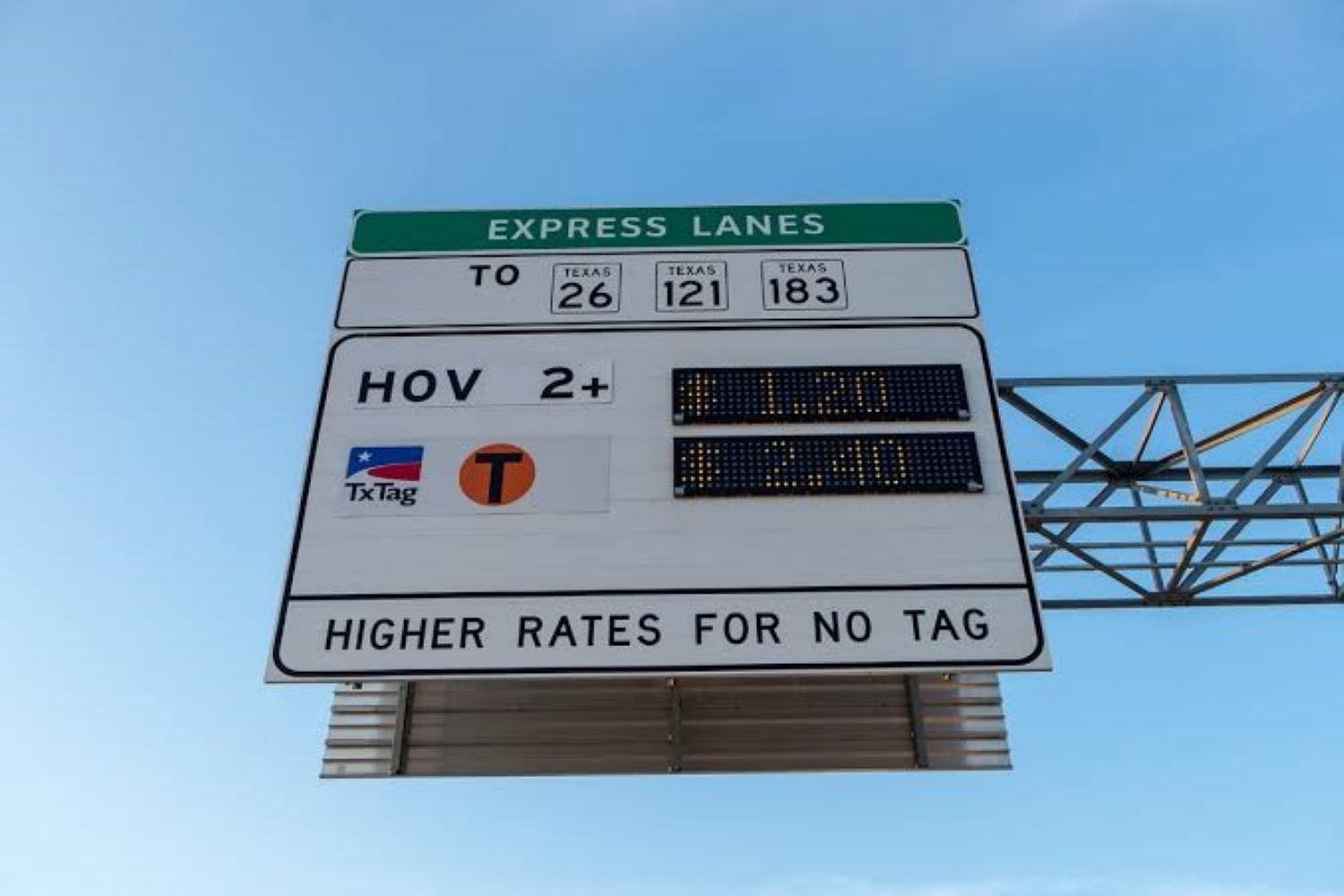
You’re merging onto I-635 at 7:45 a.m., and the digital sign overhead reads $4.80. By the time you pass the next gantry — maybe three minutes later — the price has already changed. This isn’t a glitch. It’s the TEXpress managed lanes doing exactly what they were designed to do: repricing your commute faster than an Uber surge notification on New Year’s Eve.
How the Algorithm Sets Your Price
TEXpress lanes reprice themselves every five minutes based on live speed and volume data — and the per-mile cap rises with inflation every year.
Dallas–Fort Worth’s TEXpress network spans I-635, I-30, I-35E, SH 114/183, and Loop 12, according to TxDOT. The private concessionaire operating LBJ TEXpress, LBJ Infrastructure Group (LBJIG), is contractually required to adjust tolls every five minutes when traffic volume exceeds set thresholds or average speeds drop below 50 mph over a 15-minute window, per the operator’s published FAQs.
The pricing breaks down like this:
- Light traffic: roughly $0.15 to $0.35 per mile
- Rush hour: $0.45 to $0.90 per mile
- Hard cap: 90 cents per mile per segment — CPI-indexed, so it climbs with inflation annually
- No electronic toll tag? Pay-by-mail rates plus administrative fees can add more than $50 on longer Texas trips compared to tagged rates, according to TollGuru
The pricing mechanism was approved by the Regional Transportation Council (RTC) and TxDOT. The operator frames it as designed “to keep traffic moving,” not to maximize revenue.
Public Money, Private Toll Booth
Taxpayer subsidies helped build lanes that a private company now operates and profits from for decades — and the financing details deserve scrutiny.
These lanes follow a public-private partnership (P3) model. TxDOT owns the highways. Private concessionaires invest capital, build the infrastructure, then collect tolls for decades. Public funds and federal loans fill the gap alongside private equity. Specific subsidy figures have circulated online, but those numbers remain unverified in official documentation reviewed here — and on a story about public spending, that gap matters.
Critics call these “Lexus lanes,” according to Governing‘s coverage of North Texas toll roads — premium speed for those who can afford it, while everyone else idles in the free general-purpose lanes. Those free lanes do still exist. That’s the standard pro-P3 answer.
The counter is harder to dismiss. When peak pricing approaches 90 cents per mile on infrastructure that public funds helped build, the system’s default architecture rewards higher incomes. Drivers without a TxTag absorb the steepest costs automatically. The algorithm doesn’t care about your budget.
Traffic genuinely moves faster in the managed lanes — the system works as designed. Whether charging taxpayers to build roads, then charging them again to drive on those roads, represents sound policy is a question Dallas still hasn’t answered.