Somewhere between a physics textbook and a fever dream, a maker named Engineezy built a machine that lifts steel marbles, drops them through paddle wheels, and uses the resulting rotation to charge a phone. It works, for about 30 seconds.
The device adapts the same logic as pumped-hydro storage: spend energy lifting a mass, then recover some of it as the mass falls through a generator. Engineezy’s version does exactly that at tabletop scale, using steel marbles instead of reservoir water. This is a documented experimental build, not a product.
The Generator
A salvaged stepper motor does the electrical heavy lifting once the marbles start falling.
The generator is a stepper motor pulled from a 3D-printer system, run in reverse: spin the shaft mechanically and it produces electricity. Because that output is alternating current, a full-bridge rectifier converts it to direct current, and a voltage converter steps it down to roughly 5 volts for USB charging, according to techeblog.com.
Early tests with the marbles exposed an efficiency problem. The marbles were bouncing off the 3D-printed paddle wheels and carrying their energy away in continued motion instead of transferring it to the shaft. Engineezy added a second paddle wheel and adjusted the pulley ratios to increase resistance and capture more of the impact energy.
The Marble Routing
Jamming funnels and chaotic flow sent the design back to the drawing board more than once.
A conveyor-style elevator returns the marbles to the top of the system after each run. Early funnel and guide designs jammed under accumulated marble traffic, so Engineezy rebuilt the routing to run more vertically and added passive lanes that reduced dependence on active gates or sensors.
To split one incoming stream into 16 channels feeding the paddle assemblies, he adapted the “Holy Grail” zigzag divider associated with Wintergatan’s Marble Machine, a widely recognized maker-community project. The modified divider reportedly handled the flow without the bottlenecks that plagued earlier versions, according to techeblog.com.
The Physics
Small marbles store very little energy, and the math is unforgiving at this scale.
An 8-gram steel marble raised one meter stores approximately 0.078 joules of gravitational potential energy, following the standard mass-times-gravity-times-height calculation. At a flow rate of 64 marbles per second, the idealized power output approaches 5 watts, per techeblog.com. That figure does not account for friction, collision losses, belt losses, or electrical-conversion inefficiency, and real-world losses reduce it substantially.
The Result
The machine triggered the phone’s charging indicator while the marble supply lasted.
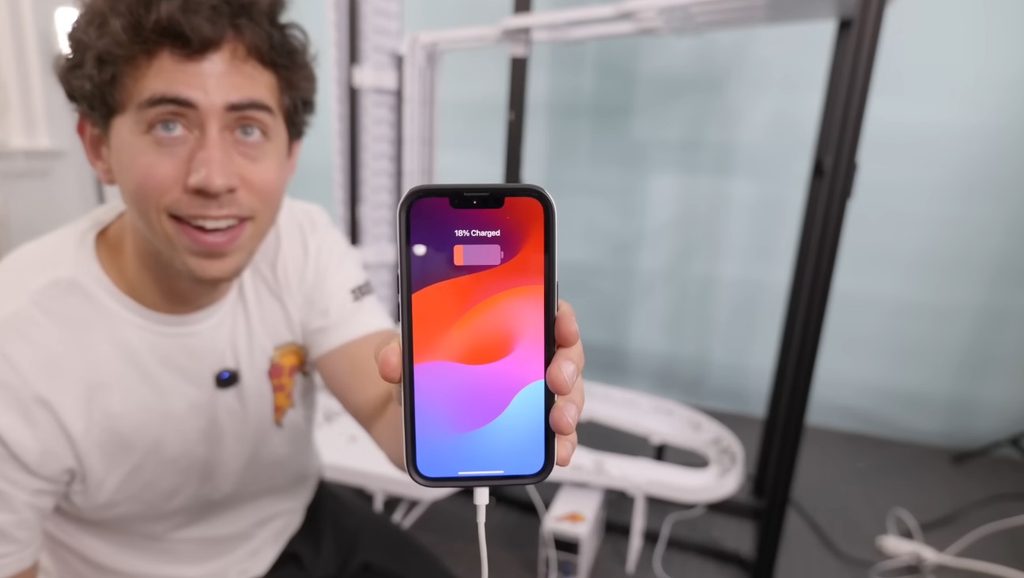
The completed machine displayed a charging indication on the connected phone while marbles moved through the system, per techeblog.com. That run lasted roughly 30 seconds before the marble reservoir needed replenishing, according to hackster.io.
The elevator motor consumed substantially more electricity lifting the marbles than the generator returned on the way down. A conventional power bank sitting beside the machine could charge the same phone multiple times over, hackster.io noted.
The project illustrates the severe efficiency and energy-density limitations of small-scale gravity storage at this implementation’s scale. For anyone in the maker community curious about mechanical energy conversion, the build is a precise and honest education in where the physics stops cooperating.