Reach your front door after a 12-hour shift, dig through your pockets, and insert a coin — just to get to your own floor. That’s not a dystopian thought experiment. It’s an ordinary Tuesday in parts of Tbilisi, Naples, and Shandong Province. Coin- and card-operated residential elevators exist across three continents, surviving or re-emerging wherever building budgets crack under the weight of aging infrastructure. The central question they force isn’t technical. It’s this: is the elevator in your building an amenity, or a utility?
The Logic Is Painfully Simple
Pay-per-ride systems have a straightforward financial rationale — but the details reveal how quickly that logic gets complicated.
Property managers argue that heavy users should pay more. Direct fees create a funding stream for electricity and repairs that flat condo fees never quite cover.
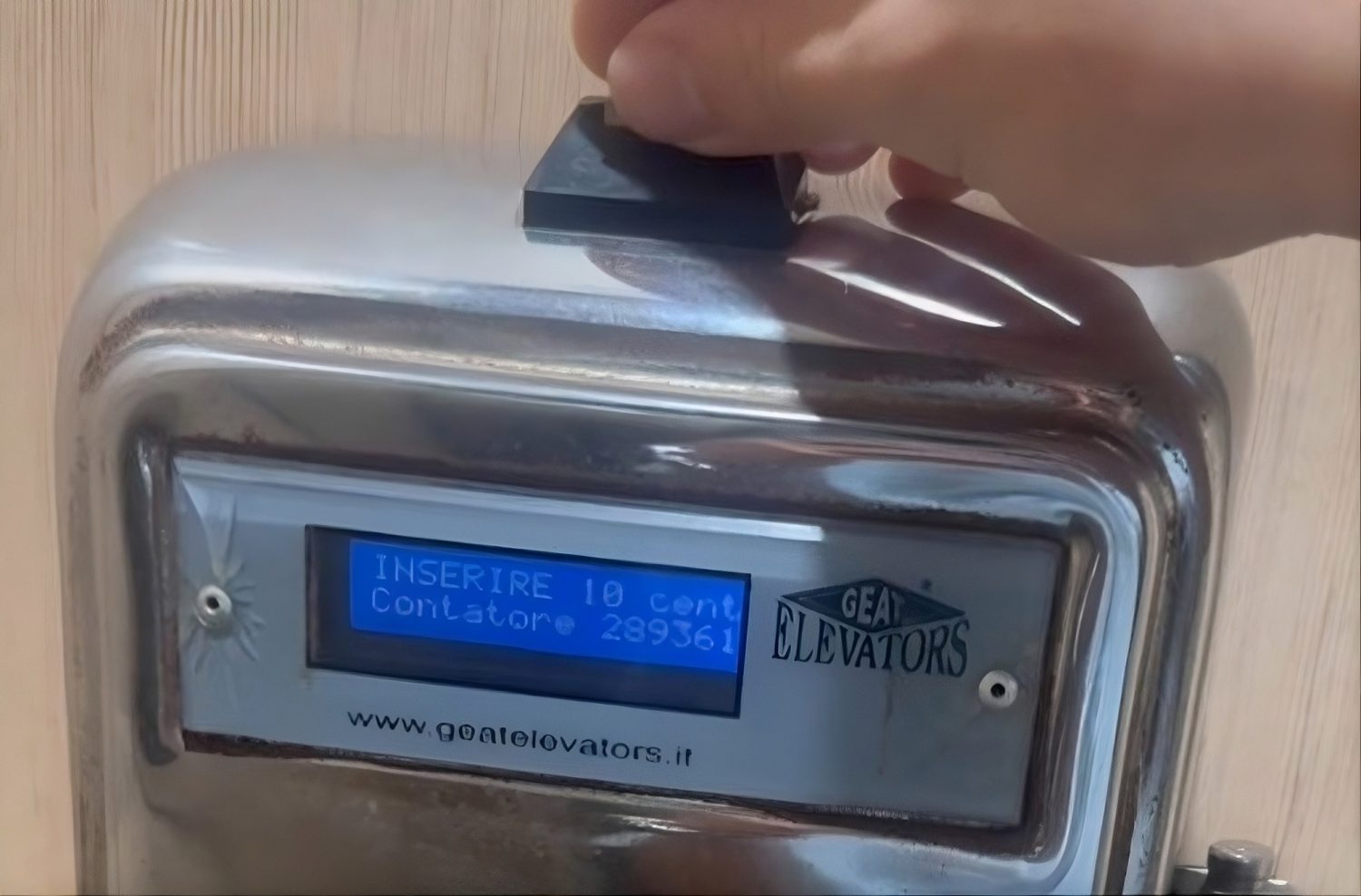
In Georgia, Soviet-era towers introduced rudimentary metal coin boxes — taking 5 to 10 tetri per ride — after their lifts blew past their expected lifespan. The goal, according to Architectural Review reporting on the Georgian systems, was “partly to raise funds for electricity bills and lift maintenance.” A useful side effect: people started walking more. Notable examples across regions include:
- In Naples, a 20-cent coin was standard from the 1950s through the early 1990s, with some buildings now substituting remote controls tied to monthly fees.
- In China around 2020, Shandong Province residents used blue prepaid plastic cards — 30 yuan bought 600 rides, roughly 0.05 yuan each, according to Hankook Ilbo reporting.
- Some complexes charged 0.15 yuan per use with floor-based pricing, per reporting by The Paper.
- Vendors like Kalifang market IC card systems supporting both monthly subscriptions and per-ride billing, with cards deactivating the moment a balance runs out.
Think of it as Spotify for vertical transport, except the free tier is just the stairs.
When the Coin Runs Out
Regulators and residents have pushed back hard — and the accessibility concerns are anything but theoretical.
The pushback has been fast and sharp. Chinese regulators ordered at least one property company to halt per-ride charges outright and offset already-paid fees against future bills — national media covered it as a matter of basic fairness. Italian residents described feeling “massively offended” upon discovering a coin requirement, according to community accounts. Elderly residents, anyone with mobility limitations, anyone without exact change — they all hit the same wall.
A person without card credit in 2020 Shandong had to walk. Different decade, identical problem.
The Micro-Toll Is Already Here
The pay-per-ride elevator is a preview of something larger — and the question of where it stops is genuinely open.
Georgian systems persist. Italian ones mostly faded. Chinese regulators moved quickly to stop them. But the impulse behind pay-per-ride elevators doesn’t disappear — it just looks for the next surface to attach to. Examples already within reach include:
- Per-use package lockers
- Metered stairwell lighting
- Tiered heating access
The technology to implement any of it already exists. What remains unsettled is whether building residents are willing to accept subscription fatigue bleeding from their streaming accounts all the way into their front hallway.
Charging per ride works. It just turns getting home into a transaction.