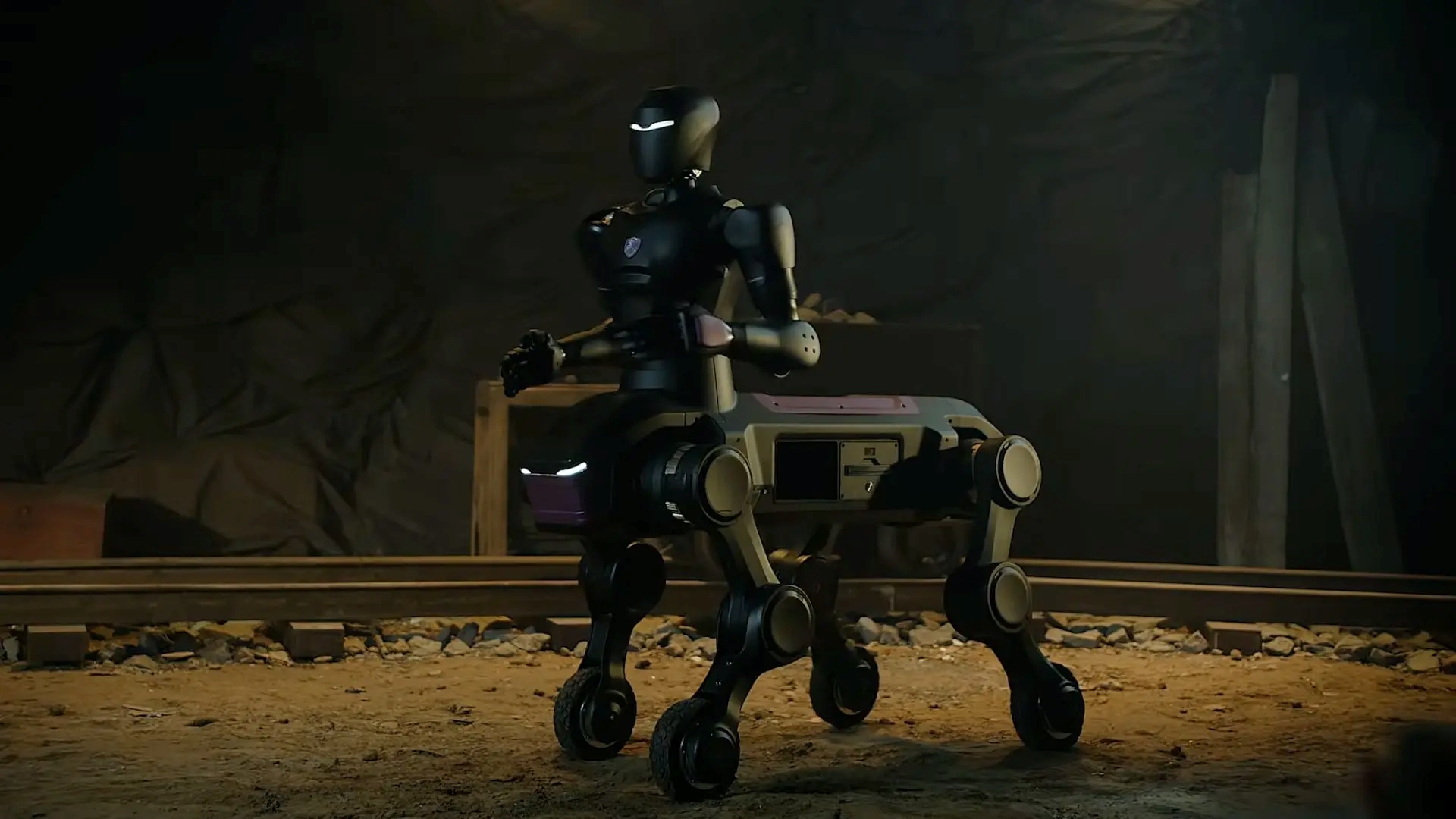
Steel mills hit 1,400°C. Methane fills mine shafts without warning. Radiation zones don’t negotiate. These are environments where sending a human has always been a grim cost-benefit calculation. Run Robotics, a Shanghai-based startup, just presented its answer at WAIC 2026: a “centaur” wheel-leg hybrid robot that pairs a four-wheel all-terrain chassis with a humanoid upper body capable of actual physical work. It already has commercial orders before a single production line exists, according to Global Times — worth noting that the “world’s first” label and all payload figures below reflect manufacturer-stated specs, not independent third-party validation.
The lower body rolls fast on flat ground, then shifts into leg-like articulation over stairs, ice, and rubble — think of it as the robotics equivalent of a rally car that can also rock-climb. Up top, dual arms with 30-plus free-moving joints and tactile-sensing hands manipulate valves, press buttons, and clear debris. The suspension auto-adjusts to terrain in real time.
- Dynamic payload while moving: 100–120 kg (220–265 lb)
- Maximum static load: 210 kg (463 lb)
- Perception stack: lidar, binocular vision, and depth cameras
- Explosion-proof chassis; 95%+ domestically produced components
- Modular upper body with swappable arms and multi-axis force sensors
The onboard AI closes the loop from seeing to doing. It identifies pipelines, gauges, obstacles, and people, then autonomously plans routes and executes tasks — all using human-designed interfaces, no factory retrofits required. You don’t need to modify your plant. The robot adapts to your equipment, not the other way around.
China’s humanoid robot manufacturers have developed over 400 models — more than half the global total — with domestic quadruped robots accounting for nearly 70% of worldwide sales, according to China’s Ministry of Industry and Information Technology.
The “World’s First” Claim – Does It Hold?
Several robots carry the “centaur” label, but none match this combination of payload capacity, blast-proofing, and dexterous manipulation.
Reasonable skepticism applies. SUSTech built a robotic knee exoskeleton — that’s a cyborg suit, not an autonomous platform. LimX’s TRON 2 has a centaur mode but operates in a different payload class entirely. Elite Robots’ Centaur-G1 carries roughly 5–12 kg on its arms. Calling your product a “centaur” is the robotics version of every streaming service branding itself “the Netflix of” something — the label is easy; the specs are what actually matter.
Run Robotics plans an automated assembly line by Q4 2026, with small-scale production to follow. If field performance matches the WAIC debut, you may be looking at the practical form factor for dangerous industrial work — not the bipedal humanoid everyone keeps hyping, but the centaur.