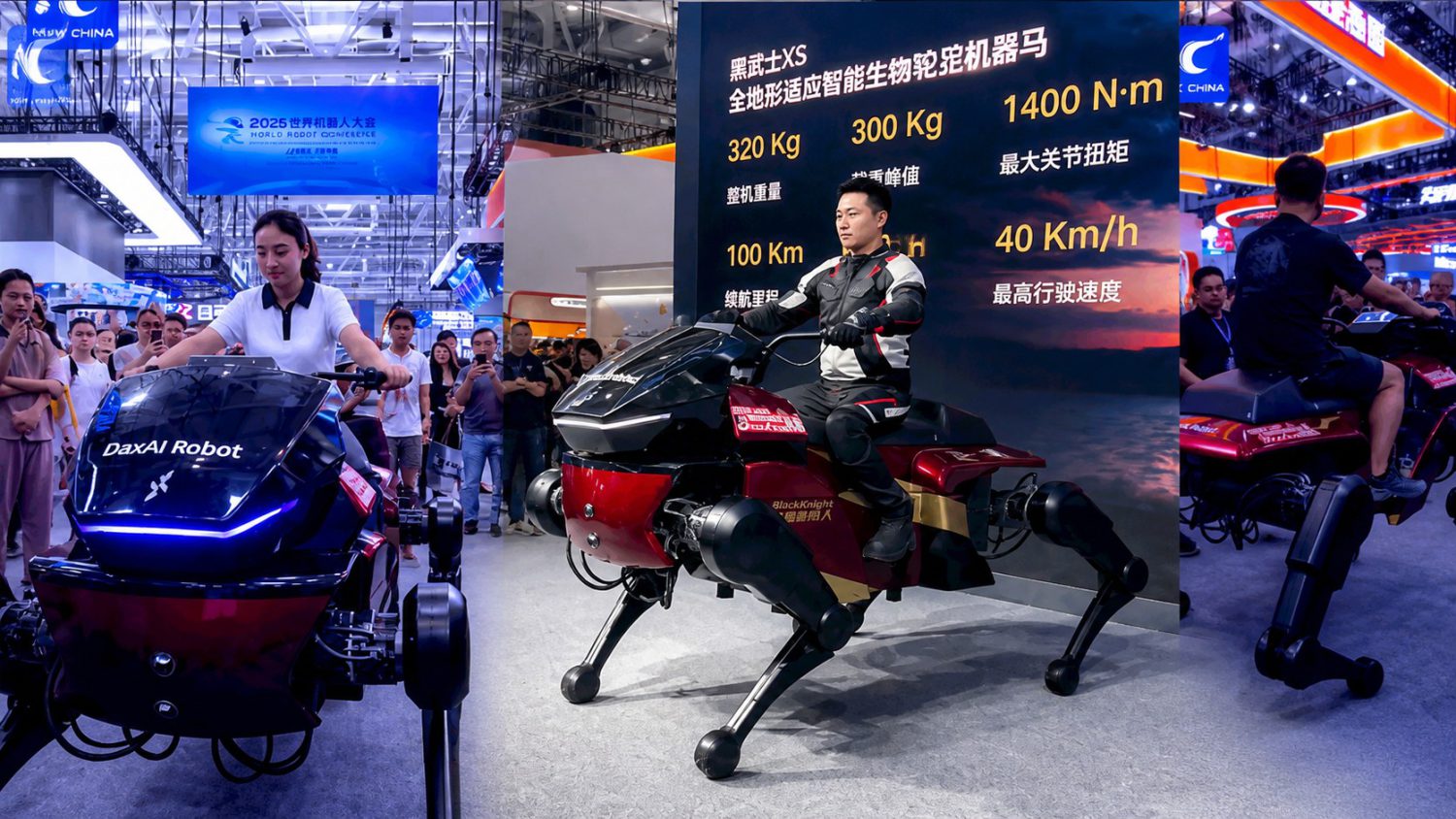
At Beijing’s 2026 World Robot Conference, people queued to climb onto a four-legged machine and ride it around a carpeted exhibition hall. Not a concept render. Not a demo video. A functioning robot. DaxAI Robotics’ Qiji X1 — saddle, handlebars, mechanical legs and all — carried real humans across the floor while crowds filmed on their phones. Then, reportedly, a humanoid robot climbed on and rode it too — not as a stunt, but as a live payload demonstration.
What the Qiji X1 Actually Does
The confirmed specs cut through the noise and set realistic expectations before your imagination runs too far ahead.
Sourced from China Daily, Futurism, and Xinhua:
- Payload: up to 300 kg (660 lb)
- Top speed: ~10 km/h (6 mph)
- Range: ~40 km (25 miles) per charge
- Terrain claim: autonomous navigation over slopes, gravel, and mud — per China Daily; no independent off-road test data published yet
- Starting price: reportedly ~289,000 yuan, per regional tech media; no official English-language pricing confirmed
A Motorcycle Bolted Onto a Robot Dog
Reuters photos and exhibition footage tell the honest story — functional, rough around the edges, and unlike anything else on a showroom floor right now.
The Qiji X1 moves — but jerkily. The rider sits in a saddle and steers with handlebars, giving the experience a motorcycle-logic feel on a platform that’s unmistakably a quadruped. Think Boston Dynamics’ Spot, except someone asked the obvious follow-up question: “but what if you could actually ride it?”
DaxAI frames the machine as built to “transform AI from lines of code on a screen into a truly rideable, real-world device,” according to China Daily. That’s marketing language, but the footage backs up the basic claim. It carries people. It remained upright throughout the demonstrations. The jerky motion is real and worth noting — this is a prototype, not a finished product, and the ride comfort reflects that honestly. For a look at how specialized robotic knee exoskeleton technology is tackling real-world wearable applications, the pricing and development parallels are instructive.
The “horseless horse” jokes writing themselves across social media aren’t wrong, either. History has a sense of humor: cars made horses obsolete, and now we’re engineering the horse back from scratch.
What Nobody Knows Yet
The gap between manufacturer claims and verified reality is significant — and worth keeping in mind before reading too much into the specs.
Every off-road terrain performance figure — slopes, gravel, mud — comes from state media and DaxAI itself. No independent benchmarks exist. Battery specs beyond range estimates are unknown. Safety data is absent from public documentation. That credibility gap is real, and no outside engineering voice has yet weighed in to close it. Snake Robots deployed in real rugged terrain offer a useful contrast for what verified off-road robot performance actually looks like.
Global Times calls it “the world’s first AI-powered smart riding quadruped.” Maybe. “World’s first” claims deserve scrutiny until independent testing confirms them.
Compare this to Kawasaki’s Corleo robot horse concept, which has appeared mainly through CGI promotional material without equivalent real-world rider footage. DaxAI’s demo is comparatively tangible — a meaningful distinction when most of this category still lives in render files.
At 289,000 yuan, the buyer pool is tiny — that’s firmly specialized-equipment territory, not a mass-market gadget. This is a proof-of-concept wearing a price tag. But the direction is clear: rideable quadrupeds are leaving industrial labs and moving toward something stranger and more personal. Don’t sell your ATV yet — but do pay attention to what comes next.