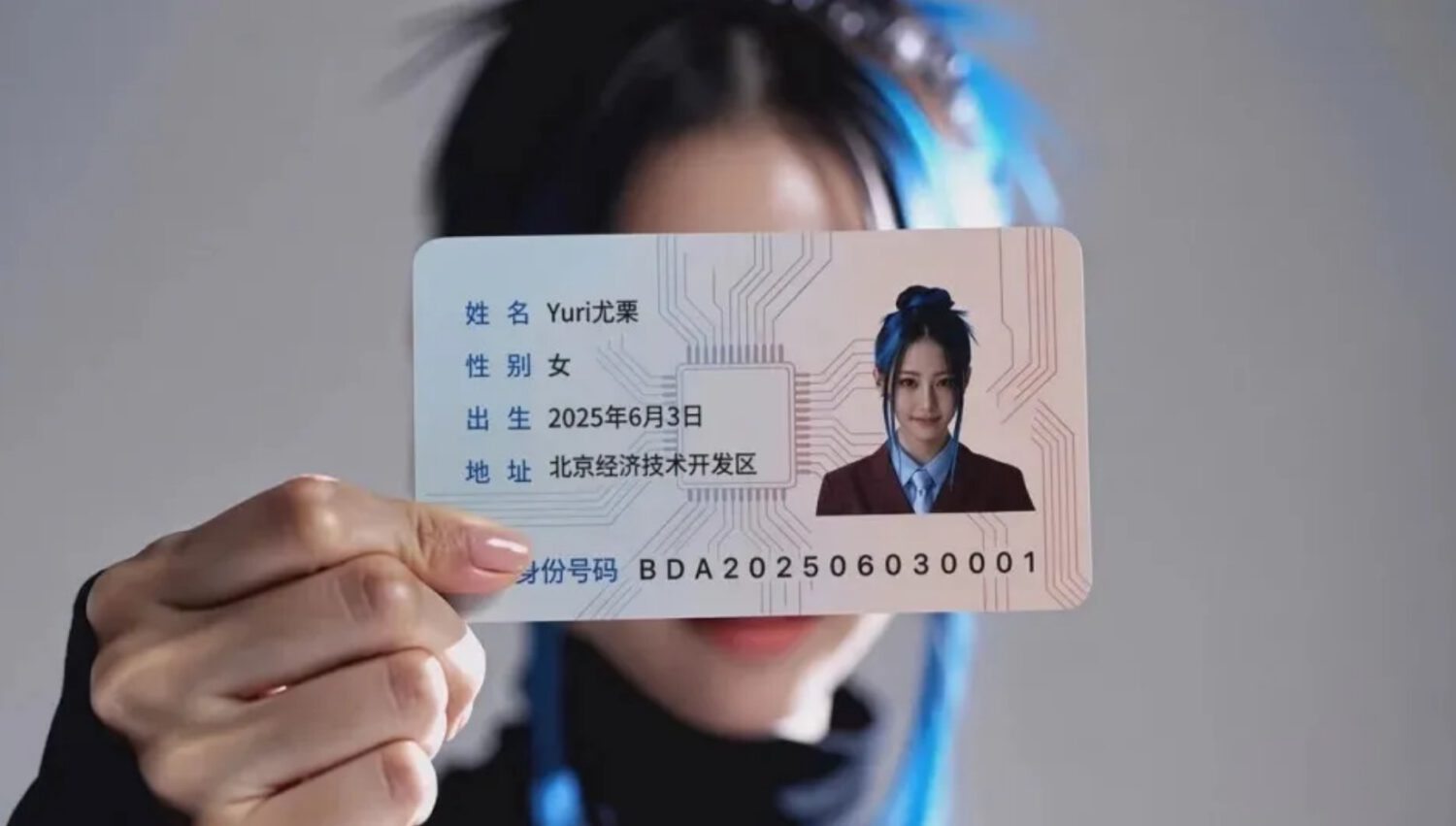
An AI singer named Yuri now carries official credentials in Beijing. She has a name on file, a listed address, recorded facial features, and a Digital Artist Card issued June 11, 2026, under Beijing E-Town’s regulatory sandbox framework.
Yuri is not a person. Her operators are, and that distinction is the entire point.
Beijing’s pilot program assigns administrative identity documents to AI-generated virtual personas. Each avatar is connected to the company or team operating it.
China’s digital-human sector reportedly includes more than 1.3 million active firms, according to reporting by ABC News Australia and Cybernews. The methodology behind that figure has not been fully disclosed publicly.
What the Credentials Actually Cover
The credentials link a digital persona’s recorded details to its operating company, not to any independent legal identity.
The credentials record a digital persona’s name, birthday, address, and facial features, as reported by ABC News Australia. Yuri also received a sandbox access certificate under Beijing E-Town’s framework for commercial digital performances.
Her designation as a “digital resident” is administrative. It does not appear to constitute a declaration of legal personhood, though the official announcement does not explicitly define the term’s legal scope.
Financial access runs through the operating company, not through the avatar acting independently. The available reporting supports digital-currency wallet access and commercial partnership eligibility for operators; it does not establish that virtual personas can open conventional bank accounts independently.
Why It Exists, and What It Leaves Open
The accountability rationale is straightforward. Registration connects a virtual character to a named, responsible human entity. That link gives authorities a clearer path when fraud, misleading advertising, or intellectual-property disputes arise.
Beijing E-Town’s sandbox places specific obligations on operators. They must verify their rights to the character, demonstrate technical stability, and keep a responsible human available to intervene if problems occur.
Critics raise a less comfortable concern. Mandatory registration can reduce anonymity and expand the state’s visibility into digital spaces, potentially encouraging self-censorship , a dynamic seen in contexts such as a surveillance app built to monitor political dissidents.
Concentrating facial-feature data and behavioral records in official systems creates security exposure if those databases are breached or repurposed , risks illustrated by incidents such as the leak exposing thousands of Hollywood Actors and directors. One question the pilot does not answer clearly is whether the credentials identify the fictional character, the human whose likeness was used to create it, or both. The distinction carries significant consequences for likeness rights and data privacy.
What Comes Next for Digital Identity
Beijing’s model is an early example of a government treating virtual personas as identifiable commercial actors without granting them full human legal status. Other governments are likely to face similar pressure as virtual influencers accumulate digital assets, run advertising campaigns, and enter agreements at scale.
The policy issues likely to follow include operator liability, mandatory AI-content disclosure, likeness and personality rights, taxation, financial compliance, data protection, and cross-border recognition.
The credential Yuri carries today functions as a compliance mechanism tied to a commercial product. What remains unanswered is what happens when that product makes decisions its operators did not anticipate.