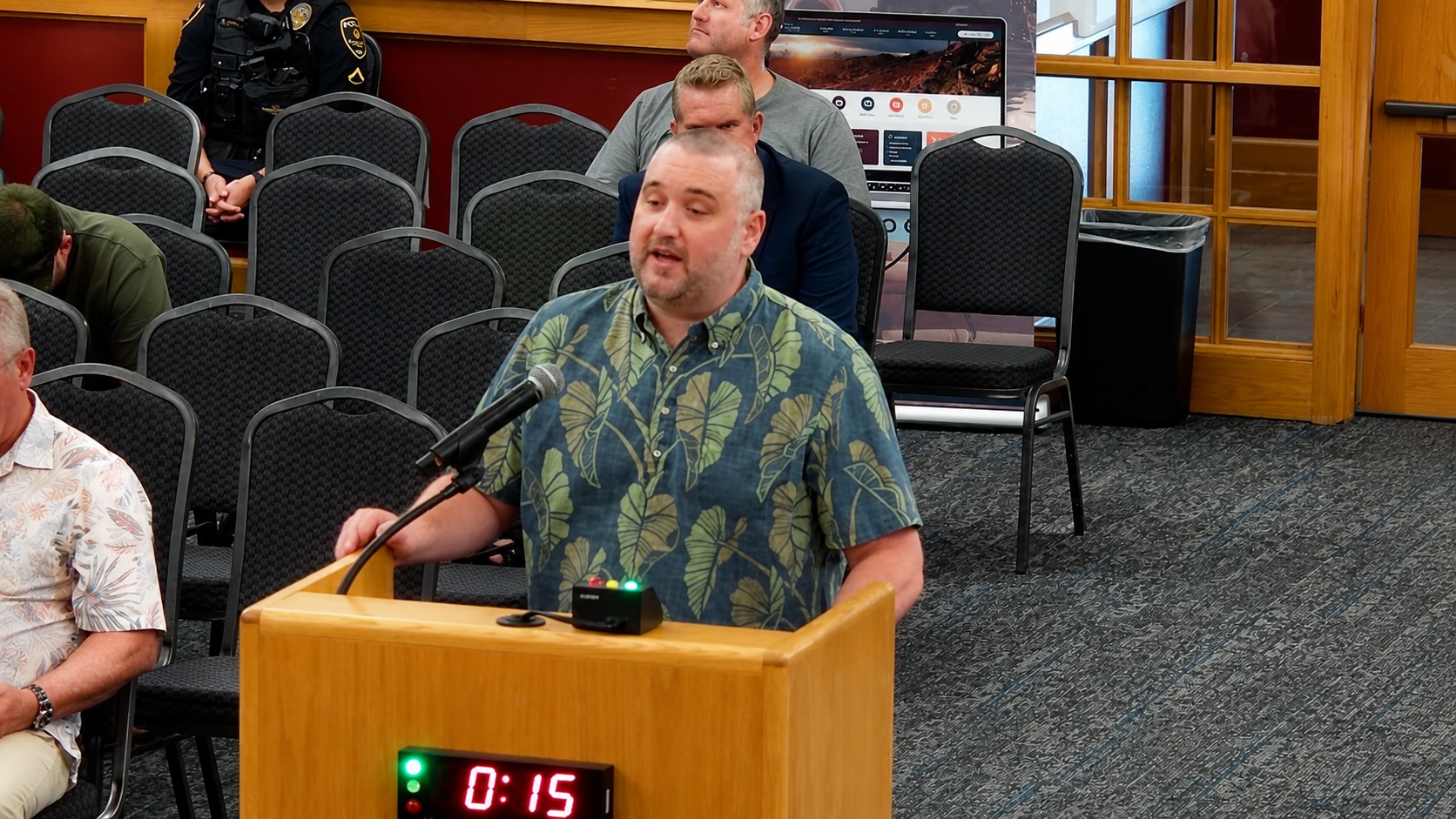
Standing at a podium in Casa Grande, Arizona, a self-described nerd named Jacob Petrosky calmly pitched city council members on a new company called “Shepherd Safety.” Satellites, Bluetooth sniffers, AI — the works. His system would track where officials go, who they meet, when they come home. It would monitor their spouses’ cars and their children’s vehicles. Council members’ faces shifted from confusion to something closer to fury. Then Petrosky pulled the reveal: “I would never do this to you. Could I? Probably. But I wouldn’t because it’s wrong. Just like what you guys are doing to us is wrong.” The clip went viral because it compressed a national fight over AI-powered license plate surveillance into three minutes of deeply uncomfortable theater.
200 Cameras, One Exit Strategy
Your neighborhood’s entrances are already logged — Casa Grande’s $10 million Flock deployment makes that impossible to ignore.
Casa Grande’s council unanimously approved a 10-year, $10 million contract with Flock Safety, the Atlanta-based surveillance company now serving over 5,000 law enforcement agencies nationwide. As of late June, roughly 140 of 200 planned cameras were installed — a mix of license plate readers and pan-tilt-zoom units feeding a Real Time Information Center running Flock OS. Petrosky says the cameras appeared “almost overnight.” He cannot leave his neighborhood on a paved road without passing one.
What those cameras actually capture, stated plainly:
- plate number, make, model, color, bumper stickers, even minor damage
- each image time-stamped, geo-tagged, and uploaded to a searchable database
- queryable by any of Flock’s 5,000-plus law enforcement clients across jurisdictions
Data is retained for 30 days by default, with permanent audit logs required for every search. Petrosky reviewed those logs and found approximately 70 percent of search entries had no documented justification, according to Pinal Post.
Flock maintains its cameras capture “point-in-time images of vehicle characteristics” and do not use facial recognition, citing “over 30 courts” that have affirmed the cameras do not track people. Police Chief Mark McCrory has described the system as “turning information into actionable intelligence.” The counter-evidence is harder to dismiss: an EFF analysis found more than 50 agencies ran hundreds of Flock queries directly tied to protest activity. The ACLU calls the network a dragnet that chills free expression, echoing concerns raised by researchers who have studied a surveillance app built to target political dissidents.
Three Arizona Cities Said No – Petrosky Wants a Fourth
A growing number of communities are discovering that canceling a Flock contract is easier than unlearning what the data already knows.
Flagstaff, Sedona, and South Tucson have already canceled Flock contracts after sustained resident pressure. Petrosky launched the DeFlockCG campaign and collected nearly 900 petition signatures. His demand is narrow — not abolition, just warrant requirements and independent third-party audits before police can reconstruct where you have been. The stakes sharpened further when NPR reported that some cities discovered their Flock data had been accessed by U.S. Border Patrol well beyond what local officials believed they had authorized — a pattern consistent with reports of authorities secretly tracking users without meaningful oversight.
The ACLU describes Flock as a system recording “every car that comes into view” into a database “that any law enforcement agency with a Flock contract can search — with few regulations or oversight.”
Petrosky registered to vote this year. Before cameras blanketed his commute, he said he couldn’t care less about city council or politics. His satire worked not because it was clever, but because it forced officials to experience, briefly, the surveillance they had approved for everyone else.