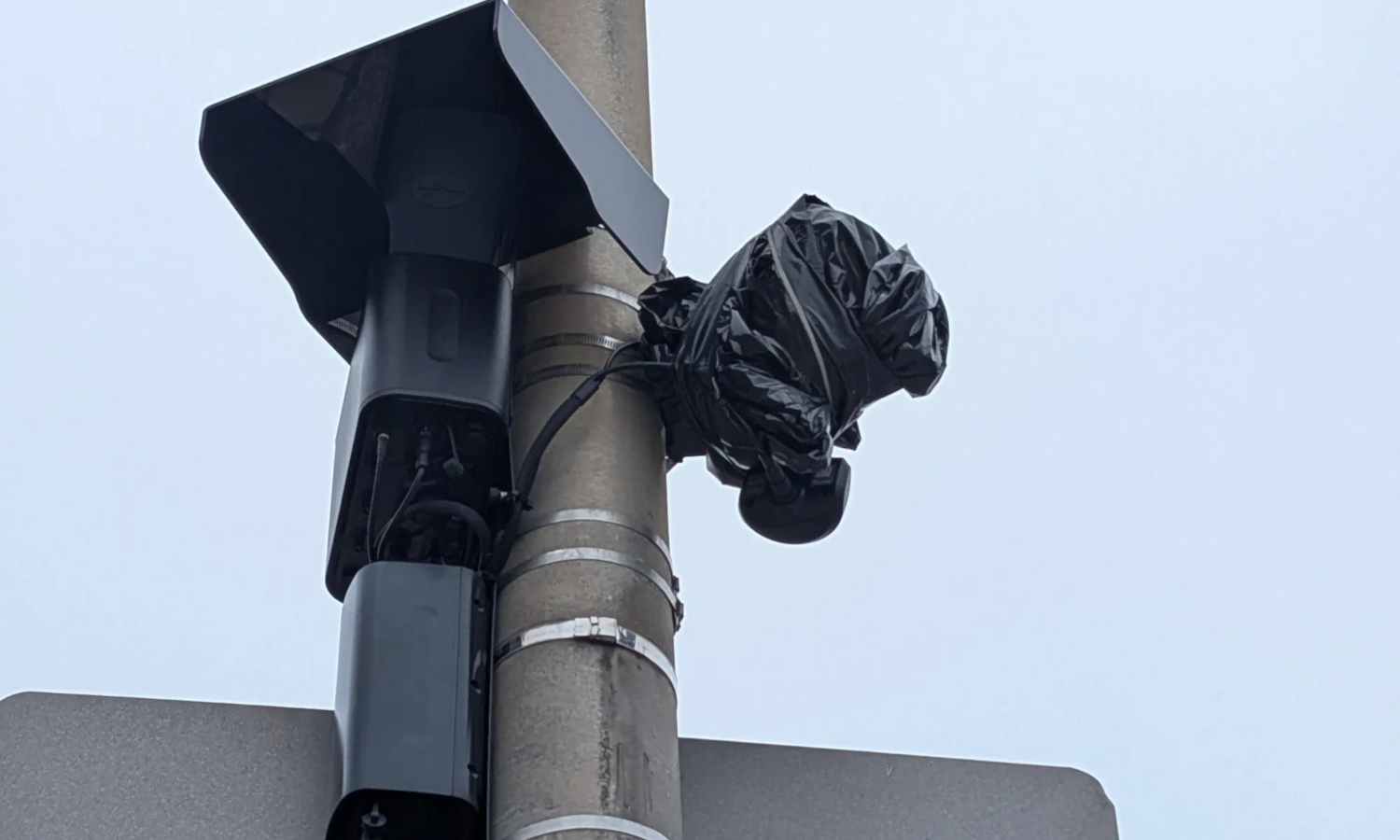
Employees at Elgin Community College covered six surveillance cameras with black trash bags and zip ties. Workers arrived in what College President Peggy Heinrich described as an unmarked vehicle and pulled the coverings off. The college covered them again. This cycle repeated for months.
The episode was not a prank. The college said it was unable to secure early removal of the equipment under the terms of its agreement with the vendor.
What Happened
A contract dispute over campus surveillance cameras stretched across nearly a year, ending only when the agreement itself expired.
Elgin Community College installed six Flock Safety cameras in April 2025, according to Chicago Sun-Times reporting. The stated purpose was practical: help locate stolen vehicles and assist in missing-person investigations.
By September 2025, administrators had grown concerned on several fronts, according to The Verge. College officials worried that camera data might be shared with U.S. Customs and Border Protection, that camera feeds were not adequately secured, and that law-enforcement personnel or Flock employees could misuse their access.
In October 2025, the college asked Flock to cancel the arrangement and remove the cameras. Flock refused, reportedly arguing it had not breached the contract and therefore was not obligated to exit early, according to Heinrich’s account as reported by the Chicago Sun-Times and The Verge.
In December 2025, college officials offered to pay out the remaining five months of the contract if Flock would take the equipment back. That silence left administrators with no path forward except to wait out the remaining months, according to Chicago Sun-Times reporting.
The standoff ended when the contract expired in April 2026. Flock removed the cameras then.
The Data Question
An internal audit found no confirmed misuse of Elgin’s camera data, though records from other Illinois institutions told a different story.
An internal audit found no evidence that federal immigration agents had accessed data from Elgin’s own cameras. Heinrich said the removal request was made “out of an abundance of caution” for Latino students on campus.
The picture elsewhere in Illinois is less clear. Public records reviewed by WBEZ and cited by the Chicago Sun-Times reportedly showed that Flock data from Illinois higher-education institutions had been searched in connection with immigration matters, including via a surveillance app. Those institutions include Joliet Junior College, the University of Illinois Chicago, and the University of Illinois Urbana-Champaign.
That distinction matters. Confirmed data access at other schools does not establish that Elgin’s cameras were used the same way. Both facts belong in the record.
The Broader Implication
The reported ownership structure of Flock’s hardware appears to have shaped the college’s limited options throughout the dispute.
Flock reportedly retains ownership of the cameras it installs, even when the hardware sits on a customer’s property. The reported ownership and contract terms appear to have limited the college’s ability to secure voluntary early removal.
Flock’s system does more than record a fixed scene. It uses artificial intelligence to log license-plate numbers alongside identifying vehicle details, including model, color, dents, and bumper stickers. Those observations become searchable records, shareable across agencies that opt into sharing arrangements , a pattern consistent with how institutions have been found secretly tracking users without adequate disclosure. It is a meaningfully different tool than a standard security camera, and it carries correspondingly different risks.
Whether Elgin’s contract included provisions for early termination, equipment ownership transfer, third-party data-access limits, or removal procedures is not established in available reporting.
What Institutions Should Ask Before Signing
The terms buried in a surveillance contract can matter as much as the technology itself.
Any public institution evaluating a similar system should treat contract terms with the same scrutiny it applies to technical specifications. Who owns the hardware on your property? Under what conditions can you exit early? Who else can query your data, and do you receive a log when they do? What happens to stored records if the relationship ends?
The Elgin case shows that a governance dispute can arise even without an established data breach. The contract itself was enough.