Silicon Valley’s rightward drift has left progressives scrambling for alternatives to corporate-controlled AI tools. While Elon Musk’s X pushes the openly right-wing Grok chatbot, activists are building their own answer.
An Organizing Mentor That Lives on Your Machine
Outcry brings curated activist knowledge to your desktop without cloud surveillance.
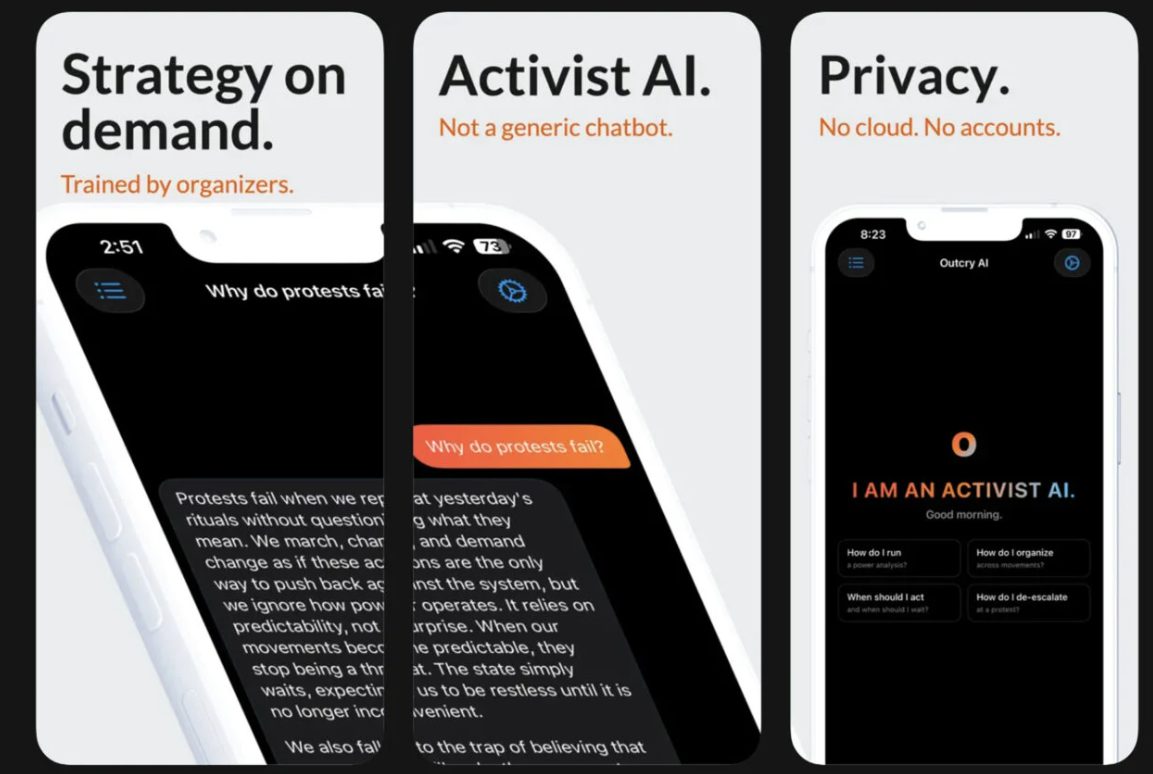
Micah White, co-founder of Occupy Wall Street, created Outcry as a “private, on-device AI mentor for activists.” The free app downloads everything locally—no cloud processing, no user accounts, no activity logs. That 3GB install includes both the AI model and a carefully curated dataset focused on organizing tactics and movement history.
Ask Outcry about workplace unionizing and you’ll get step-by-step guidance drawn from activist literature rather than corporate HR handbooks. The advice stays general—don’t expect hyperlocal group recommendations—but it delivers concrete frameworks for campaign building that newcomers can actually use.
Seizing the Means of Computation
Progressives are appropriating Big Tech’s own tools to build independent organizing infrastructure.
The shift reflects broader concerns about mainstream AI platforms serving conservative interests. OpenAI’s corporate partnerships and X’s political messaging have convinced organizers they need their own infrastructure.
Outcry represents something new: purpose-built AI aligned with progressive values. Instead of scraping the entire internet like ChatGPT, White’s team selected training materials from trusted movement sources. The result feels less like talking to a generic chatbot and more like getting advice from an experienced organizer who’s read every protest manual.
This matters because information shapes strategy. When your AI mentor understands mutual aid networks better than venture capital, your organizing benefits.
Reality Check for Revolutionary Claims
Local processing solves privacy concerns but creates new limitations.
Outcry shares every large language model’s fundamental flaw: it can confidently synthesize wrong answers from correct data. White acknowledges the app remains “imperfect” and asks activists to test it rigorously.
The offline architecture that protects your privacy also constrains usefulness. You’ll still need Twitter, Signal, and local contacts for real-time intelligence. Think of Outcry as strategic support rather than tactical command—like having Howard Zinn’s entire library condensed into a chatbot that never forgets which tactics actually work.
The bigger question isn’t whether Outcry succeeds, but whether progressives can build lasting alternatives to Silicon Valley‘s increasingly conservative AI ecosystem. Based on this promising start, they’re finally ready to try.