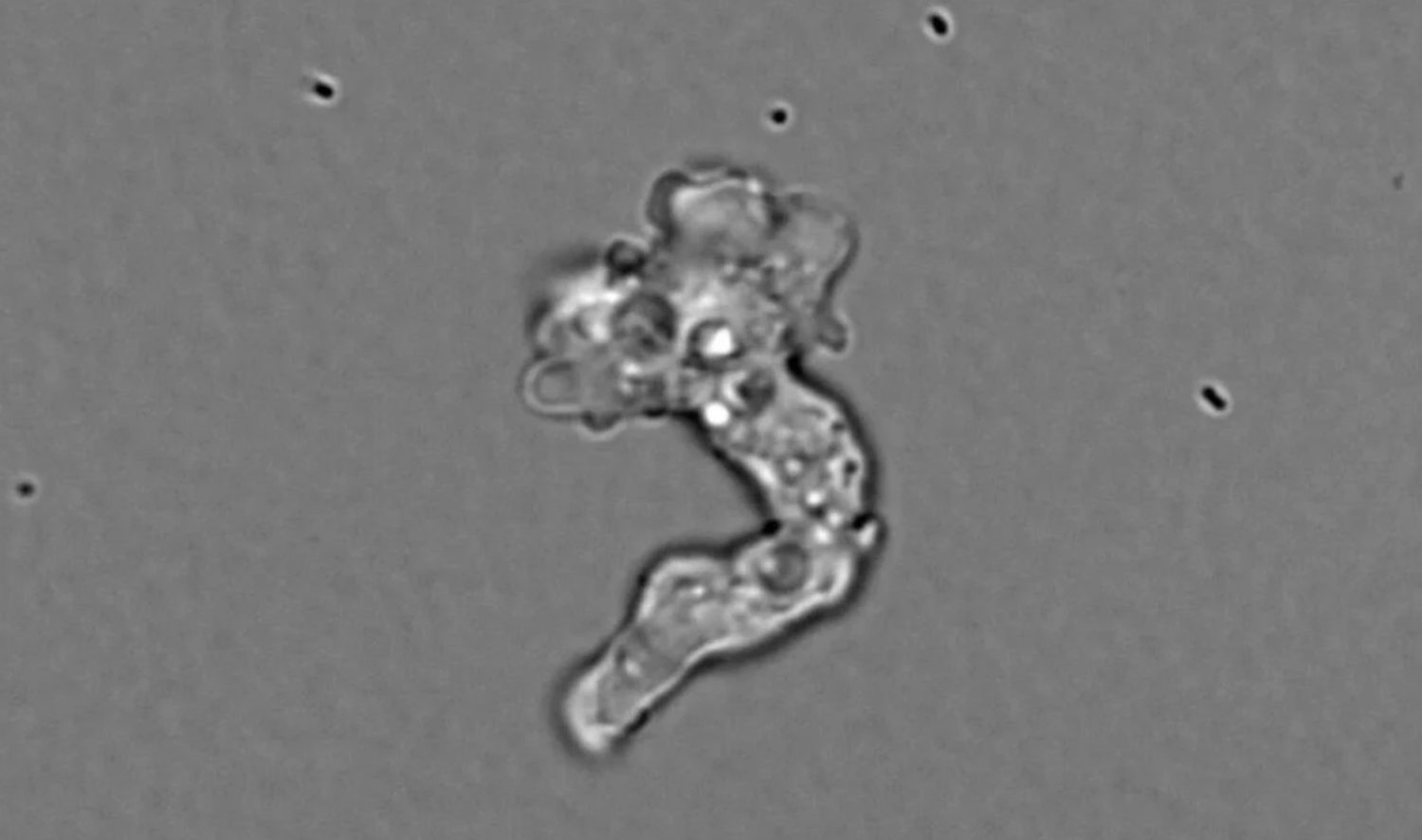
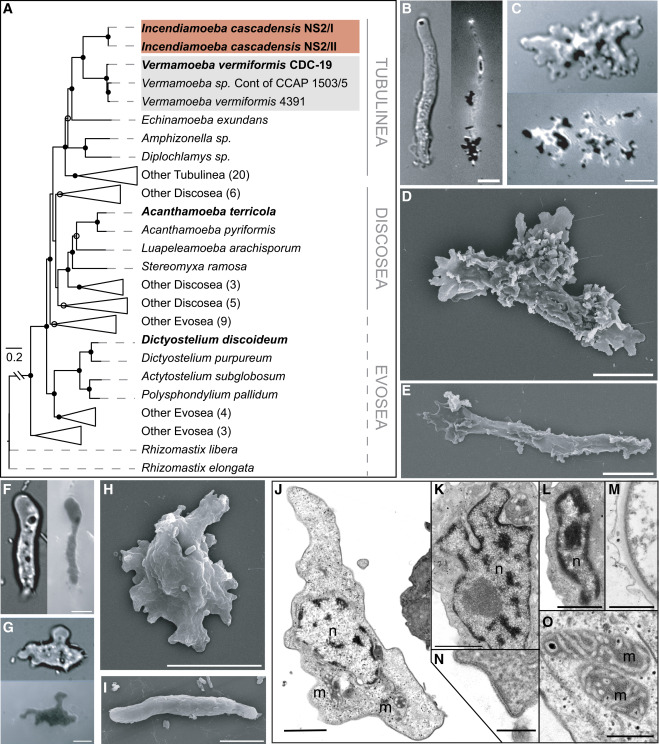
Something fed and reproduced at 63°C (145°F), which shouldn’t be possible. The organism is Incendiamoeba cascadensis, informally called the “fire amoeba,” and it is a eukaryote: a cell with a nucleus and membrane-bound organelles, the kind of cellular architecture long considered heat-vulnerable.
For decades, roughly 60°C stood as the accepted upper boundary for eukaryotic growth. The best-documented amoeba record was around 57°C. A study published in Cell in September 2026 by Syracuse University researchers now puts the new ceiling at 63°C, six degrees higher.
A Volcano’s Tenant Rewrites the Rules
The discovery emerged from geothermal streams inside a California national park, collected over two field seasons by a small Syracuse University team.
Biologist Angela Oliverio and graduate researcher Beryl Rappaport collected samples from geothermal streams at Lassen Volcanic National Park in California’s Cascade Range between 2023 and 2025. They first identified an unknown amoeba capable of growth near 57°C, then raised laboratory temperatures incrementally to locate its upper limit.
At 63°C it fed and divided. At approximately 64°C (147°F) it remained active.
Push the temperature to 70°C (158°F), however, and the organism shifted strategy. It changed shape and formed a protective outer cyst, entering a dormant state from which it later recovered.
That distinction matters. Surviving a brief heat spike inside a protective shell is not the same as actively growing and dividing at that temperature. The record applies specifically to eukaryotic growth and reproduction, not to temporary heat endurance.
Bacteria and archaea, the prokaryotes, lack a nucleus and membrane-bound organelles entirely, and they have long been known to thrive above 60°C. I. cascadensis is notable precisely because it is structurally more complex and still manages to function at temperatures where complex cells were not previously documented to grow.
What Keeps It Alive
Gene-expression data and protein analysis offer early clues about how the amoeba tolerates conditions that should overwhelm its cellular machinery.
Comparing gene expression at 48°C and 61°C, the researchers found increased activity in pathways associated with maintaining cellular integrity and repairing DNA as temperatures climbed. The organism appears to ramp up its internal repair machinery rather than simply enduring the heat passively.
The team also identified protein-stability mechanisms resembling adaptations found in heat-tolerant bacteria. Unrelated organisms independently arriving at similar molecular solutions under comparable environmental pressure is a hallmark of convergent evolution, though confirming that interpretation requires further analysis. The precise mechanisms remain under investigation.
Oliverio’s team plans to survey additional geothermal environments for I. cascadensis and compare it with closely related amoebae that cannot tolerate comparable temperatures. Those comparisons could reveal which specific adaptations confer heat tolerance and whether similar traits evolved more than once across eukaryotic lineages.
The finding also carries exploratory relevance for astrobiology. If complex microbial life can function at temperatures previously considered prohibitive, the range of environments worth examining for biosignatures expands, though that implication remains speculative and well short of any claim about life beyond Earth. Many geothermal environments remain incompletely studied, according to Oliverio’s team, and I. cascadensis raises the possibility that other heat-tolerant eukaryotes are still out there, undiscovered.