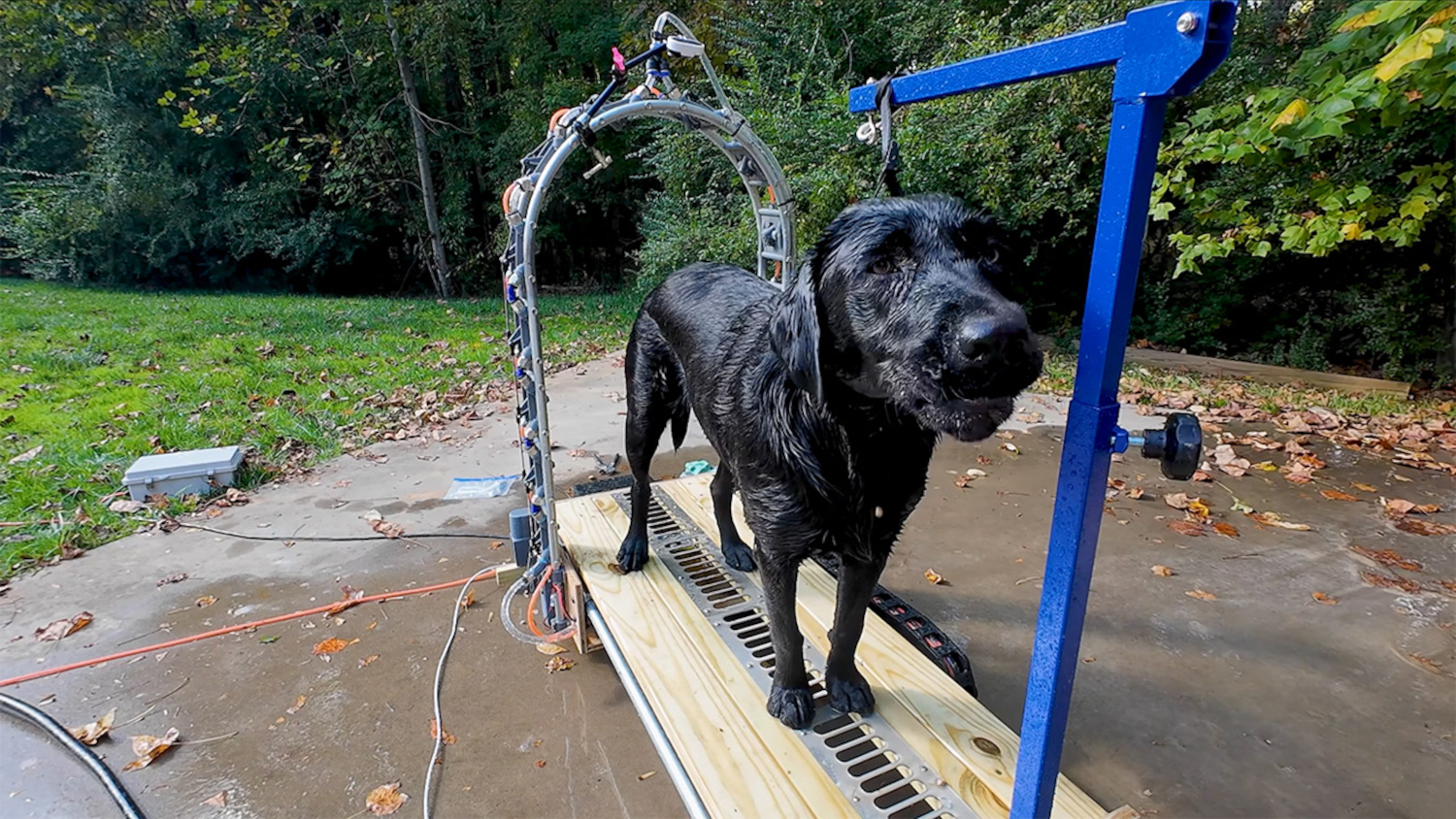
Your dog hits the door soaking wet and coated in mud, and you already know what comes next. That full-body shake sends everything outward, and you absorb most of it.
Shane Wighton, the engineer behind the YouTube channel Stuff Made Here, decided to solve that specific moment with automation. His answer is a car-wash-style machine that moves a spray assembly along the dog while the owner stands clear of the spray.
How the Machine Works
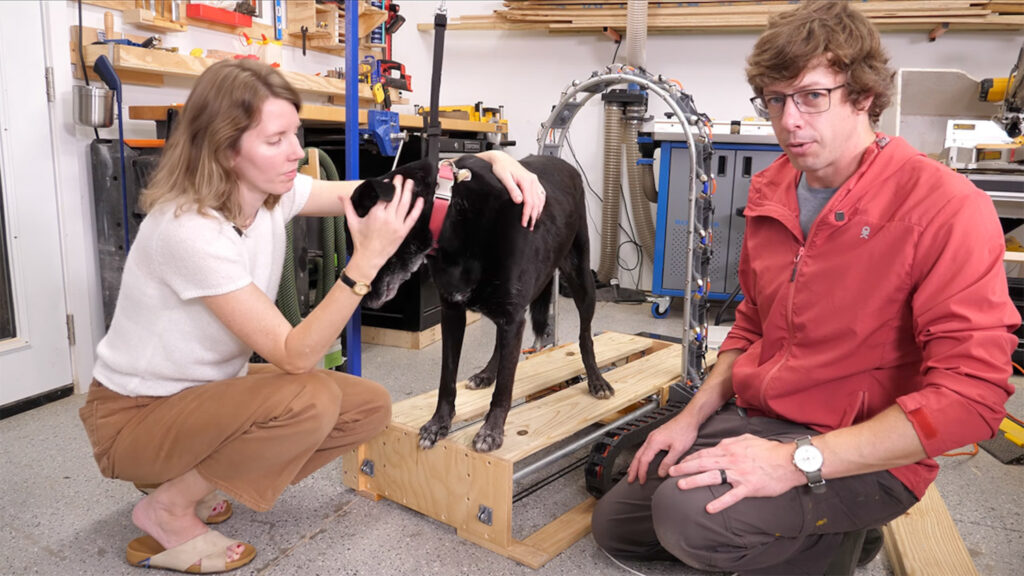
The system combines a moving nozzle arch, undercarriage sprayers, and an Arduino control box to automate the entire rinse cycle.
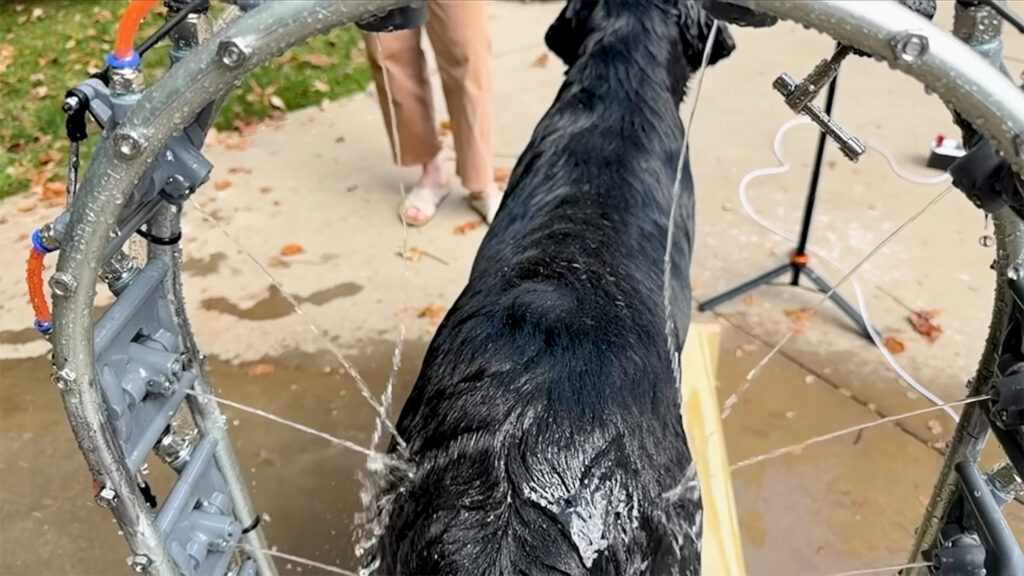
The core of the system is an arch of galvanized tubing, bent into a loop and carrying 15 spray nozzles. Each nozzle has separate internal water and air paths, O-ring seals, and swivel movement controlled by linked rods and ball joints. That linkage lets the entire nozzle array change orientation together.
The arch rides on a belt-driven wooden carriage. A central shaft prevents the structure from twisting or sagging as it travels, while linear rails and end-of-track limit switches govern the back-and-forth motion.
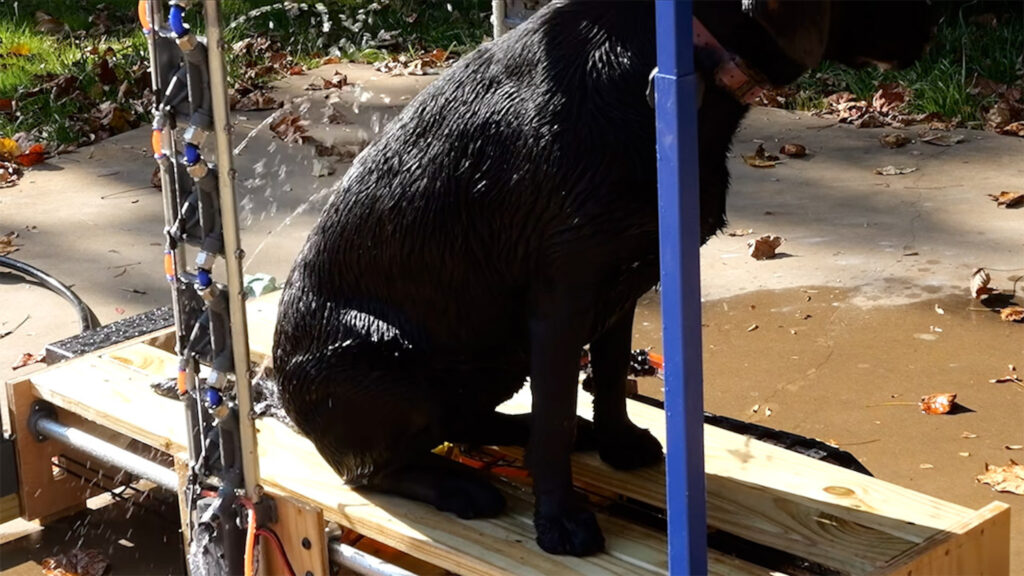
Belly and leg coverage comes from a separate set of sprayers mounted beneath the platform, firing upward to reach areas that a hose held from above tends to miss. An Arduino-based control box manages the carriage motors and the main water valve.
Sealed motor compartments and a prominent emergency-stop button protect the electronics and give the operator an immediate manual shutdown option.
What It’s Made Of
The build combines several fabrication methods into a single working structure.
The build draws on 3D-printed components, bent conduit, and plywood framing. Roller wheels were machined on a CNC lathe that reportedly arrived mid-project.
Testing Revealed the Hard Parts
Two test dogs exposed both the machine’s capability and its remaining gaps.
Wighton tested the machine on two dogs, Ava and Bri. Both animals were frightened by the platform and required calming measures during operation.
Early runs exposed mechanical problems. Upper nozzles produced weak spray, streams near the rear of the arch interfered with each other, and gaps in the deck left some areas of the dog’s body unreached.
Wighton revised the floor grate, adjusted how the dogs’ heads were positioned to reduce water entering their ears, and replumbed sections of the system to improve flow distribution.
The revised machine removed most of the mud from both dogs in a single pass and kept the owners clean. Coverage around the head and upper back remained inconsistent. The air-blowing phase lacked enough force to dry the dogs effectively.
What Comes Next
Wighton has named two specific targets for a follow-up version.
Wighton has identified a more powerful blower and refined nozzle alignment as the clearest improvements for a future version.
A Prototype That Earned Its Limitations
The machine solved its central problem and, in doing so, mapped what still needs solving.
Owners stayed clean, and the dogs came out significantly less muddy than they went in. The test also surfaced what automated pet washing demands beyond a single prototype: stronger drying power, more consistent coverage at the extremities, and a platform that nervous animals can tolerate with minimal restraint.