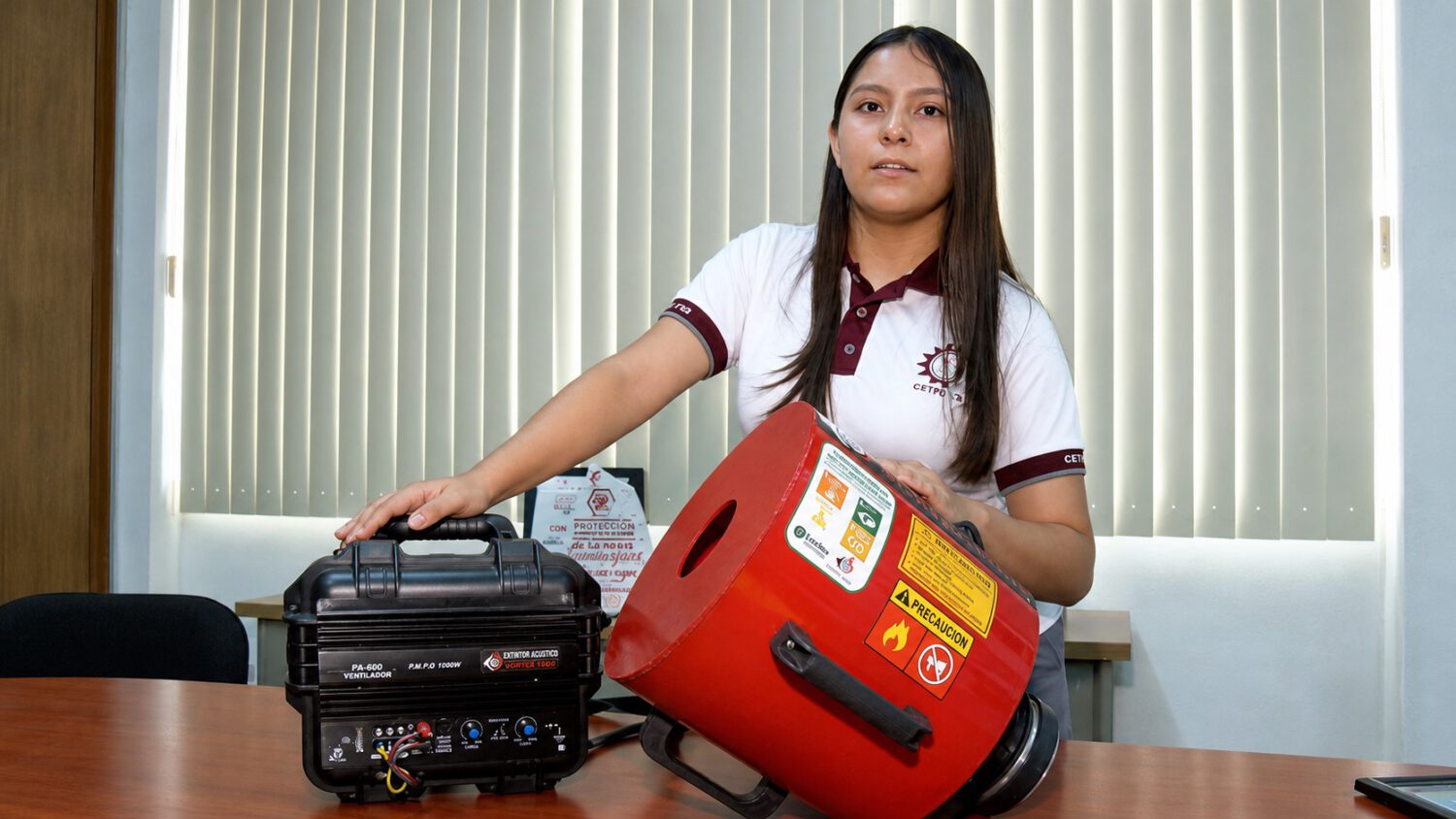
Sound can extinguish a flame. That counterintuitive principle sits at the heart of Vortex Tech, a prototype fire suppression device built by Ángela Karime Venegas Hernández, a high school student from CETis 78 in Altamira, Tamaulipas, Mexico.
At the International Science and Invention Fair (ISIF 2026) in Indonesia, Venegas earned a gold medal, according to reporting from El País, Infobae, and El Financiero. Reports indicate the competition included approximately 110 selected projects from around 25 countries, though published accounts vary on the precise totals.
How Vortex Tech Works
The prototype uses low-frequency sound waves to disrupt a flame’s combustion environment without applying water, foam, or chemical powder.
A 12-volt battery powers a frequency generator, an amplifier, and a speaker. Those components produce acoustic waves at approximately 30 hertz, near the lower limit of typical human hearing, creating air turbulence around a flame that displaces the oxygen supply combustion needs to survive.
Think of it as blowing out a candle, but with physics doing the work instead of your lungs. In demonstrations, the prototype reportedly extinguished small flames within approximately five to eight seconds, though that figure reflects controlled prototype conditions, not a general safety rating.
The suppression mechanism does not directly discharge water, foam, or chemical powder. The system still requires electrical components and a power source, so “chemical-free” describes the suppression method, not the full device.

The Competition and the Recognition
Vortex Tech earned regional recognition in Tamaulipas before advancing to an international stage in Indonesia.
The project, also formally described as a “Fire Suppression System Using Acoustic,” had already earned recognition in a Tamaulipas state creativity and technological innovation competition prior to the international event. Her adviser was identified as José Arturo Hernández Muñoz.
At ISIF 2026, the project earned not only the gold medal but also the IYSA Semi Grand Award, which gives Venegas the opportunity to participate in the Indonesia International Applied Science Project Olympiad (I2ASPO). Mexican President Claudia Sheinbaum publicly congratulated Venegas after the award, drawing broader national attention to the project, according to Excélsior.
What the Prototype Is and Is Not
Vortex Tech is an experimental student prototype, and the competition award does not establish compliance with professional fire-protection standards.
Vortex Tech has not been commercially certified as a fire extinguisher. The gold medal confirms recognition within a student science competition, not a professional fire-protection determination.
Effectiveness in real-world conditions would depend on flame size, fuel type, distance from the device, acoustic intensity, and surrounding airflow. The supplied reporting does not establish performance against larger fires or different fuel classes, and the device does not replace certified extinguishers, sprinkler systems, fire alarms, or emergency services.
What Comes Next
Further independent testing and regulatory review would be required before any practical deployment of the technology.
Before Vortex Tech could move toward any practical deployment, it would require controlled independent testing and repeatability studies across different fire scenarios. Safety analysis and review against applicable fire-equipment regulations would also be necessary. The supplied reporting does not indicate that this work has begun.
What the project does establish, clearly, is that a student from Tamaulipas built something original enough to earn international recognition. That achievement puts Mexican applied science on a competitive global stage, and for experimental acoustic suppression research, it is a legitimate starting point.