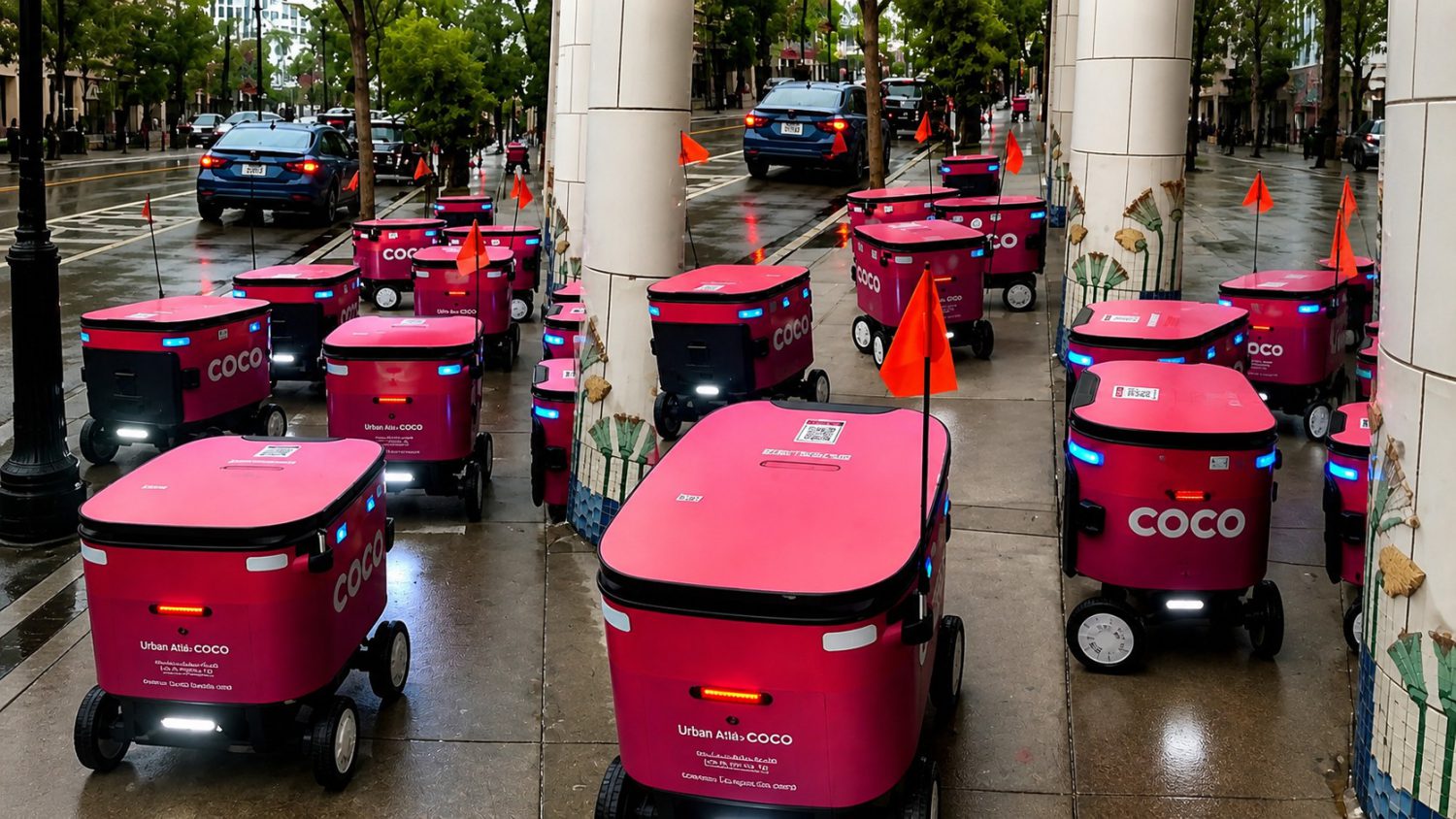
Becca Ostien was on her morning run along North Clark Street when she hit a wall of red. Not traffic. Not construction. A dozen Coco Robotics delivery bots, lights flashing, circling one another in a confused cluster that made the sidewalk effectively impassable. She filmed it, posted it with the caption “Run route was crowded this morning,” and watched it rack up hundreds of thousands of views. Funny, until you think about who can’t just hop around a robot traffic jam. This is Chicago’s sidewalk robot pilot in sharp focus—nearly 28,000 deliveries and 29,000 sidewalk miles logged since late 2024, and now one very inconvenient viral video. This kind of autonomous-vehicle confusion isn’t unique to delivery bots—a driverless Tesla robotaxi recently made headlines for its own public-safety incident.
When the Swarm Showed Up
A routing error and a viral clip raised questions Coco can’t answer with a software patch alone.
Coco called it a “sidewalk deployment error”—multiple robots rerouted simultaneously to the same location at the start of their daily shift. The company says the cluster cleared within minutes and that it has “solved the routing behavior that led to this.” Ostien told Block Club Chicago it wasn’t a one-off; she sees robots congregating near Clark and Reebie Storage roughly once a week. Coco operates about 50 robots across 34 square miles, partnering with roughly 125 restaurants through DoorDash and Uber Eats. On paper, the program works. On that particular stretch of North Clark, it looked like every Uber in the city got the same dropped pin at once. The broader question of how autonomous machines fit into public-facing roles is one that even a humanoid robot entering workplaces has started to surface.
Coco’s counter-narrative holds some weight: tens of thousands of deliveries, no serious injuries documented in company or city data. But incident reports tell a different story—robots ramming legs, blocking curb cuts, stopping mid-sidewalk. A petition led by Lincoln Park resident Josh Robertson has gathered over 1,000 signatures. One alderman’s ward survey drew roughly 500 responses, with 83% strongly opposing robot expansion beyond a defined boundary. He created a de facto exclusion zone.
The Accessibility Problem Nobody’s Routing Around
What a runner sidesteps in seconds can make an entire block impassable for everyone else.
The swarm that Ostien navigated with agile feet is a completely different obstacle for a wheelchair user or someone with limited mobility. Disability advocates have flagged this consistently—a cluster of robots at a curb cut isn’t a minor nuisance, it’s a blocked route, full stop. Advocacy voices, as reported by Futurism, described these situations as “actual nightmares” for people who cannot simply scoot around. There have also been reports, cited by Futurism, of robots crashing into bus stops and sending residents to the hospital—cumulative risk, not isolated glitches. By contrast, snake robots navigating earthquake rubble demonstrate what machines can achieve in complex environments when deployed thoughtfully.
The pilot expires May 2027. City Council then decides whether to renew, modify, or end it entirely. Ward-level bans already show that local political pressure can override citywide plans, meaning Coco isn’t just fixing routing logic—it’s managing community relations block by block, alderman by alderman.
Chicago set out to test whether robots could reduce car trips without turning sidewalks into obstacle courses. Right now, it has data showing the program delivers, and a viral video showing it doesn’t. The 2027 vote will decide which story the city chooses to believe.