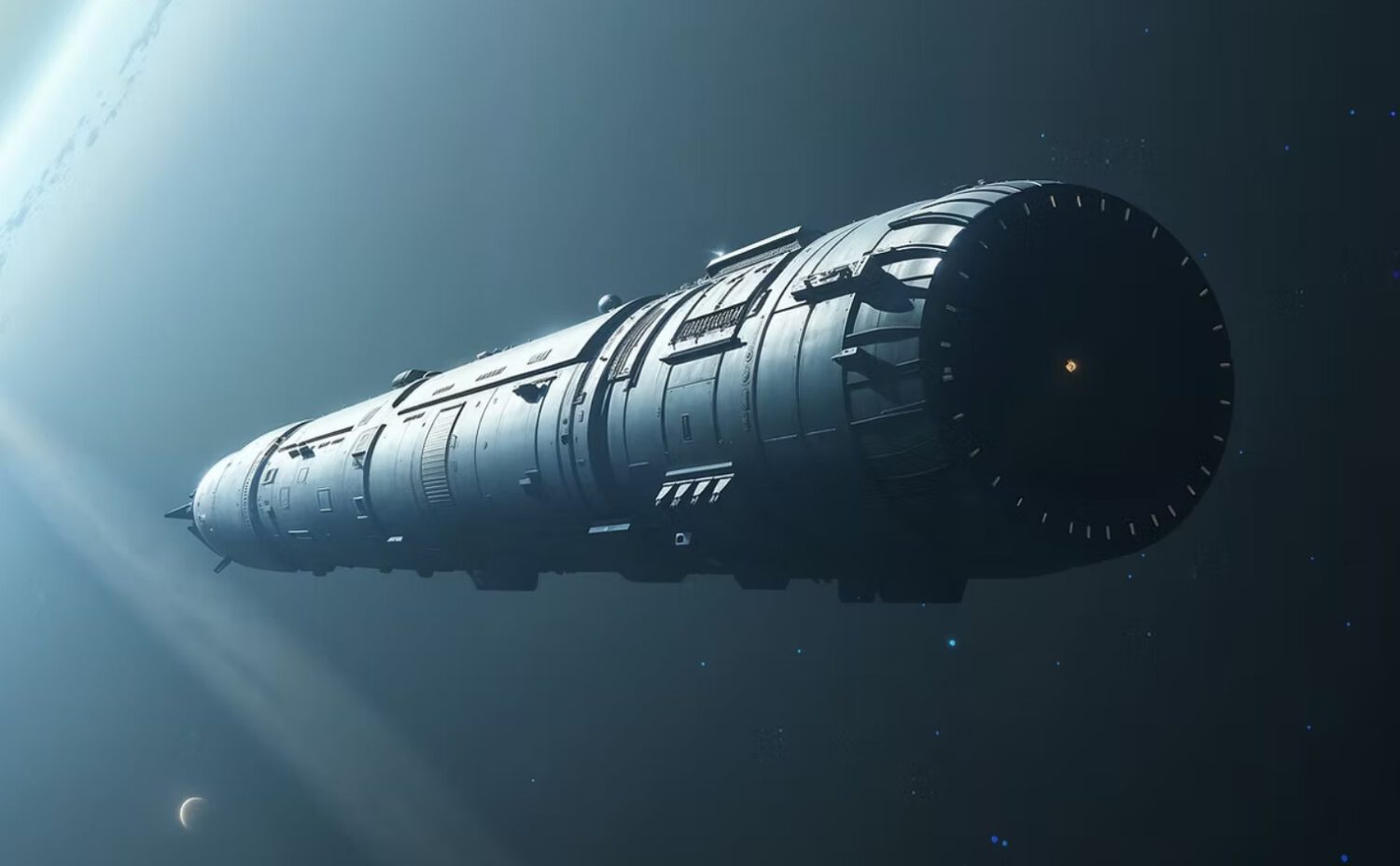
A spacecraft 58 kilometers long, carrying up to 2,400 people, traveling one way toward a star roughly 4.24 light-years away: that is the premise of Chrysalis, the winning entry in the Project Hyperion Design Competition run by the Initiative for Interstellar Studies. No publicly documented funding or approved construction program exists, and the concept depends on propulsion technology that does not yet exist. What it does have is arguably more useful: a serious, integrated attempt to treat interstellar travel as a civilization problem rather than an engineering sprint.
A City That Flies
Chrysalis is organized like a Russian nesting doll, with each layer serving a distinct function.
While most spacecraft designs concentrate on propulsion and payload, Chrysalis works differently. Its concentric cylindrical shells follow a matryoshka principle: the outermost layer serves as a robotic warehouse and industrial zone, intended to help shield the interior from radiation and micrometeoroid impacts. Middle layers hold housing, healthcare, education, and recreation, while inner sections are reserved for agricultural fields, forests, and closed ecosystems. The central core houses command systems, communications, and landing shuttles. The entire structure is designed to rotate, producing artificial gravity and addressing the health consequences of centuries in weightlessness.
Propulsion, per the design, would reportedly rely on a direct fusion drive using deuterium and helium-3, targeting roughly 10 percent of the speed of light. That figure describes a design goal, not a demonstrated capability.
Born Into the Mission
Several generations will live and die aboard before Chrysalis reaches its destination.
Where most space mission planning stops at the airlock, Chrysalis keeps going. The proposal envisions AI-assisted governance shared among humans, robots, and AI agents, with long-term knowledge-transfer systems designed to keep technical skills, cultural memory, and mission objectives intact across generations. Birth planning would reportedly help manage population size, with the design targeting a sustainable figure of around 1,500 people while preserving genetic diversity within the closed community.
Before launch, the initial inhabitants would reportedly spend 70 to 80 years in an Antarctic isolation settlement. The goal is to stress-test social resilience and institutional continuity under conditions designed to approximate life aboard the vessel. The ethical question the proposal does not fully resolve sits at the center of the concept: people born mid-voyage would inherit a mission they never agreed to, governed by institutions they did not choose, traveling toward a planet whose habitability remains unconfirmed.
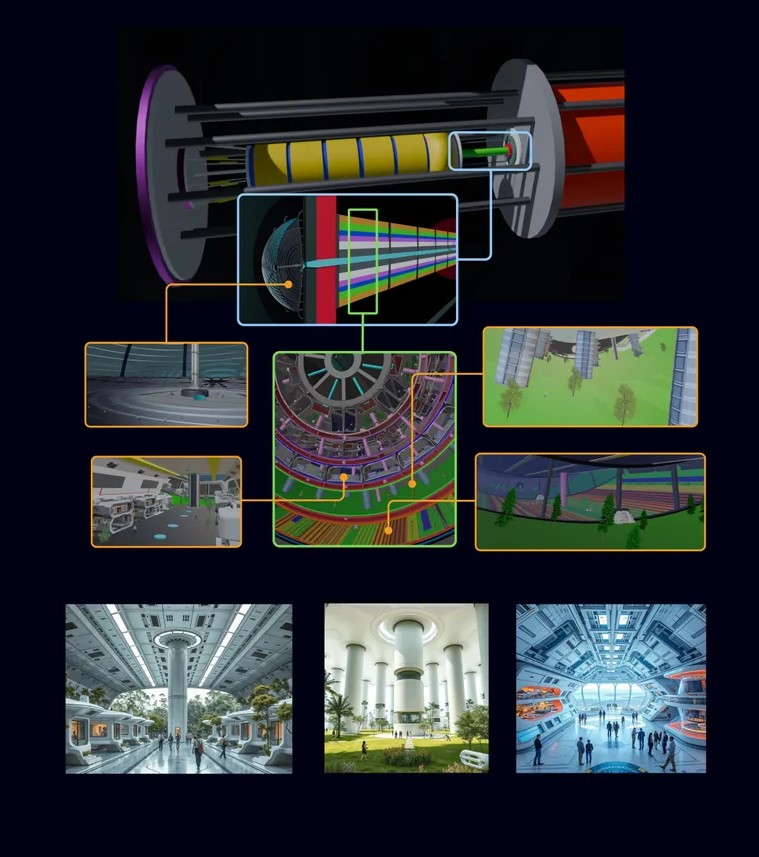
(Image credit: Giacomo Infelise, Veronica Magli, Guido Sbrogio’, Nevenka Martinello and Federica Chiara Serpe)
The Gap Between the Blueprint and the Build
Propulsion is the largest of several unresolved obstacles standing between this design and any real mission.
Commercial nuclear-fusion power generation is not an established operating industry. No publicly documented structure anywhere near 58 kilometers in scale has been assembled in orbit, though the designers suggest a 20 to 25 year construction period at the Earth-Moon L1 region as a proposal-level estimate. Closed-loop ecosystems, autonomous manufacturing, multigenerational medical care, and the social cohesion of an isolated community across four centuries all remain open problems.
The Project Hyperion competition jury praised Chrysalis for its system-level coherence, modularity, radiation-protection strategy, and attention to in-space manufacturing, according to the competition’s official results page. That recognition reflects quality of thinking, not readiness to build. The team comprising Guido Sbrogio’, Giacomo Infelise, Veronica Magli, Nevenka Martinello, and Federica Chiara Serpe has produced a framework connecting propulsion, ecology, architecture, governance, and ethics into one coherent question. Sustaining a functioning society during a 400-year voyage may ultimately be the harder half of the problem. Chrysalis at least has the honesty to ask both questions at once.