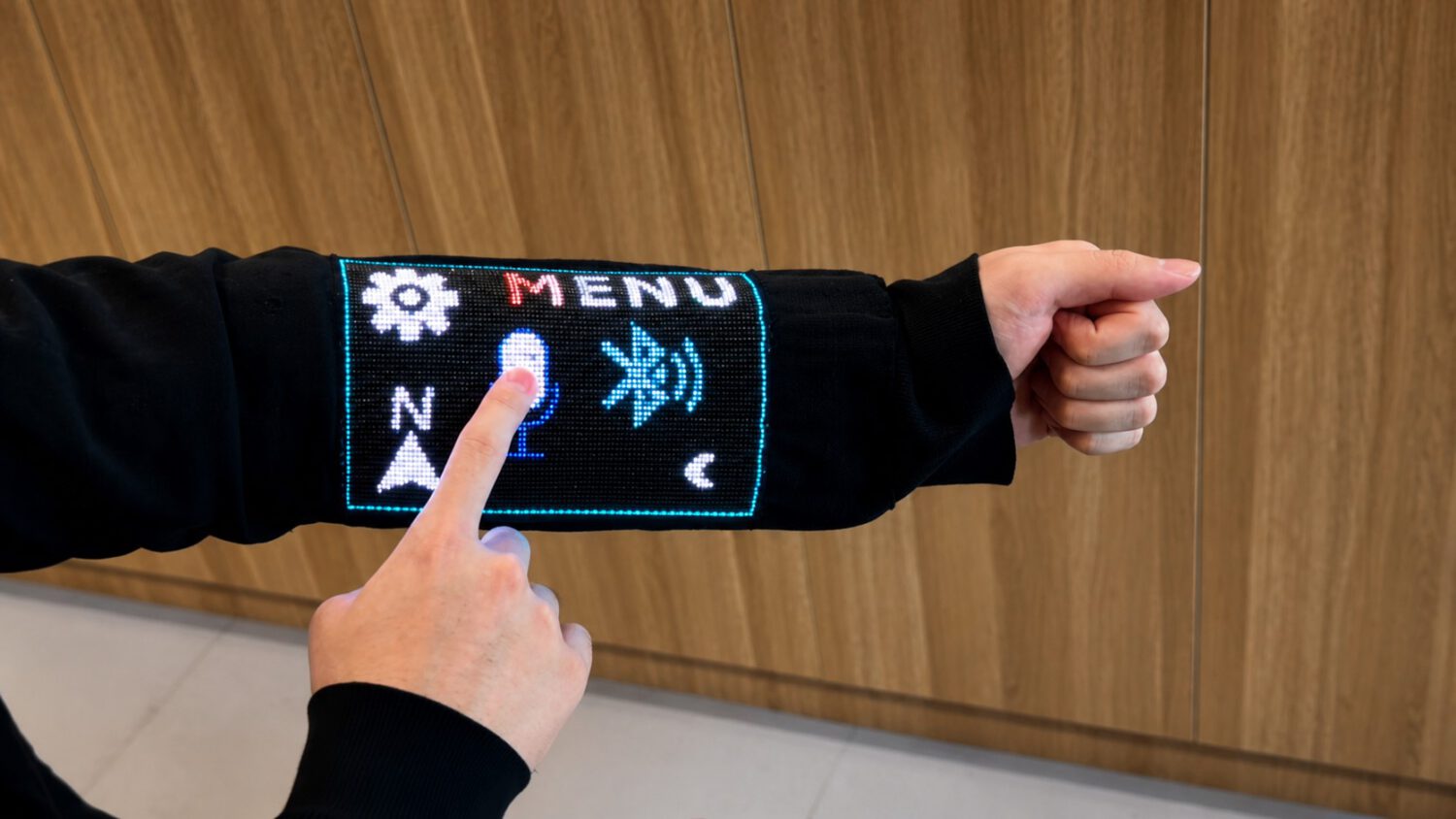
Your next computing interface might not sit in your pocket. Researchers at the National University of Singapore have woven a functional, full-color touchscreen directly into a garment sleeve, producing what NUS describes as the world’s first touchscreen built into clothing. The sleeve displays video, responds to finger presses, and retained nearly unchanged performance after 50 detergent-based machine-washing cycles under the reported test conditions.
How the Fiber Actually Works
Each thread in this sleeve is simultaneously a pixel, a sensor, and a circuit board.
Each electronic fiber runs approximately 10 meters long at about 1 millimeter thick, packing 96 LEDs and a pressure-sensitive layer into a structure closer in size to yarn than to any screen you have handled. Pressing the fiber closes a circuit, the nearest LED lights up, and the touch registers. A laser-drilled, solder-guided fabrication process made this density possible, fitting nearly 5,000 chips and more than 20,000 electrical connections into the developed fiber architecture.
Weaving 54 of those fibers into a forearm sleeve produces a 168 by 105 millimeter display. It runs at 96 by 54 pixels, 30 frames per second, and 8-bit color: clear enough for icons, body-temperature readings, a calculator, a photo gallery, and short video clips with audio. Think of it as early-era portable gaming display territory, a useful analogy for scale rather than a technical equivalence.
Each fiber operates on an independent control line, so a single fiber failure leaves the rest of the display running. The architecture also supports simultaneous touch inputs across the surface.
Washable, Flexible, and Still a Prototype
Lab durability results are real; a commercial product is not.
According to NUS, brightness and touch response held close to baseline after 50 machine-wash cycles with detergent and after 1,000 bends around a 5-millimeter radius. The team also reports air permeability comparable to cotton, polyester, and denim, with materials falling within established safe limits for skin contact.
Those numbers are meaningful, but they reflect selected laboratory conditions, not every detergent, wash temperature, or wear pattern a garment actually encounters. The 96-by-54-pixel resolution handles simple graphics and icons comfortably; it is far below the screen you are likely reading this on. No commercial release date, consumer pricing, or mass-manufacturing plan appears in NUS’s announcement, and the “world’s first” claim should be understood as NUS’s characterization, since precedence depends on how precisely you define a touchscreen garment.
What It Could Mean, and What It Cannot Promise Yet
Healthcare is the clearest potential use case; everything else remains speculative for now.
The most concrete application sits in healthcare. A sleeve combining physiological sensors, on-device processing, and a textile display could monitor body data without requiring a separate screen. NUS identifies this as a potential direction, though the prototype does not constitute a clinically validated healthcare device.
The research team, led by Assistant Professor Tural Khudiyev at NUS’s College of Design and Engineering, points to higher resolution and smaller microchips as the next development targets, which would enable sharper and potentially larger woven displays. Other potential uses include hands-free industrial interfaces, assistive technology, and sports monitoring, though none of those applications currently exist beyond the conceptual stage. The work was published in Nature on October 21, 2026.
The demonstrated prototype does what it does: display images and respond to touch on a sleeve that retained its performance through rigorous lab washing tests. If computing interfaces continue migrating closer to the body, the question for you shifts from “what device do you carry?” to “what are you wearing?” NUS’s sleeve is a credible early step in that direction.