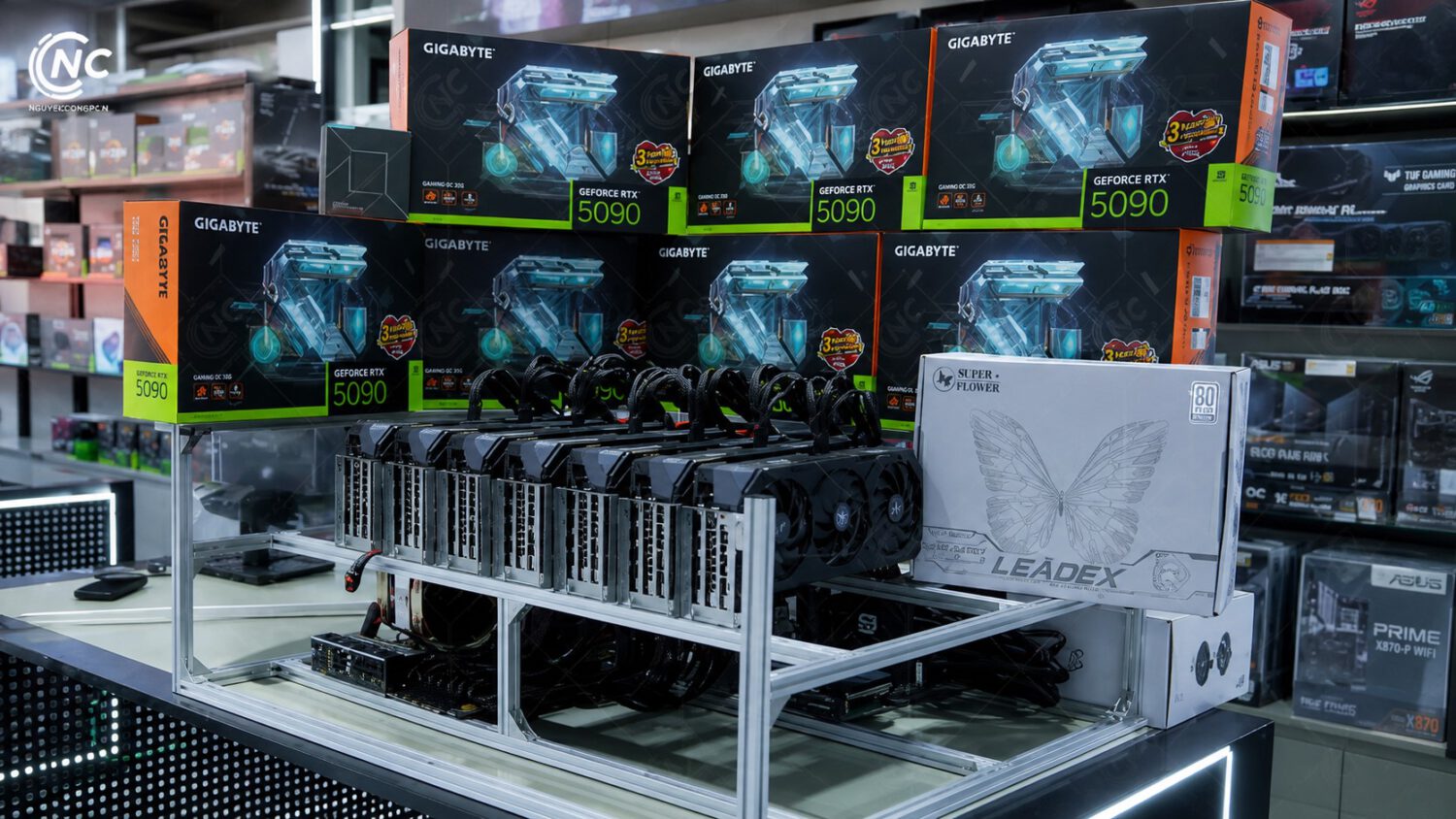
Finding an RTX 5090 at its $1,999 launch price has become something close to impossible, and there may now be a reported reason why. According to Tom’s Hardware’s account of footage shared by Hong Kong hardware outlet HKEPC, Chinese workshops are allegedly dismantling brand-new RTX 5090s and repurposing their core components for AI data centers.
The footage reportedly shows the GB202 GPU die and GDDR7 memory being desoldered from retail boards and transplanted onto compact, blower-cooled cards built for dense server racks. It has not been independently verified, and the exact number of cards involved cannot be confirmed from available reporting.
A $1,999 Gaming Card Becomes an AI Server Module
The reported conversion exploits a gap between consumer gaming hardware and the surging demand for AI compute capacity.
The conversion logic is not complicated. Nvidia’s Blackwell architecture and the RTX 5090’s large GDDR7 memory pool make the card genuinely attractive for AI workloads, particularly when purpose-built professional accelerators are scarce or expensive. Strip away the oversized three-fan cooler, transplant the die and memory onto a dual-slot blower board, and the result fits a server rack without taking up unnecessary space.
The RTX 5090 is reportedly not officially sold in China, which means cards appearing at these facilities would have entered through gray-market or indirect channels, according to Tom’s Hardware. Modified units are reportedly benchmarked on large test rigs before being shipped to data centers or AI laboratories. Nvidia has not issued any statement confirming the facility, the volume of cards involved, or the company’s relationship to this operation.
The Bill Is Being Sent to You
When gaming hardware competes with AI infrastructure demand, consumers absorb the cost without ever knowing the game was on.
Tom’s Hardware reported that first-party US RTX 5090 inventory has nearly vanished, leaving third-party sellers asking between $6,500 and $9,500 or more. The cheapest listed price tracked was around $4,999. One Micro Center location reportedly still had cards near $4,299, an outlier in a market that has more than doubled from the $1,999 launch price.
Multiple factors contribute to that price explosion: limited production, speculative buying, distributor allocation, and broader AI hardware demand all play a role. The reported gray-market conversion operation is not proven to be the primary driver, but it is a concrete example of a structural problem the supply chain is not visibly rushing to fix.
Tom’s Hardware also reported, without confirmation from Nvidia, that the company may have halted RTX 5090 production or redirected silicon toward higher-margin professional products. That remains an unconfirmed signal, not a settled fact, and should be read accordingly.
At the root of this is a gap Nvidia has not closed between its consumer and professional silicon pipelines. Gray-market operators have turned that gap into a business opportunity, and retail buyers are the ones absorbing the markup. Tighter distribution controls, transparent allocation between gaming and AI channels, and clearer communication about production decisions would meaningfully help here.
What This Means for Anyone Buying High-End GPU Hardware
This is less a one-off leak story and more a structural preview of what happens when AI demand and gaming hardware share the same supply chain without guardrails.
Until Nvidia and the broader industry draw a cleaner line between who gets what silicon and why, buying flagship GPU hardware at launch price will feel less like a retail transaction and more like winning a raffle you did not know you had entered.