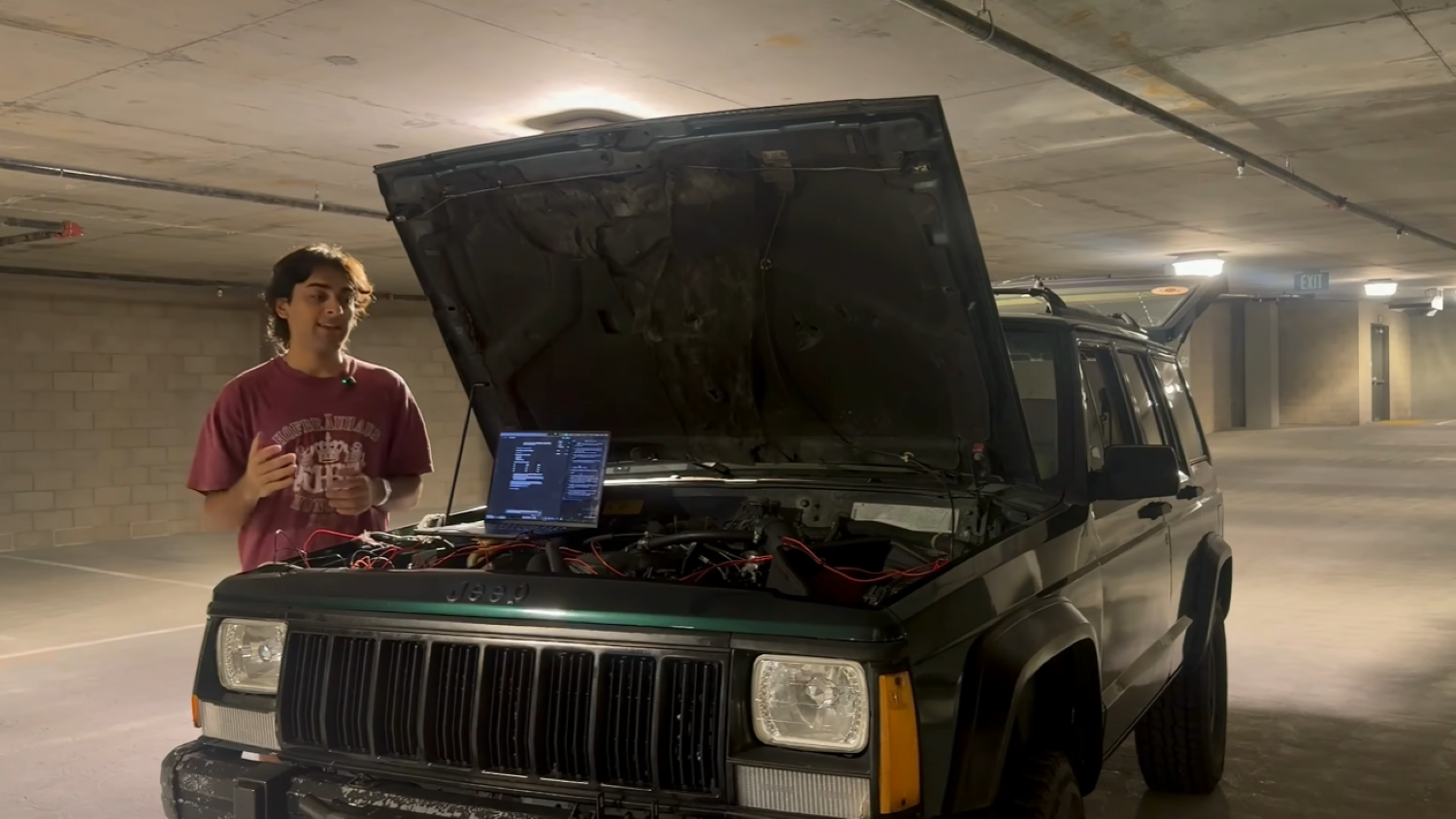
Muhammad Zulali’s 1994 Jeep Cherokee was failing California smog tests on nitrogen-oxide (NOx) emissions at test speeds of 25 mph and, during one adjustment phase, 50 mph. He addressed that with an Arduino Nano, roughly $15 in parts, and two AI coding agents.
The difficulty starts with the vehicle’s age. The Cherokee predates the OBD-II standard that governs modern diagnostic ports, so its engine control unit (ECU, the computer managing fuel delivery and ignition) communicates over a Chrysler SCI bus, an older serial system running at approximately 7,800 baud with electrically inverted signaling. Inverted signaling means the signal’s high and low electrical states are reversed from standard serial communication, requiring conversion hardware before a modern laptop can interpret the data.
Three Wires and a Breadboard
The hardware solution cost less than a tank of gas.
Zulali connected three wires from the Jeep’s six-pin diagnostic port through an Arduino Nano to a laptop. Total reported hardware cost, including the Nano, breadboard, wires, and terminals, came to about $15, according to coverage by Tom’s Hardware.
Claude Reads the Engine; Codex Handles the Memory
Two AI tools divided the labor along a clear line: diagnostic reasoning versus code injection.
Claude identified the SCI protocol settings and handled diagnostic reasoning, interpreting live engine data logged during drives at the relevant test speeds. An early reading suggested the engine was running rich by approximately 22 percent; further investigation revealed that figure came from a misread formula, illustrating that AI analysis required human judgment to validate at each step.
The ECU was too old to support conventional firmware reflashing, so Codex addressed a different problem. It developed a method to inject custom code and write it into the ECU’s nearby EEPROM, nonvolatile memory that retains stored data without power, according to MotorBiscuit.
“Claude did most of the diagnostic work and Codex did pretty much all of the memory work. I just did the wiring and the driving.” Muhammad Zulali, Jeep owner and project developer, as reported by Tom’s Hardware.
The Result and Its Limits
The Jeep reportedly passed. Official documentation of the emissions readings has not surfaced in published coverage.
After iterative adjustments and additional test runs, the Cherokee reportedly passed California smog testing. Published coverage does not include complete official test documents or independent laboratory replication of the emissions readings.
Zulali published the project as “xj-scanner,” with wiring diagrams and code intended for owners of compatible 1991–95 Jeep and Chrysler vehicles using similar SBEC-era computers. The project was built and tested on one specific vehicle, a 1994 Cherokee with a 4.0-liter engine, so compatibility and results will vary.
Modifying ECU behavior can affect fuel delivery, drivability, engine reliability, and emissions across operating conditions beyond the test cycle. This was an experimental enthusiast project conducted on a privately owned vehicle. It is not an endorsed or officially reviewed emissions-compliance method, and anyone considering a similar approach should research the DIY car fixes and regulatory requirements in their jurisdiction before proceeding.