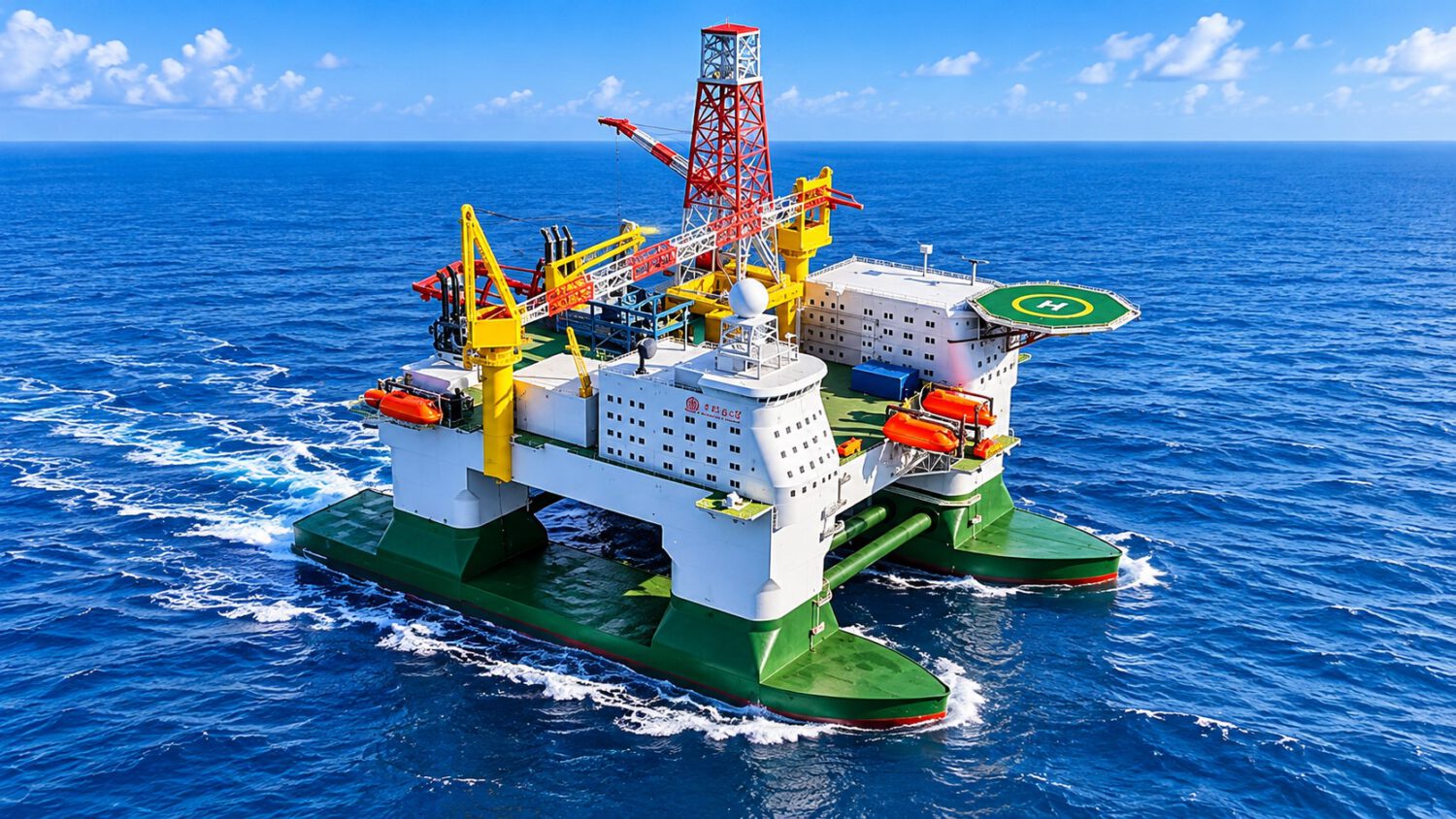
Chinese state media has taken to calling it a “floating island,” but that description favors marketing over engineering. The planned structure is a semi-submersible twin-hull platform, scaled up from offshore oil and gas technology and fitted with laboratories, long-stay accommodations, and deep-sea testing infrastructure.
Shanghai Jiao Tong University will operate the facility, while Shanghai Waigaoqiao Shipbuilding, a subsidiary of China State Shipbuilding Corporation, holds the construction contract. The contract is valued at approximately 2.76 billion yuan, or around $405–413 million. Construction is scheduled to begin in 2028, with delivery targeted for June 2030.
The Numbers Behind the Ambition
74,000 tonnes of displacement and berths for 238 people define the platform’s planned scale.
Measuring 138 meters long and 85 meters wide, the platform is designed to accommodate 238 crew members and researchers across six onboard laboratories and an offshore operations-support center. Self-propulsion at approximately 11 knots means it can reposition under its own power. Designers are targeting Sea State 7 operating capability and resistance to typhoons rated up to Force 17 on the extended Beaufort scale.
These are design specifications, not demonstrated performance. The design has been validated in a Shanghai Jiao Tong University test basin, but full-scale ocean trials remain ahead.
What Researchers Would Actually Do There
The facility is intended for persistent, long-duration deployment rather than the shorter mission cycles typical of most research vessels.
Research vessel missions vary widely in length and scope, but most are limited in how long they can sustain heavy-load, deep-sea operations in one location. This platform is designed for a different role: deep-sea equipment testing, marine disaster and meteorological observation, and long-term ecosystem monitoring. It is also planned to support trials of large offshore systems.
A moon pool integrated into the hull would let researchers lower equipment directly into deep water from inside the structure. Some Chinese project descriptions reference research capability extending to full ocean depth, though those claims should be treated as design targets until the platform is operating.
The Strategic Dimension
China has tied the project to national science and technology infrastructure, with implications reaching well beyond marine biology.
China has linked the project to its 14th Five-Year Plan for science and technology infrastructure. Potential applications include testing deep-sea mining systems, offshore energy equipment, and heavy marine machinery intended for harsh environments.
Professor Usha Haley told Newsweek that the real significance may be control over the testing environment itself. A domestic open-ocean test bed gives China substantial control over operational data and testing conditions, and could influence the standards against which marine technologies get evaluated.
What Remains Uncertain
All specifications describe a planned facility; construction has not yet begun and full-scale ocean performance remains unproven.
The “world’s first” designation comes from Chinese state media and project sources, not from an independently verified global ranking. The design has shown promise in basin testing, but planned capabilities are not demonstrated capabilities. If construction or sea trials fall behind, every figure on record stays aspirational. The contract is signed and the timeline is set; the ocean will render its own verdict in 2030.