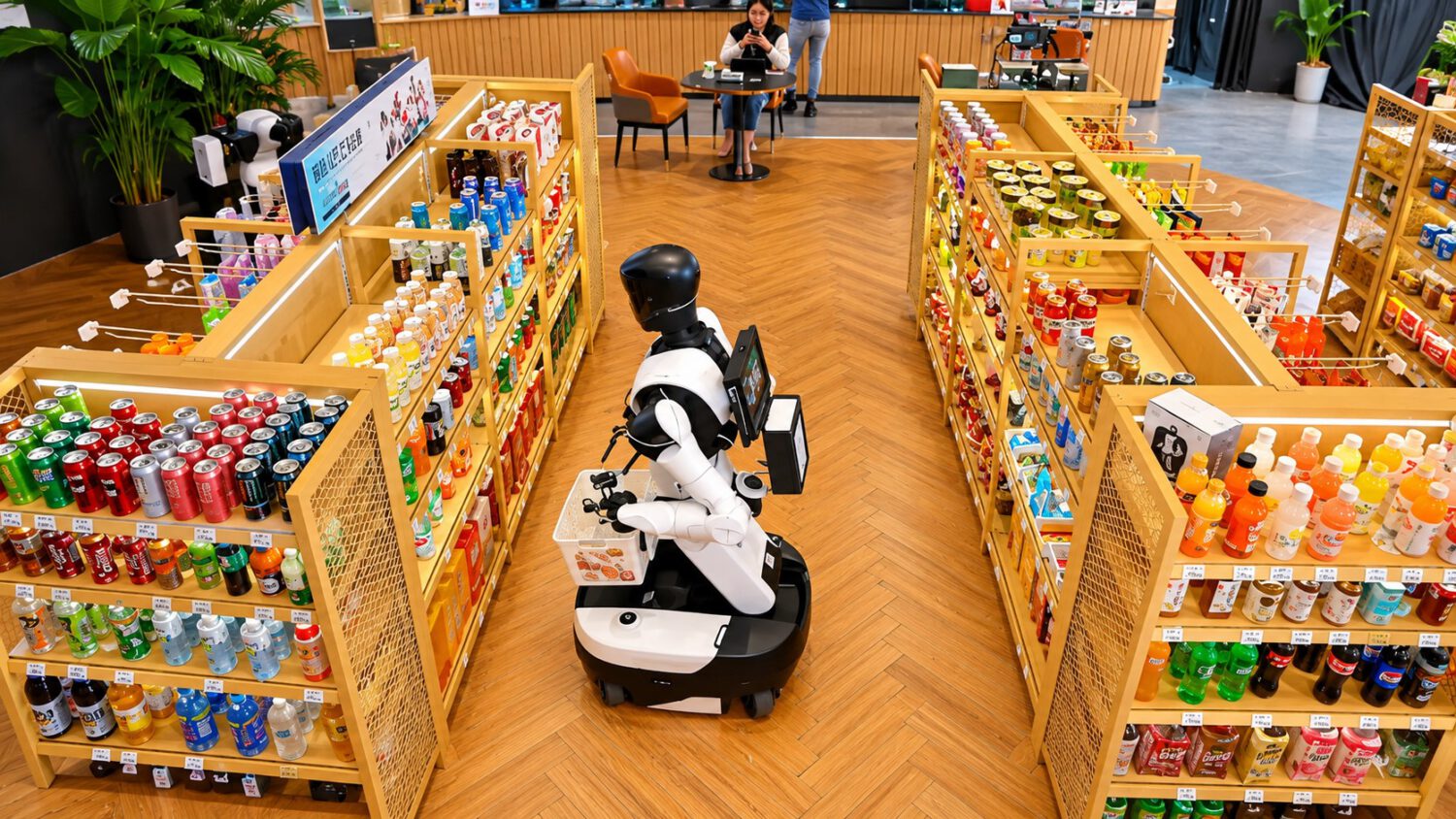
A convenience store in China hosted six AGIBOT G2 humanoid robots for a 24-hour livestream the company branded “Robots Never Clock Out,” running November 2 to November 3, 2026. The event placed the robots in a shared space alongside actual customers and store staff, rather than a controlled setting where engineers could reset conditions between attempts.
Why a Convenience Store Is a Harder Test Than It Looks
A store typically offers far fewer opportunities to reset conditions than a laboratory does.
Navigation, shelf manipulation, customer interaction, and task-switching all unfold simultaneously in an aisle shared with real people. That combination of demands is meaningfully harder to manage than a single, repeatable laboratory task.
What the Robots Were Asked to Do
Four task categories were assigned across four distinct operating periods.
AGIBOT tasked the G2 units with stocking and organizing shelves, preparing coffee and hot food, greeting customers, and clearing rubbish. The company divided the challenge into four periods: the lunch rush, the evening rush, late-night duty, and breakfast preparation.
What the Livestream Actually Shows
A longer observation window than a highlight reel, but not a substitute for a task log.
A 24-hour broadcast offers more visibility than a short, edited clip. Failures, repeated attempts, and recovery behavior can surface in real time when cameras run for an extended period, making the format more revealing than a curated demonstration.
What the Livestream Does Not Prove
The duration of the broadcast and the duration of uninterrupted robot operation are not the same thing.
The runtime of the stream does not establish that every robot operated continuously without charging, maintenance, or human intervention. The reviewed materials do not provide an independently audited task log, intervention count, or failure rate from the event.
The Evaluation Gap
Stronger evidence requires numbers that promotional footage cannot supply on its own.
A meaningful performance assessment would require completed versus failed tasks, time per task, intervention frequency, charging intervals, and output compared against a human worker baseline. The reviewed reports from Humanoids Daily and Interesting Engineering do not provide that data for the November event.
The Worken Framework
AGIBOT wants a new way to measure robot productivity, and the store test fits that ambition.
At its Innovation Day, AGIBOT introduced a proposed measurement framework called “Worken,” which tracks robot productivity through active robots, autonomous working hours, and an output-efficiency ratio. The convenience-store challenge aligns with that productivity-first framing. However, the disclosed event data does not yet support a reliable Worken calculation.
What This Event Actually Represents
A meaningful step in embodied-AI testing, contingent on data that has not yet arrived.
The “Robots Never Clock Out” event represents a shift from short laboratory demonstrations toward extended testing in a public, semi-structured environment. That shift is analytically significant: a 24-hour retail scenario introduces variables that a controlled lab deliberately eliminates. Whether the G2 robots handled those variables effectively remains an open question. The evidentiary value of the event depends on operational data, such as an independently audited task log or a third-party performance report, that promotional livestream footage alone cannot supply.