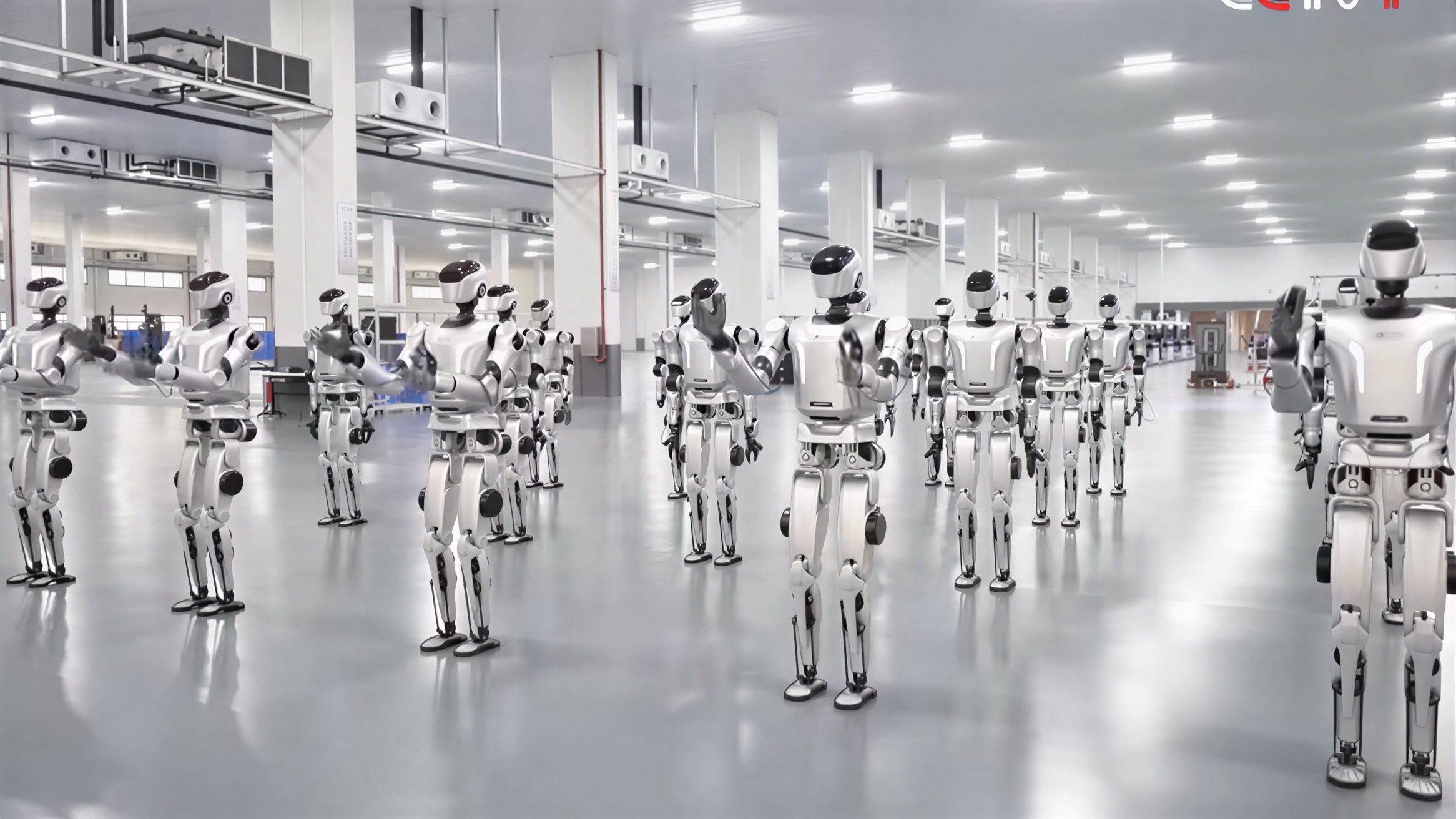
China just hit a manufacturing milestone that could reshape robot pricing forever. A new automated production facility in Foshan, Guangdong province, cranks out one humanoid robot every half hour—targeting 10,000 units annually at unprecedented scale.
Mass Production Meets Precision Engineering
This facility transforms humanoid robotics from boutique craft to industrial commodity.
The facility runs like a precision Swiss watch, if Swiss watches involved 24 digitalized assembly stages, 77 inspection checkpoints, and 41 simulated work-condition tests per robot. This joint venture between Leju Robotics and Dongfang Precision Science & Technology reportedly boosts efficiency by over 50% compared to traditional manufacturing methods.
You’re looking at the kind of systematic approach that transformed smartphone production from boutique craft to mass commodity. The scale represents a fundamental shift from prototype development to genuine industrial manufacturing.
The Numbers Game Gets Serious
Chinese robotics companies are betting billions on robot ubiquity becoming reality.
Competition in China’s humanoid robot sector resembles a high-stakes manufacturing arms race:
- Unitree Robotics just secured $580 million in funding to build a 75,000-unit facility
- UBTECH targets sub-$20,000 unit costs for 5,000 robots yearly
- Agibot recently celebrated its 10,000th robot milestone
These aren’t garage startups anymore—they’re industrial powerhouses with serious production capabilities and investor backing.
Flexibility Drives Real-World Applications
The production line adapts to multiple robot models without complete retooling.
The Foshan line uses automated guided vehicles and digital controls for multi-model switching without complete retooling. Target markets include:
- Automotive assembly
- Home appliance manufacturing
These applications focus on repetitive tasks humans prefer avoiding.
The flexible design suggests manufacturers expect diverse robot form factors rather than one-size-fits-all solutions for different industrial applications.
Breaking Down the Accessibility Barrier
Mass production traditionally drives down costs—robotics could follow the same trajectory.
Mass production traditionally drives down costs—remember when flat-screen TVs cost $10,000? Similar price trajectories for humanoid robots could potentially reach consumer-friendly ranges within the next decade, according to industry reports.
You’re witnessing the transition from prototypes gathering dust in research labs to actual production lines shipping units to real customers. This manufacturing milestone signals robotics moving from science fiction curiosity to industrial reality.