Phase noise has been the invisible enemy of high-frequency wireless for decades. Above 350 GHz, traditional electronic systems turn into jittery, power-starved disasters that barely manage a few gigabits per second. Japanese researchers just obliterated that barrier, hitting 112 Gbps at 560 GHz using an ingenious photonic approach that could reshape 6G infrastructure.
Think downloading multiple 4K movies in the blink of an eye—except this isn’t coming to your phone anytime soon. This is backbone tech, the invisible fiber connecting tomorrow’s cell towers.
The 560 GHz Breakthrough That Changes Everything
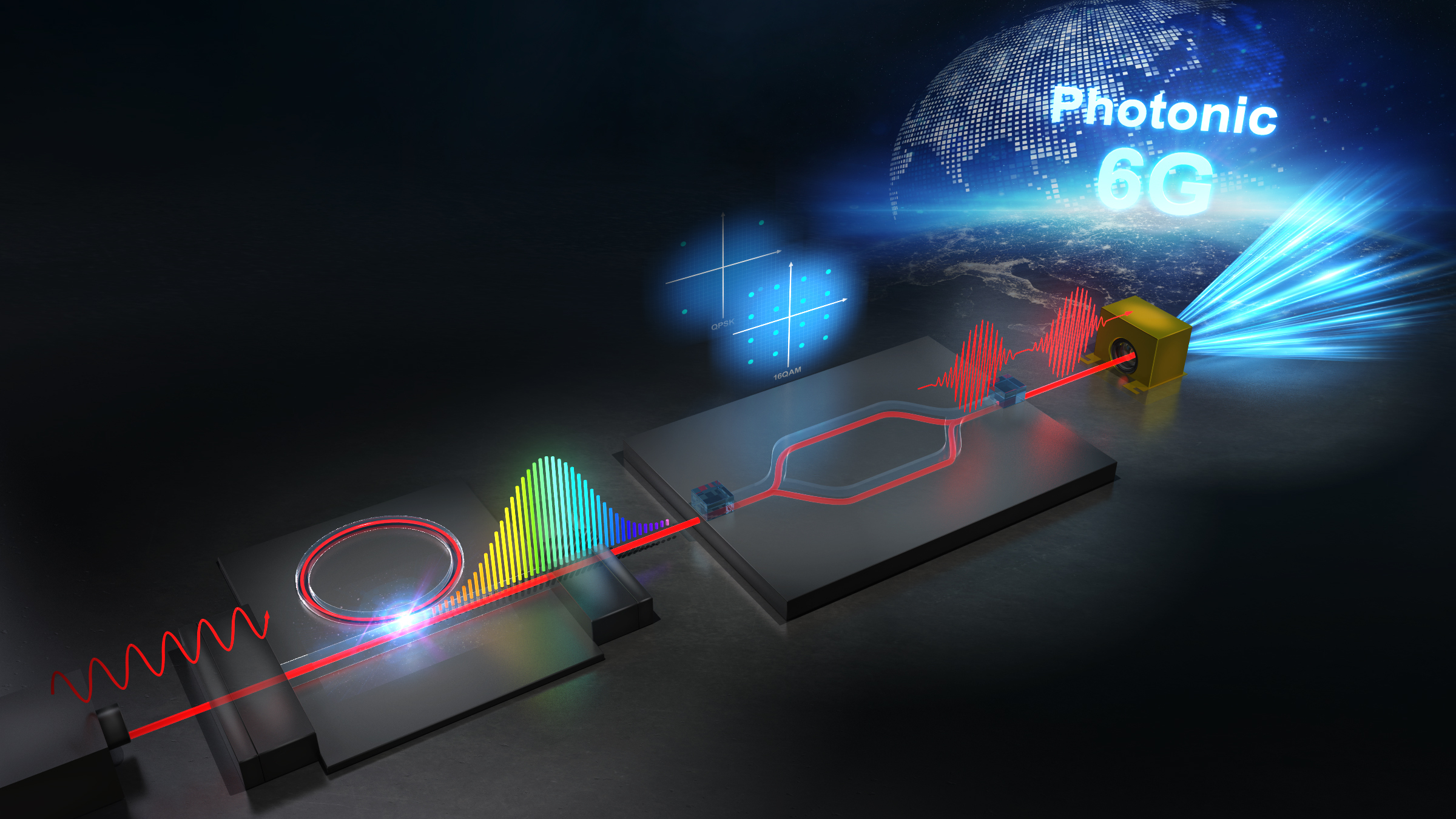
Microcombs solve the phase noise problem that has plagued terahertz wireless for years.
Teams from Tokushima University, University of Tokyo, and Gifu University cracked the terahertz code using soliton microcombs—essentially optical rulers that split laser light into incredibly stable, evenly spaced frequency lines. These microcombs generate ultra-low-noise carriers that sidestep the fundamental limitations plaguing electronic THz sources.
The system achieved:
- 84 Gbps using QPSK (quadrature phase-shift keying) modulation
- 112 Gbps with 16QAM (16-state quadrature amplitude modulation)
Both at a 560 GHz carrier frequency that overwhelms conventional electronics. This marks the first time anyone has crossed 100 Gbps beyond 420 GHz, according to research published in Nature’s Communications Engineering.
“This result represents a major step toward practical 6G wireless systems and ultra-high-speed mobile backhaul,” said Prof. Takeshi Yasui of Tokushima University. The keyword here is “practical”—previous THz demos were impressive but fragile lab curiosities.
From Lab Bench to Real Infrastructure
Ruggedized microcombs shrink to fingernail size while maintaining stability for actual deployment.
The breakthrough isn’t just raw speed—it’s packaging that could survive real-world conditions. The researchers permanently bonded optical fiber directly onto silicon nitride microcombs, preventing the alignment drift that kills lab setups. Add thermal regulation and climate-proofing, and you get a fingernail-sized device stable enough for actual infrastructure.
This targets 6G backhaul applications where laying fiber is impractical or expensive. Dense urban small cells, temporary event networks, remote installations—scenarios where you need fiber-class capacity without actual fiber. The catch? These are line-of-sight, short-range links, not wide-area consumer service.
Your phone won’t use 560 GHz directly, but the cell tower serving you might connect via this tech. Faster backhaul translates to more consistent multi-gigabit service, especially in bandwidth-hungry applications like real-time cloud gaming or 8K streaming.
The timeline remains realistic: 6G standards won’t finalize until the late 2020s, with commercial deployment following years later. This research provides a crucial building block for next-generation network infrastructure, addressing the growing demand for ultra-high-capacity wireless links that will power tomorrow’s connected world.