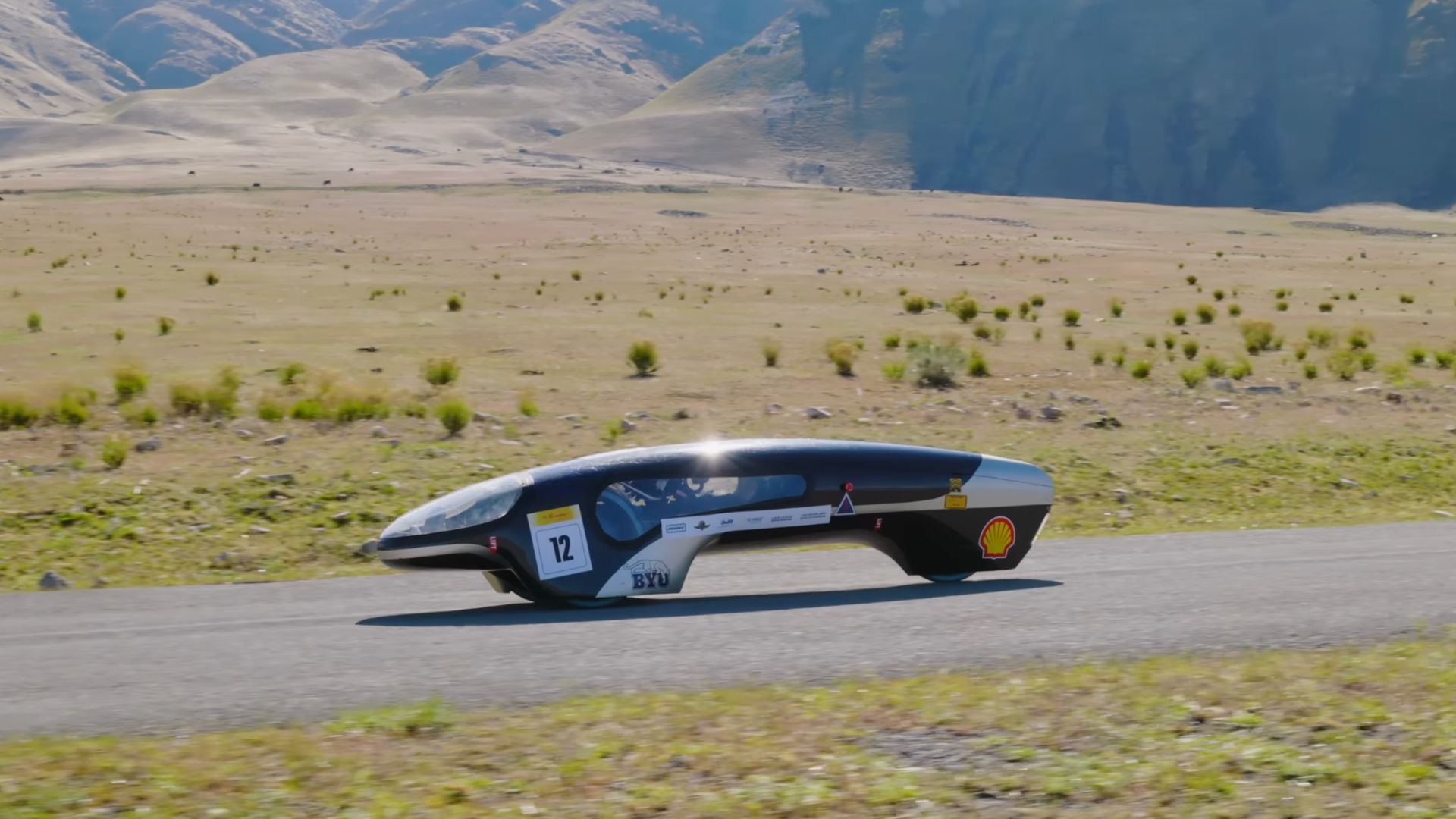
BYU engineering students just achieved what sounds like a typo: 2,145 miles per gallon. Their carbon-fiber racing machine dominated the Shell Eco-marathon at Indianapolis Motor Speedway, turning 30 milliliters of ethanol into a ten-mile victory lap that embarrassed 79 other teams.
This Isn’t Your Daily Driver
The three-wheeled vehicle weighs 108 pounds and requires drivers under 5’4″ and 120 pounds.
Before you start planning your commute, understand what “car” means here. This three-wheeled carbon-fiber pod weighs less than most college students and tops out at 23 mph. The cockpit barely accommodates someone who could fit in an airplane overhead bin.
Think Formula 1 meets origami, designed by engineers who worship at the altar of aerodynamics. You’re looking at a competition machine built for one purpose: proving that extreme efficiency is possible when every gram matters.

Ethanol Strategy Pays Off
The team chose ethanol over gasoline for its compression advantages despite lower energy density.
While most teams stick with gasoline, BYU’s 20-person engineering squad went rogue with ethanol. Sure, it packs less energy per gallon, but ethanol tolerates higher compression ratios—crucial when you’re optimizing every molecule of fuel.
The choice paid off spectacularly, beating second place by 122 mpg and third place by nearly 900 mpg. Those margins aren’t close calls; they’re engineering statements.
Competition Precision Rules Everything
Shell Eco-marathon demands standardized conditions that turn efficiency into a pure engineering sport.
This isn’t highway driving or even city commuting. Shell Eco-marathon creates laboratory conditions where 80 teams compete under identical rules on a controlled course. Think esports for mechanical engineers—every variable controlled except pure design brilliance.
BYU’s team spent months perfecting weight distribution, airflow management, and drivetrain efficiency like they were speedrunning thermodynamics.
Engineering Collaboration at Its Peak
Twenty students were divided into specialized teams to optimize every component of the ultra-efficient vehicle.
Club president Camille Nobrega described how the final sprint brought the team closer together, turning late-night lab sessions into shared obsession. Different subgroups tackled body panels, drivetrain tuning, and weight optimization—each component requiring mechanical engineering precision that would make NASA proud.
Faculty advisor Dale Tree emphasized the collaborative nature: this wasn’t one genius building a car, but systematic teamwork pushing efficiency boundaries to absurd extremes.