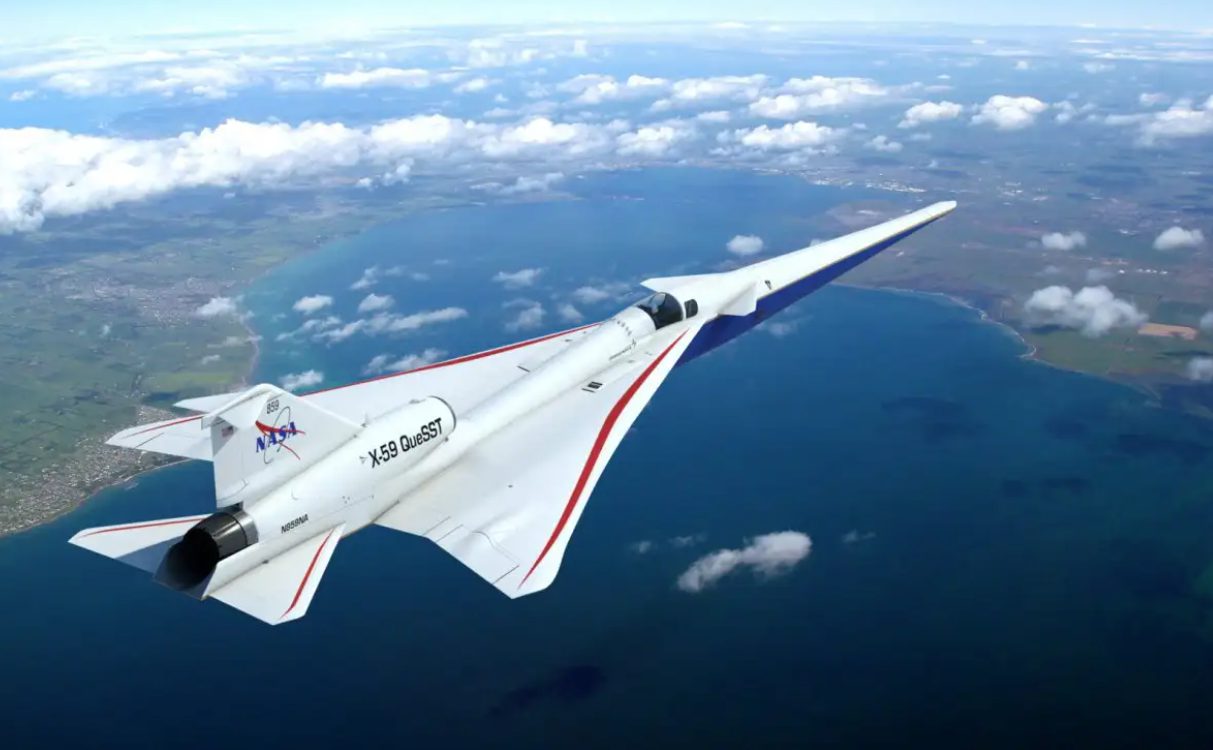
Racing through California’s Mojave Desert at 627 mph, NASA’s X-59 just proved supersonic flight might finally escape its regulatory prison. The experimental aircraft recently completed its most aggressive test flight yet—executing controlled aerobatic maneuvers at 43,000 feet and near-supersonic speeds that would make Top Gun pilots jealous.
From Cautious Crawl to Near-Supersonic Sprint
Nine test flights transformed the X-59 from a 230 mph experimental curiosity into a legitimate supersonic aircraft candidate.
The April 14, 2026 test flight marked a dramatic escalation from the X-59’s cautious October 2025 debut, when pilot Nils Larson barely pushed the needle-nosed aircraft past 230 mph at a conservative 12,000 feet. Six months later, the same aircraft was pulling “rollercoaster” pitch oscillations and bank-to-bank auto rolls while cruising at Mach 0.95—essentially the doorstep of supersonic flight.
These aren’t just fancy flying demonstrations. Each maneuver serves a specific purpose:
- Flutter excitation tests prevent catastrophic structural vibrations at high speeds
- Landing gear deployment maneuvers measure how dramatically extended wheels alter the aircraft’s aerodynamics
NASA’s methodical envelope expansion approach validates that the 99.7-foot aircraft can safely handle the extreme conditions needed for its ultimate mission.
Solving the 50-Year Sonic Boom Problem
The X-59’s radical acoustic engineering could end the regulatory barrier that’s kept supersonic civilian flights off continental routes since 1973.
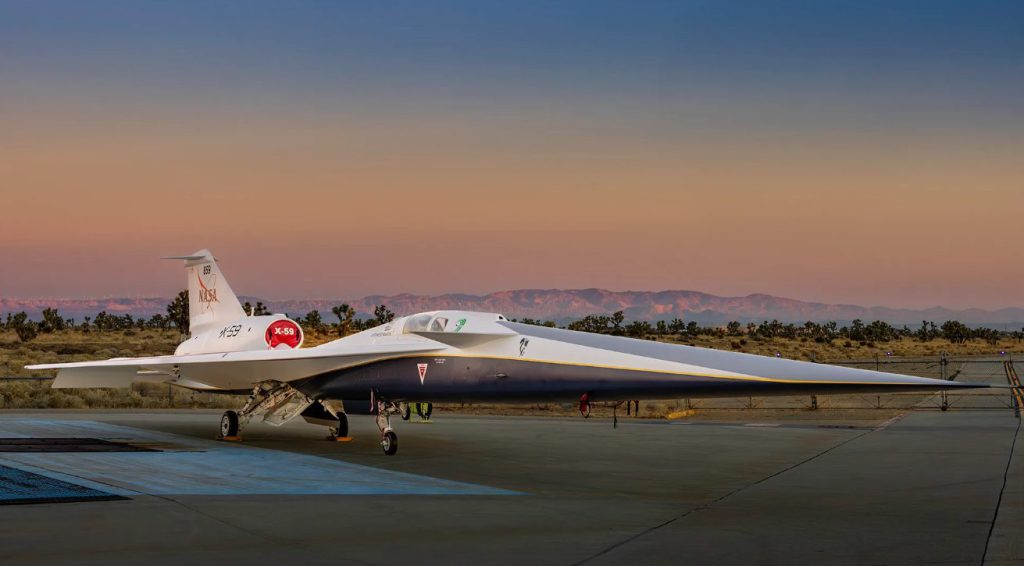
Conventional supersonic aircraft create that signature explosive “double-bang”—the reason your transcontinental flights still crawl along at subsonic speeds instead of cutting travel time in half. The X-59’s engineers took a different approach, stretching nearly half the aircraft’s length into an elongated nose that spreads pressure waves across time and space rather than creating discrete shock waves.
Combined with strategic engine placement on the upper fuselage, this acoustic shaping transforms the ear-splitting sonic boom into what NASA calls a “sonic thump“—potentially quiet enough to satisfy noise-conscious regulators. If community overflight testing confirms residents can tolerate the quieter signature, the FAA could lift restrictions that have forced supersonic aircraft onto oceanic-only routes since the Concorde era. While supersonic aircraft face such challenges, hypersonic missiles operate at even more extreme velocities with different acoustic signatures.
Commercial Aviation’s Next Chapter
Successful X-59 testing could unlock a new era where New York to London flights drop from seven hours to three and a half.
The X-59’s $518 million development represents more than aerospace engineering—it’s a regulatory Trojan horse designed to generate the empirical data needed to overturn decades of supersonic flight restrictions. NASA plans community noise surveys across selected U.S. locations, collecting human response data that could convince regulators to establish new noise-based standards by 2027. Your future transcontinental flights might finally match the Jetsons’ promises, assuming the X-59 can prove that supersonic doesn’t have to mean ear-splitting. Meanwhile, other aviation innovations like the Phantom 3500 are exploring different approaches to revolutionizing air travel efficiency.