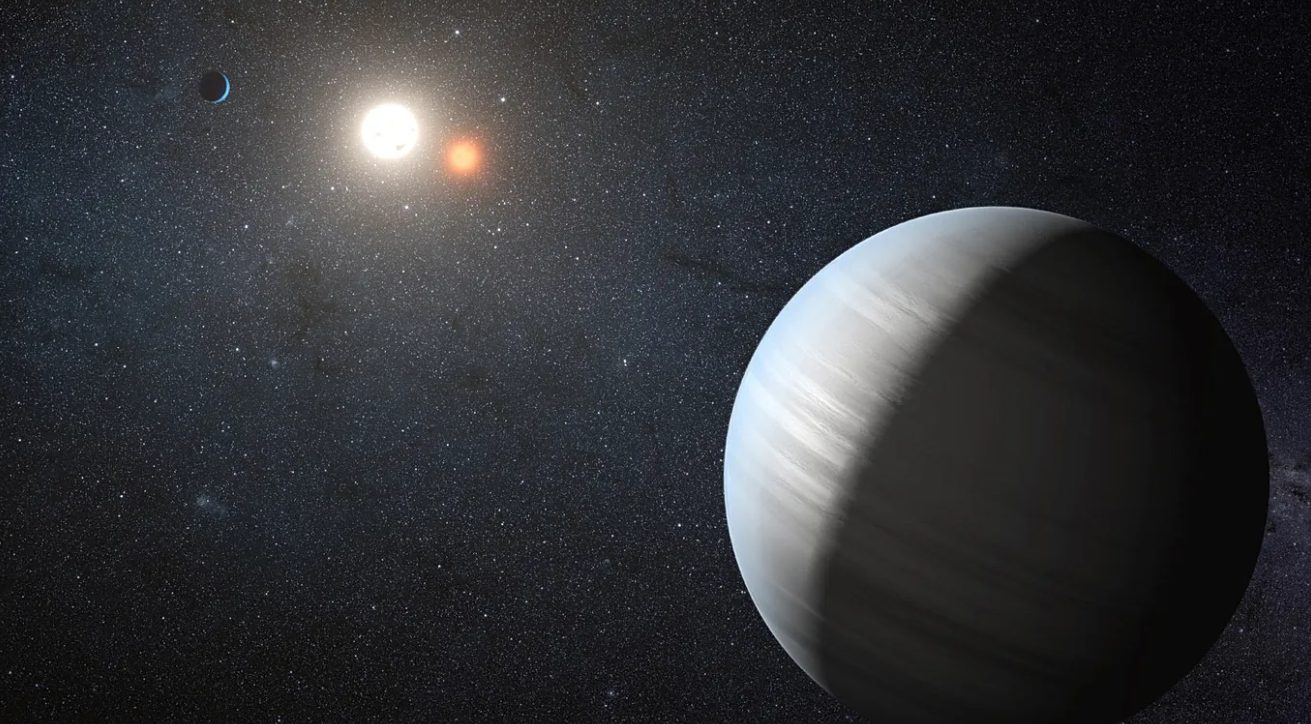
Remember Luke Skywalker watching twin suns set on Tatooine? That iconic scene just became more scientifically plausible. Researchers analyzing NASA’s TESS satellite data have potentially identified candidate planets orbiting binary star systems—worlds that could exist in configurations similar to the famous fictional desert planet.
These hidden planets emerged through detective work rather than direct observation. Traditional transit methods spot planets when they pass directly between their star and Earth, creating tiny dips in brightness. But circumbinary planets often orbit at angles that never align for transits, keeping them invisible to conventional searches.
Eclipse Timing Reveals Gravitational Secrets
The discovery method analyzed timing irregularities in eclipses from binary star systems using NASA’s TESS satellite data. When an unseen planet orbits a binary pair, its gravitational pull causes subtle shifts in eclipse timing—like detecting an invisible person by watching shadows move unexpectedly.
This approach represents a significant advancement over traditional detection methods. Researchers filtered through astronomical data to identify systems with initial timing signals. After ruling out effects from stellar spin, tidal forces, and general relativity, potential planet candidates remained for further investigation.
Worlds Beyond Our Solar System’s Blueprint
Circumbinary planet detection continues expanding our understanding of planetary systems beyond single-star configurations like our own solar system. The timing method reveals planets that exist in orbital arrangements where traditional transit detection fails.
This discovery challenges planetary formation theories built around single-star systems like ours. Computer simulations suggest binary star disks may actually foster more giant planet formation through fragmentation processes—turning the “stable single star” assumption on its head.
Follow-up observations using spectroscopy and radial velocity measurements will help determine which candidates represent confirmed planets. This timing method promises to uncover more circumbinary worlds hiding beyond traditional detection limits, expanding our cosmic neighborhood in ways that would make George Lucas proud.
The potential for planets around binary stars opens new questions about habitability and planetary formation. As detection methods improve, we may discover that worlds with two suns are far more common than previously imagined.