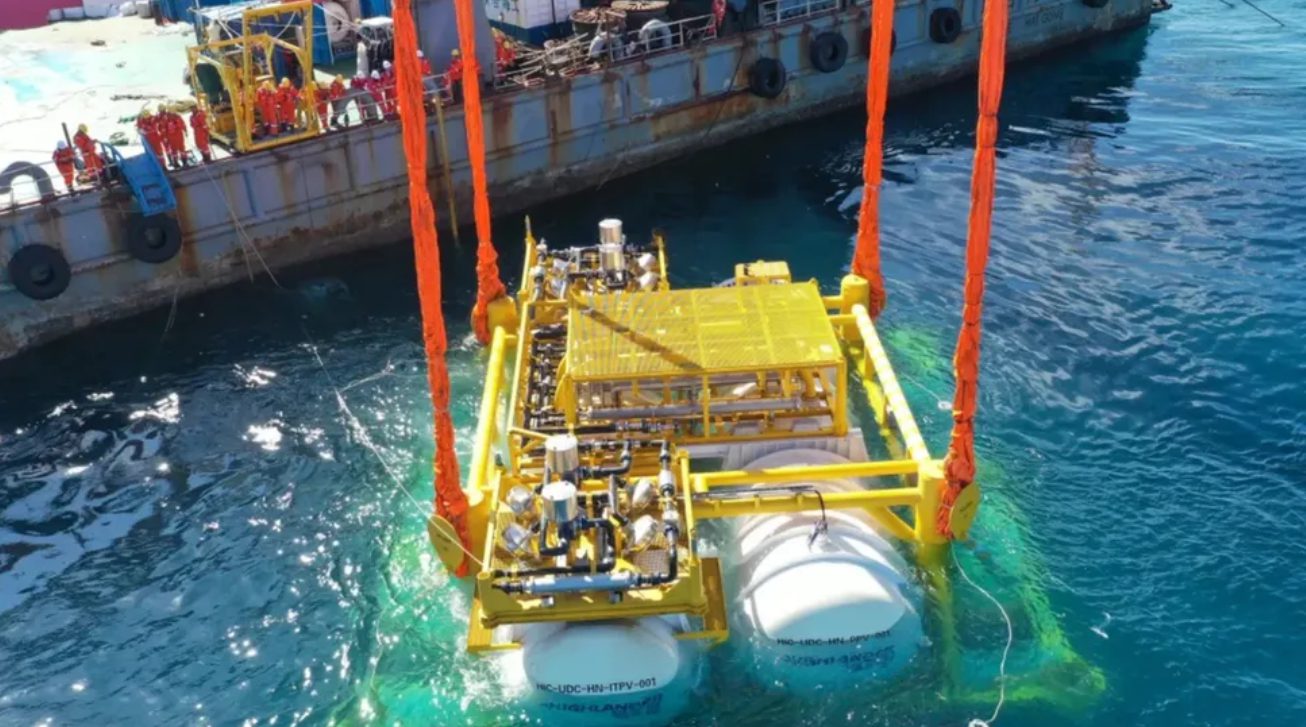
Offshore wind powers underwater data center in world-first experiment that Microsoft abandoned. China just flipped the switch on something that sounds like sci-fi fever dream: 2,000 servers humming away 35 meters underwater off Shanghai, powered by offshore wind turbines. While tech giants burn through electricity like it’s going out of style to feed AI’s insatiable appetite, China decided to literally sink its data center into the ocean.
Seawater Becomes the World’s Biggest Heat Sink
Natural cooling eliminates the energy-hungry chillers that typically devour 40% of data center power.
The 24MW facility in Shanghai’s Lingang Special Area houses GPU clusters for AI training and 5G workloads inside pressure-resistant pods. Chinese officials report this underwater approach achieves a power usage effectiveness below 1.15—dramatically better than the 1.5+ typical for land-based centers.
The secret sauce? Seawater acts as a massive, free cooling system. No chillers, no cooling towers, no freshwater consumption. Just the ocean doing what it does best: absorbing heat.
Project sponsors claim 95% of the facility’s power comes from co-located offshore wind turbines, creating what amounts to a closed-loop green energy system. The setup reportedly cuts overall power consumption by 22.8% compared to equivalent land facilities.
Microsoft Tried This First, Then Walked Away
Project Natick proved the concept worked but commercial reality proved different.
This isn’t entirely uncharted territory. Microsoft’s Project Natick deployed 855 servers underwater off Scotland in 2018, discovering that failure rates dropped to just 0.7%—one-eighth the rate of comparable land-based facilities. The controlled, sealed environment eliminated dust, temperature swings, and human interference that plague traditional data centers.
Yet Microsoft shuttered Natick in 2024, citing high costs and deployment challenges despite technical success. That makes China’s commercial push particularly bold—or potentially naive, depending on how you read the market conditions.
The Maintenance Reality Check
When servers fail underwater, you can’t just walk down the hall with a screwdriver.
Here’s where underwater data centers get interesting: maintenance means hauling entire modules to the surface. No late-night server swaps or quick cable fixes. The design philosophy assumes years of operation without human intervention, relying on high redundancy and remote monitoring.
Think of it as the data center equivalent of deep space missions—once it’s deployed, you better hope everything works.
China’s betting this trade-off makes sense as AI workloads demand ever more cooling power and renewable energy integration becomes mandatory, not optional. Whether that bet pays off could reshape how we think about the infrastructure powering our digital lives.