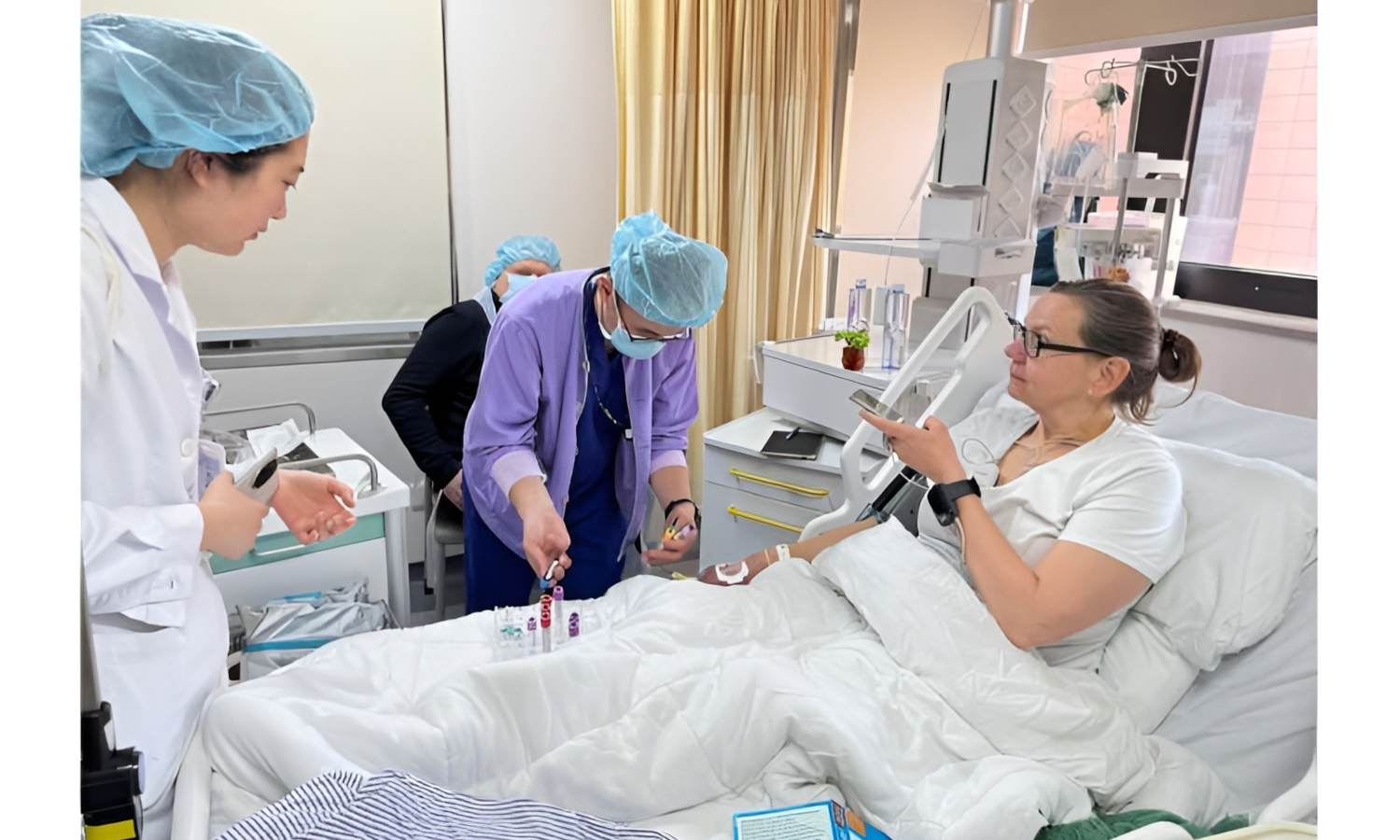
For the first time, a liver biopsy has confirmed that base editing corrected the disease-causing genetic mutation in a living human liver. That tissue-level evidence goes beyond what a blood test alone can show.
The case was published in the Journal of Hepatology by investigators from Hannover Medical School and Renji Hospital in Shanghai. It centers on a patient with severe PiZZ alpha-1 antitrypsin deficiency (AATD), the form of the disease in which a mutation in the SERPINA1 gene causes liver cells to produce a misfolded protein that damages the liver and reduces the circulating functional protein the lungs depend on for protection.
What Base Editing Actually Does
Base editing chemically alters a single DNA letter inside a living cell without introducing a programmed double-strand DNA break, distinguishing it from older gene-editing approaches.
Unlike conventional methods that add a working gene copy through a viral carrier, base editing is designed to correct the original mutation directly. The goal is precision repair at the source.
High correction efficiency was confirmed at the lowest planned dose. No detectable bystander edits or off-target alterations were found in the analyzed biopsy sample.
Biopsy analysis offers a direct genomic readout from treated tissue. That makes it a stronger form of evidence than protein measurements in the bloodstream alone.
The Mosaic Result Explained
After treatment, the patient’s liver cells shifted from a uniformly disease-causing state to a mixture of corrected and partially corrected cells.
After treatment, the patient’s liver cells were no longer uniformly PiZZ. The result was a mosaic: a mixture of fully corrected PiMM cells, partially corrected PiMZ cells, and unedited PiZZ cells.
PiMZ is generally not associated with the severe disease phenotype linked to PiZZ. Even partial correction across a substantial portion of liver cells may therefore carry meaningful clinical weight, though the case does not prove that mosaic correction has already reduced liver or lung disease risk.
The patient developed stable, clinically meaningful blood levels of functional AAT protein following treatment. This suggests the edited cells resumed productive protein synthesis, though it remains a supported inference rather than a direct observation of every producing cell.
Interim Trial Data and Its Limits
Separately reported company data from four participants showed early correction signals, but those figures require independent validation before broader conclusions are warranted.
Separate interim data from four participants, reported by the company associated with the investigational therapy, included one biopsy showing 54% target-site correction at 10 weeks. No treatment-related grade 3 or higher adverse events were recorded at the data cutoff.
Those figures require continued independent clinical validation. One published biopsy case cannot establish durability, population-level efficacy, or the absence of rare adverse effects over longer follow-up.
The finding of no detectable off-target alterations applies to the reported analysis and follow-up period, not to long-term or population-wide safety. Lung disease outcomes are not yet established by the available evidence.
What This Is Not
This therapy remains investigational and is not a substitute for currently approved or established AATD care.
The treatment is not an approved alternative to augmentation therapy. It does not replace liver transplantation as the current standard for advanced AATD-related liver damage, and patients should not interpret this report as a signal that an approved treatment is imminent.
Where the Research Goes Next
Investigators say the same liver-targeted platform could eventually be adapted for other hereditary liver disorders, pending further trial evidence.
Investigators say the base-editing platform could be adapted for other hereditary liver disorders, including certain coagulation diseases and rare single-gene variants with very small patient populations. The work also underscores liver biopsy as a potentially critical tool for assessing editing precision in human gene-editing trials.
Hannover Medical School has indicated plans to initiate a clinical program in Germany, with reporting pointing to 2027 as the target for that effort. For now, the published case represents an early proof of concept. Larger trials and longer follow-up will determine whether that early promise holds.