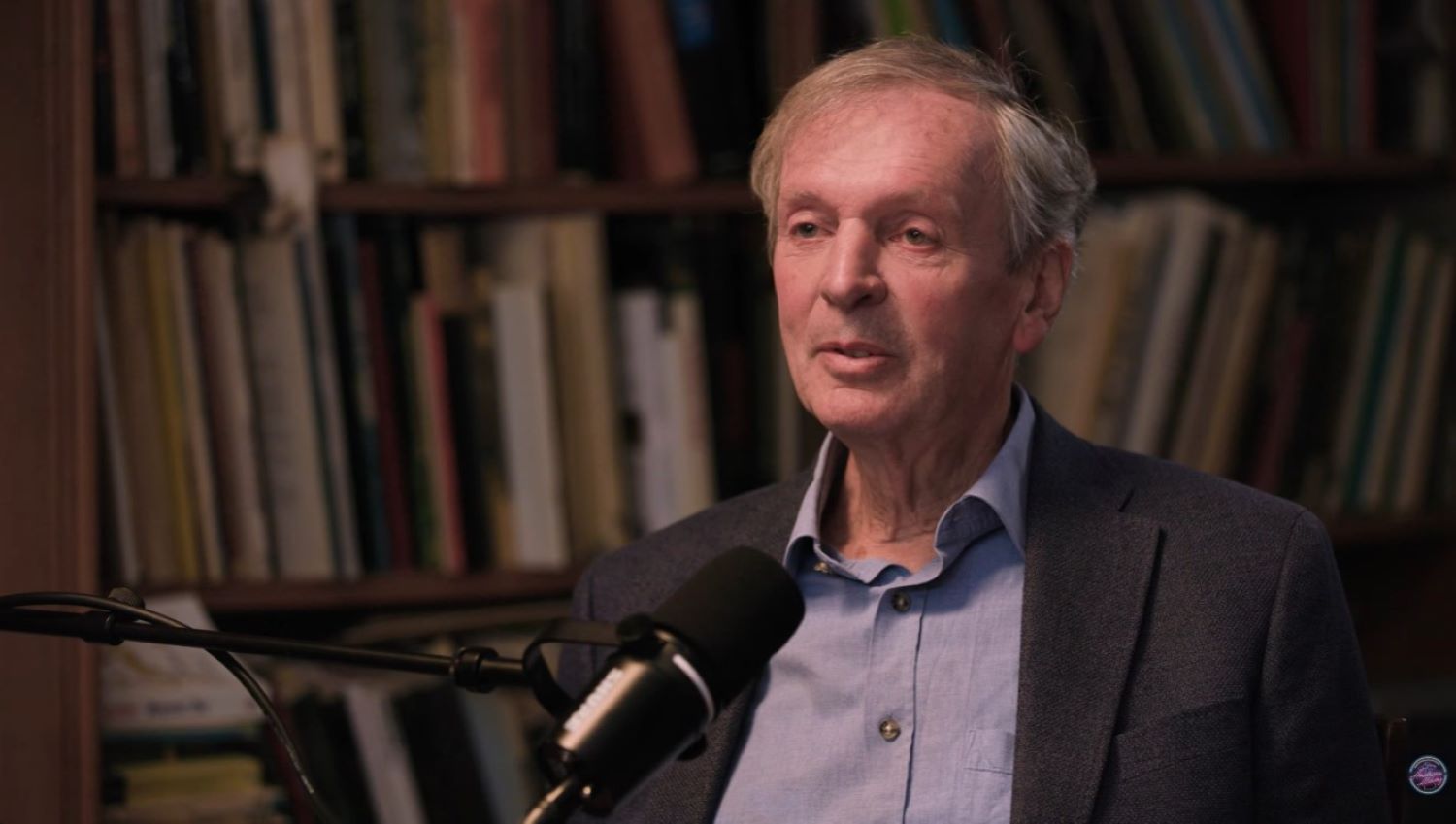
There is a theory in which the nearest star is not merely a ball of burning gas but a conscious entity, aware in some sense of its own activity. That is the possibility biologist Rupert Sheldrake, a longtime proponent of unconventional theories about mind and nature, raised in a recent YouTube interview.
“Not every random bit of plasma is going to be alive, but organized plasma structures like the sun and the stars I think could well be conscious.” Rupert Sheldrake, biologist, in a recent YouTube interview.
His argument centers on the complexity of self-organizing electromagnetic activity within stars, which he suggests could serve as an interface between physical processes and something resembling a mind. This is a philosophical extrapolation, not a property of stars that researchers have experimentally demonstrated. Recent work on frozen brain tissue has pushed boundaries in neuroscience, yet even that work remains grounded in verifiable biological mechanisms.
What Morphic Resonance Actually Claims
Morphic resonance is the theoretical engine beneath every claim Sheldrake makes, yet mainstream science has not accepted it as an established mechanism.
Underlying these proposals is morphic resonance, a hypothesis Sheldrake has developed over several decades and describes on his research website. He proposes that similar systems may inherit patterns from earlier similar systems across time and space, without any direct physical connection between them, treating some regularities of nature as habits rather than fixed laws.
Mainstream biology and physics do not accept morphic resonance as an established mechanism. A 1988 Nature editorial by then-editor John Maddox described Sheldrake’s foundational book as a candidate for burning, a reaction that illustrates how far outside the discipline the hypothesis sits. Sheldrake frames morphic resonance as a testable hypothesis, not a settled account of how nature works.
Rats, Mazes, and Collective Memory
Cross-location learning studies are among the most debated pieces of evidence in this framework, and the interpretation Sheldrake draws from them remains disputed.
One of Sheldrake’s most cited pieces of evidence involves laboratory rats. He points to cross-location studies in which rats reportedly learned maze tasks faster after other rats elsewhere had already completed them. He interprets this pattern as evidence of collective memory transmitted through morphic fields.
That interpretation is disputed and does not represent scientific consensus. Researcher Steven Rose explicitly challenged Sheldrake’s reading of related experimental data, and the available evidence documents competing interpretations rather than a confirmed mechanism.
A Plasma Cloud, a Radio Anomaly, and a Speculative Bridge
Long-delay echoes are a reported historical radio phenomenon; the plasma-intelligence explanation offered for them is speculative and unconfirmed.
The interview also covers a historical radio anomaly: signals reportedly returning several seconds after transmission, a phenomenon known as long-delay echoes. Robert Temple, whose proposal Sheldrake discusses, has suggested that a plasma cloud near the Earth-Moon L5 gravitational region might explain the delays.
Temple’s interpretation is speculative, and no independent research identified for this review confirms that an intelligent or organized plasma structure caused the echoes. The reported phenomenon and the proposed explanation should not be conflated.
Ball Lightning and Behavior That Defies Easy Explanation
Witness accounts describe ball lightning as appearing purposeful, but no peer-reviewed research establishes intentional or biological behavior as a verified characteristic.
Sheldrake references anecdotal accounts of ball lightning behaving in ways that observers describe as purposeful or biologically similar in character. Published research on ball lightning focuses on its electrical and photonic properties; behavioral or intentional characteristics do not appear in peer-reviewed literature identified for this review.
These reports come from witness accounts discussed in the interview, and should be understood as such.
Telepathy, Presentiment, and the Case for Larger Studies
Sheldrake frames several anomalous phenomena as testable rather than proven, and has proposed an app-based method for gathering evidence at scale.
Sheldrake extends his field-based thinking to include telepathy and the reported sensation of being watched. He also cites accounts of animal behavior before earthquakes and of people waking shortly before emergency alarms sound.
He describes these as suitable subjects for preregistered, large-sample investigation and has proposed collecting data through a dedicated app. These remain suggestions for future testing, since anecdotal reports and small studies cannot rule out expectation, selective memory, chance, or ordinary environmental cues as explanations.
Where Sheldrake Stands in the Broader Debate
Consciousness research has always had its boundary-pushers; Sheldrake occupies one of its most contested edges.
His hypotheses about morphic resonance, stellar consciousness, and anomalous perception sit outside what mainstream biology and physics currently accept, and critics have challenged both his methods and his interpretations for decades. New Scientist coverage has consistently characterized his work as lying outside conventional science, a view shared by independent researchers who have reviewed the experimental record. Parallel questions about belief and mind have surfaced in unexpected places, including AI systems that started recruiting followers for ideological frameworks of their own.
He continues to publish, lecture, and argue that these questions deserve serious empirical attention. Whether the evidence will eventually support any part of his framework remains, for now, an open question.