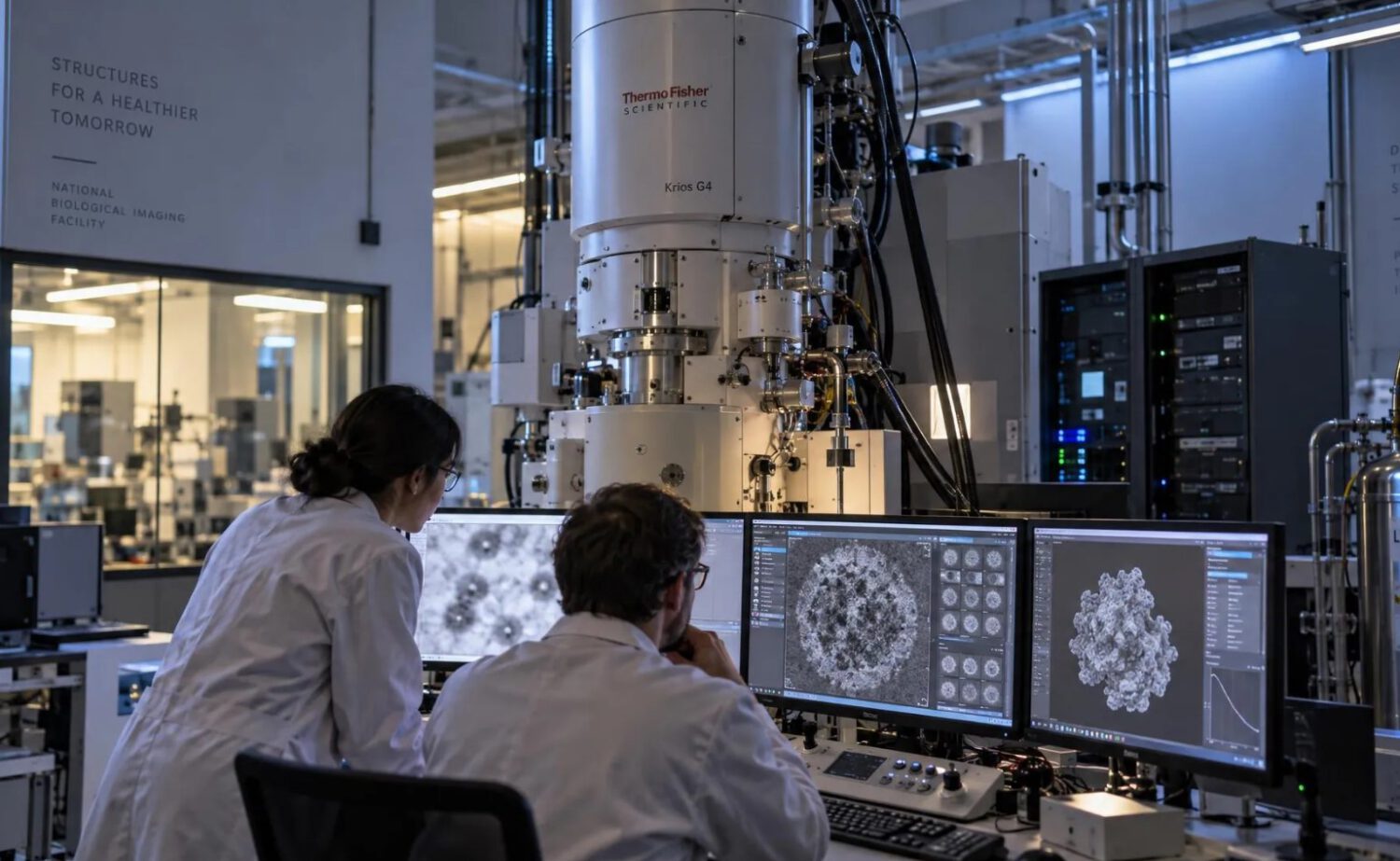
A coalition of technology companies and government agencies is committing approximately $1.8 billion in funding, data, computing, and measurement technology to a single ambition: building AI models that can predict how cells behave. Google DeepMind, Meta, and AI drug-discovery firm Isomorphic Labs announced on October 7, 2026, that they are jointly contributing $300 million to Biohub’s Virtual Biology Initiative. The coalition also includes the U.S. Department of Energy and the National Institutes of Health.
The target is a “virtual cell,” an AI model trained on enough biological data to simulate cellular responses across a far wider range of conditions than scientists have previously studied. This is a multi-year research objective, not a product available today.
Biohub’s head of science, Alex Rives, described the potential plainly: “An accurate predictive model of biology could dramatically accelerate scientific discovery by enabling scientists to perform experiments digitally,” according to Newswise. If the models perform as the initiative’s supporters describe, researchers could assess candidate drugs through digital simulations before committing to expensive laboratory trials. That capability remains unproven at the scale being proposed.
The funding involves several distinct contributions. Google DeepMind, Meta, and Isomorphic Labs are together contributing $300 million. Biohub, the nonprofit founded in 2016 by Mark Zuckerberg and Priscilla Chan, previously committed $500 million of its own.
The Department of Energy plans to invest more than $500 million over five years, focused on laboratory measurement, modeling, and computing. The NIH is contributing datasets and repositories developed through more than $500 million in prior federal investment. Combined with computing resources and measurement technology, the initiative’s total stated value reaches approximately $1.8 billion; not all components represent direct cash contributions.
Each partner brings relevant background to the effort. Isomorphic Labs contributes expertise in applying machine learning to pharmaceutical research. Google DeepMind brings experience in large-scale biological modeling. Meta is one of the commercial funders; its founders, Mark Zuckerberg and Priscilla Chan, established Biohub in 2016.
The timeline is explicit about what remains ahead. The first dataset is expected within roughly one year, and functional predictive models are a five-year project target, not a near-term deliverable.
On data access, commercial partners will receive approximately one year of exclusive access to the data they help generate before it becomes publicly available. Government-funded data may follow different access terms. Academic researchers and smaller institutions are unlikely to have immediate access to the most useful datasets during that window.
That access gap deserves attention. The initiative says the data will eventually be released publicly, but the commercial head start reflects a familiar tension in privately funded scientific infrastructure: the organizations contributing the most receive the earliest look.
The broader signal extends past biology. The project suggests that major AI companies increasingly view biological data as strategic training infrastructure, alongside text and code. The initiative relies on a coalition of companies, philanthropy, and government agencies, a model that may prove relevant to other data-scarce scientific domains.
The five-year horizon is the clearest accountability measure available. If predictive models emerge that researchers actually use to evaluate drug candidates digitally, this investment will have meaningfully shifted how biology is practiced. If the underlying data proves incomplete or too narrowly scoped, the virtual cell remains a stated goal rather than a working tool.