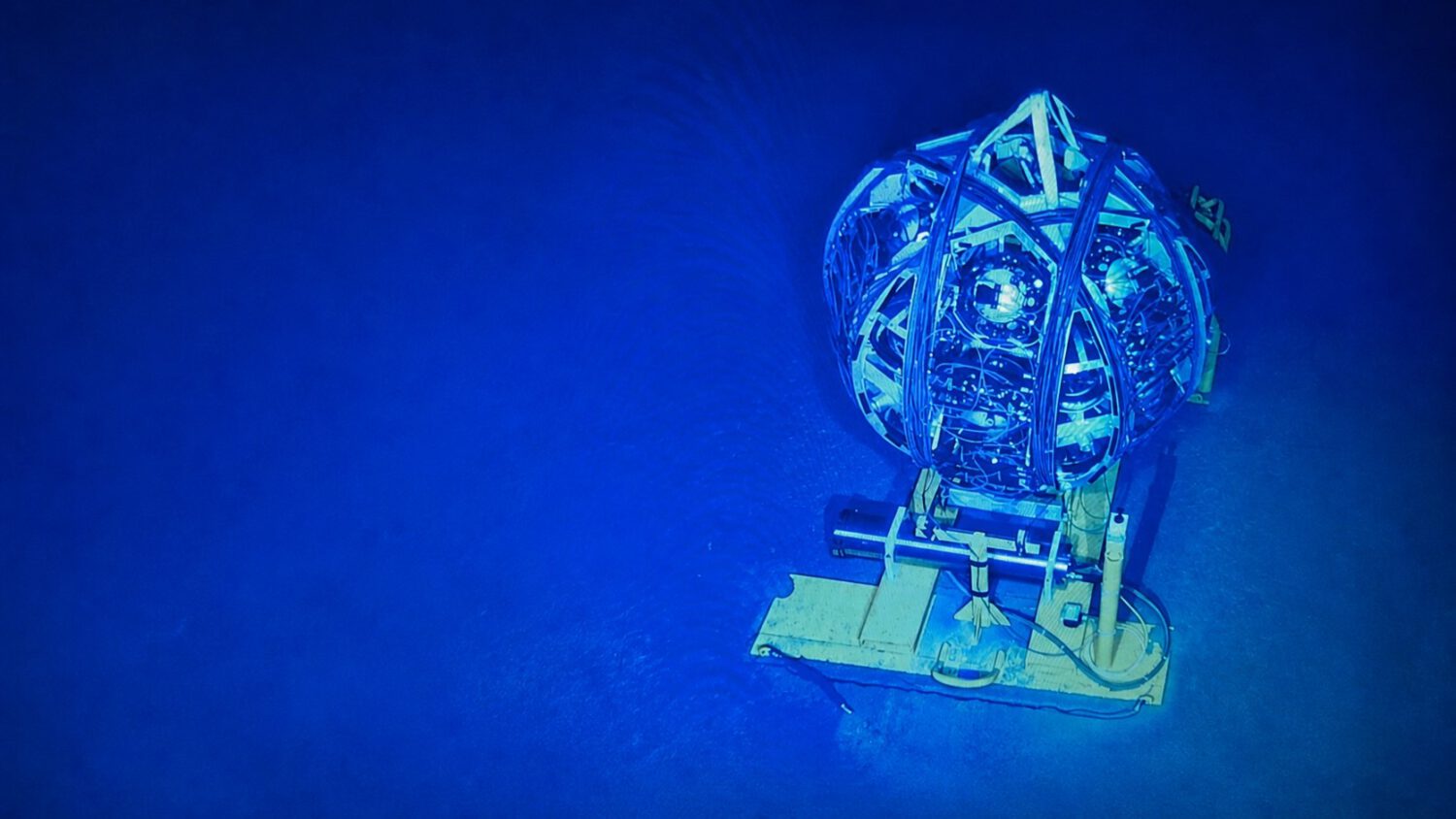
On February 13, 2023, a particle crossed through the Mediterranean Sea and into scientific history. It carried approximately 220 petaelectronvolts (PeV) of energy, an inferred figure representing roughly 30 times more than any neutrino previously recorded.
That number deserves a moment. One petaelectronvolt equals one quadrillion electron volts. At 220 PeV, this event sits in a class entirely its own.
KM3NeT published the findings in Nature on February 12, 2025, more than two years after the detection. The collaboration subjected the data to extensive analysis before publishing a claim of this magnitude.
What the Detector Actually Caught
A single high-energy muon triggered sensors across more than a third of the ARCA array, pointing researchers toward a parent neutrino of extraordinary energy.
The ARCA detector sits anchored to the seafloor off Sicily, roughly 3,450 meters underwater, where the deep Mediterranean reduces interference from background particles. When the particle passed through, it produced a muon, a heavier cousin of the electron, that activated over one-third of the detector’s active sensors. Researchers inferred a parent neutrino energy of approximately 220 PeV from that muon signal, though the directly reconstructed muon energy was 120 PeV with substantial uncertainty.
Neutrinos interact so weakly with matter that they travel across cosmic distances largely undisturbed. They arrive with their original direction and energy mostly intact, making them extraordinary messengers from the universe’s most energetic environments.
The KM3NeT collaboration named the event KM3-230213A and was direct about what one detection can and cannot establish.
The Problem With One Data Point
No confirmed electromagnetic counterpart has been identified, and the discrepancy with IceCube’s observations adds to the interpretive challenge.
The neutrino arrived without an obvious partner signal. No confirmed counterpart from the same direction has been identified in available follow-up data, which complicates any attempt to pin down a source.
IceCube, the other major neutrino telescope buried in Antarctic ice, did not detect a comparable event. Researchers note that differences in detector geometry, location, and exposure make direct comparisons difficult, but the discrepancy remains part of the scientific puzzle.
Four Candidate Explanations, One Confirmed Baseline
The proposed origins range from well-studied astrophysical sources to highly speculative theoretical constructions requiring several unconfirmed ingredients.
The most conventional explanation points to a blazar, an active galaxy whose relativistic jet happens to point toward Earth. Researchers have examined whether a population of blazars could account for the observed neutrino flux without exceeding gamma-ray observational limits.
A second proposal suggests the event was not caused by a conventional neutrino at all. One model argues that high-energy dark matter from a blazar could scatter inside Earth’s crust and mimic a muon signal, potentially explaining why IceCube recorded nothing comparable.
Primordial black holes, hypothetical objects that may have formed in the early universe, represent a third possibility. Their evaporation could theoretically produce ultrahigh-energy particles, though no primordial black hole has ever been directly identified.
The most speculative interpretation reportedly combines primordial black holes, cosmic strings, and an unconfirmed extra spatial dimension. In this scenario, a black hole formed through cosmic-string interactions in a hypothetical dark dimension could emit neutrinos into our observable universe. It would produce few or no accompanying photons. This model requires several unconfirmed theoretical ingredients working in concert, and KM3-230213A does not constitute evidence that an extra dimension has been detected.
What Comes Next
Resolving the origin of KM3-230213A will require additional detections, better directional data, and coordinated observations across multiple observatory types.
Additional detections at comparable energies, or a directional match to a known astronomical object, would help narrow the field. Correlated signals across gamma-ray, cosmic-ray, and gravitational-wave observatories could narrow it further.
No confirmed counterpart or additional event has yet established the source of KM3-230213A. A single detection opens the question; answering it will require more data.