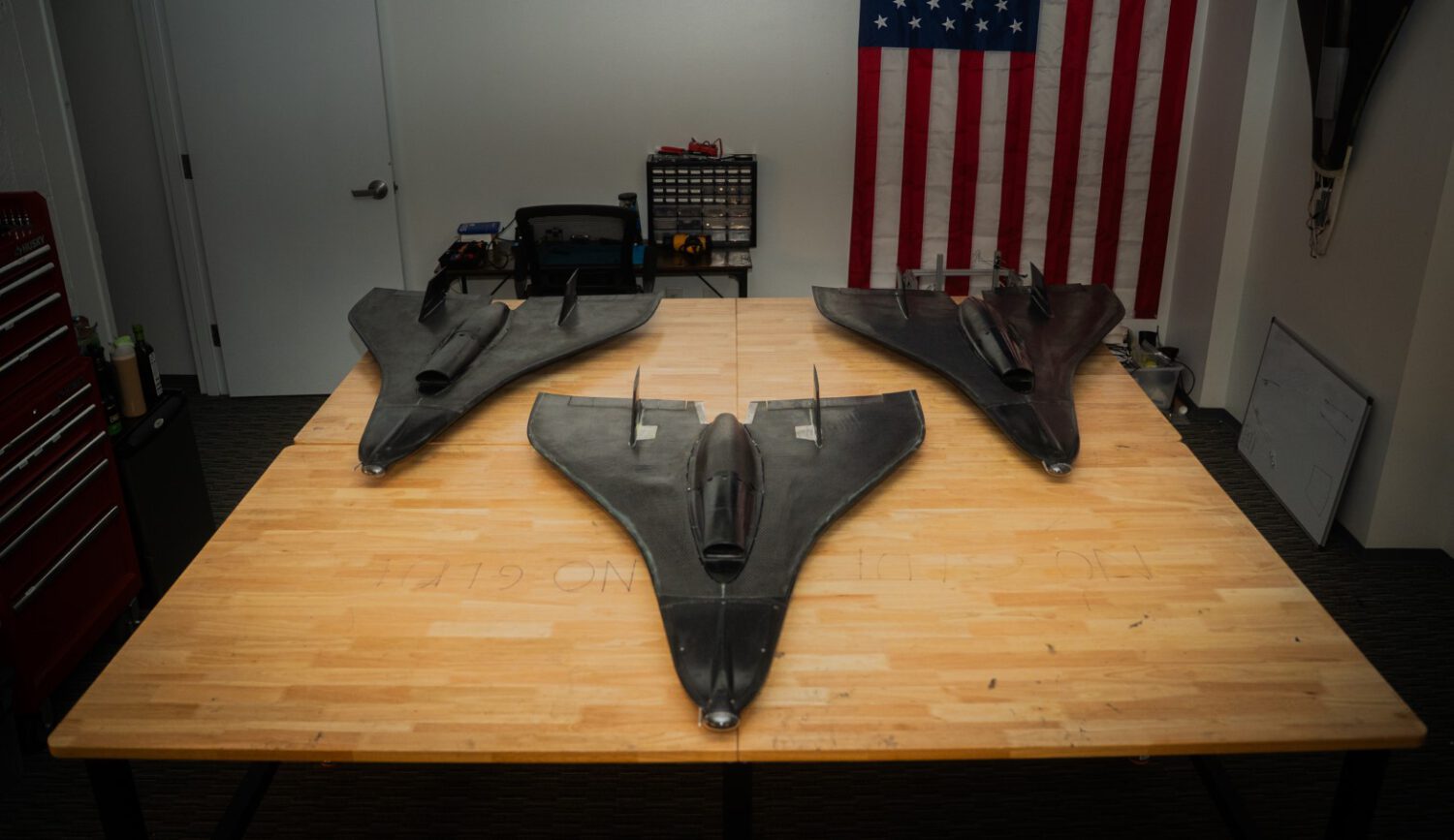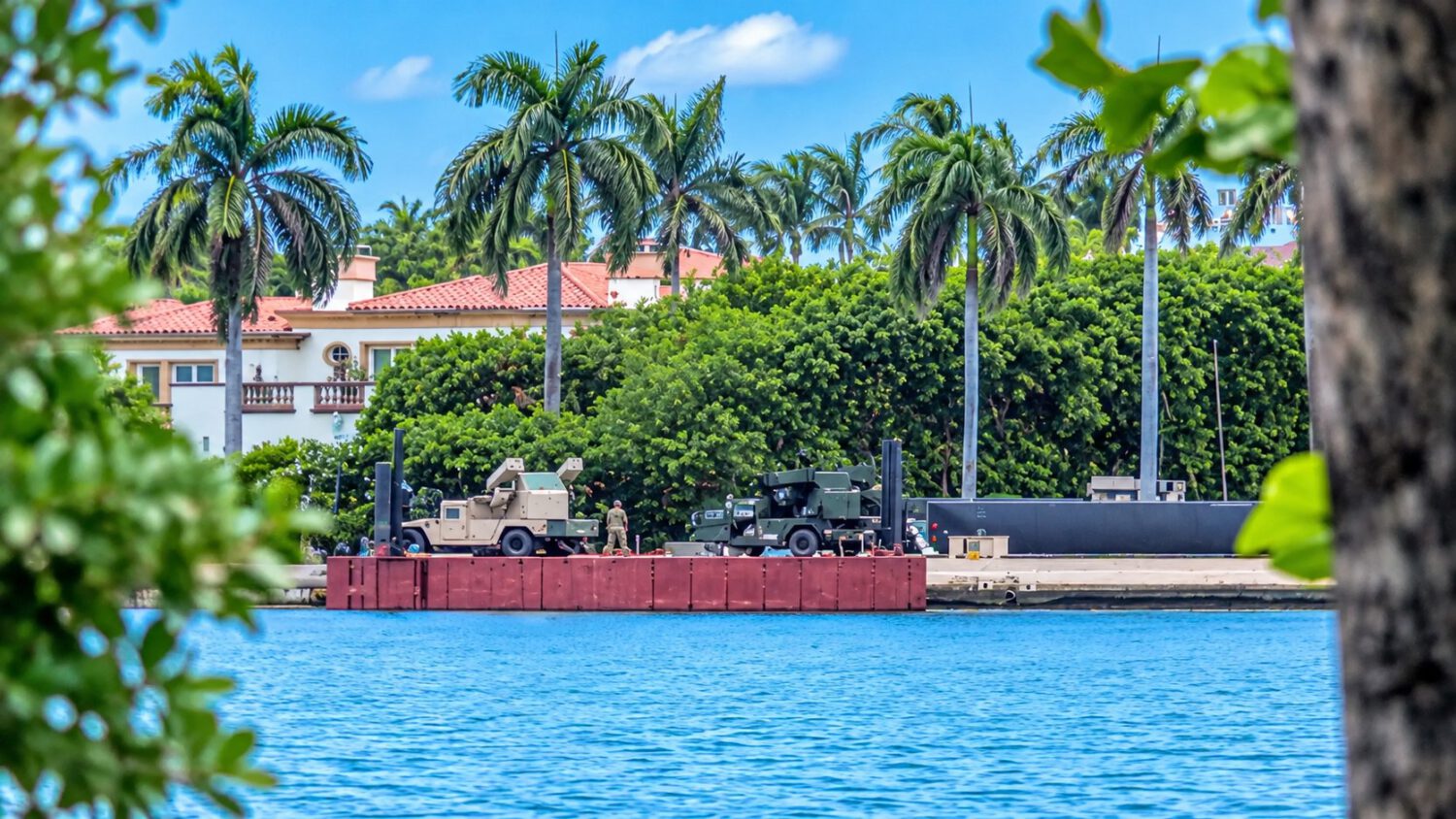
Photographs taken at Mar-a-Lago on October 31 revealed a JLTV-mounted AeroVironment LOCUST laser weapon system among the estate’s air defenses, a deployment now confirmed by NORAD and U.S. Northern Command.
NORAD and U.S. Northern Command confirmed that ground-based air-defense and counter-UAS capabilities had been deployed “in and around” the estate at the Secret Service’s request. The commands cited a heightened threat environment but withheld operational details for security reasons.
A Layered System, Not a Single Shield
The laser is one component inside a broader security architecture that includes missiles, radar, and electronic countermeasures.
The laser does not stand alone. Two AN/TWQ-1 Avenger short-range air-defense systems were positioned on a floating platform in Lake Worth Lagoon adjacent to the estate, with additional Avenger units reportedly deployed near Donald J. Trump International Airport, approximately three miles west.
Counter-UAS Fly-Away Kit components, including Ku-band radar, electronic-support measures, jammers, and infrared search-and-track sensors, round out the architecture.
What LOCUST Actually Does
LOCUST pairs a turret-mounted laser with optical and infrared cameras to find, track, and engage airborne targets.
The system can also receive target cueing from offboard sensors, allowing it to function as one node in a networked counter-drone operation rather than as an isolated weapon.
Why Pair a Laser With Missiles
The case for directed energy comes down to cost per engagement and the ability to sustain fire without reloading.
A laser’s effective magazine is replenishable as long as power and cooling hold, making it potentially lower-cost per engagement than a conventional interceptor when the target is an inexpensive commercial drone. Avenger systems remain available for threats outside the laser’s practical engagement envelope, including faster or more distant aircraft, such as hypersonic missiles.
The Limitations That Make the Rest of the System Necessary
Weather, range, power demands, and maintenance requirements mean a laser cannot operate effectively on its own.
A laser engages one target at a time and must dwell on it long enough to cause damaging heat. Beam effectiveness degrades with range, and humidity, rain, and particles in the air can attenuate or scatter the beam. That is a relevant constraint in South Florida’s climate.
Army officials have identified power-generation demands, cooling requirements, and the fragility of precision optics as ongoing maintenance and reliability challenges.
Where LOCUST Fits in the Broader Military Picture
The Mar-a-Lago deployment reflects a wider push to bring directed-energy weapons into operational service across the Army and beyond.
The Army selected the LOCUST X3, a 30-kilowatt-class system, for its Enduring High Energy Laser program under a contract valued at up to $464.8 million, described as the service’s first production effort for a high-energy laser weapon. JLTV-mounted versions have already appeared near the U.S.-Mexico border, where one incident contributed to a temporary airspace closure near El Paso and prompted the Pentagon and FAA to develop a new agreement governing laser directed-energy operations in domestic airspace.
What This Deployment Does and Does Not Confirm
Operating a directed-energy system in a real-world protective mission produces experience that a test range cannot fully replicate.
Public information does not confirm whether the Mar-a-Lago LOCUST has conducted an actual intercept. The presence of Avengers, jammers, and radar alongside it makes clear that complementary defenses remain essential to the overall plan.
The deployment reflects growing institutional confidence in directed energy as one layer of counter-UAS protection. It is not a signal that lasers have made conventional air defense obsolete.