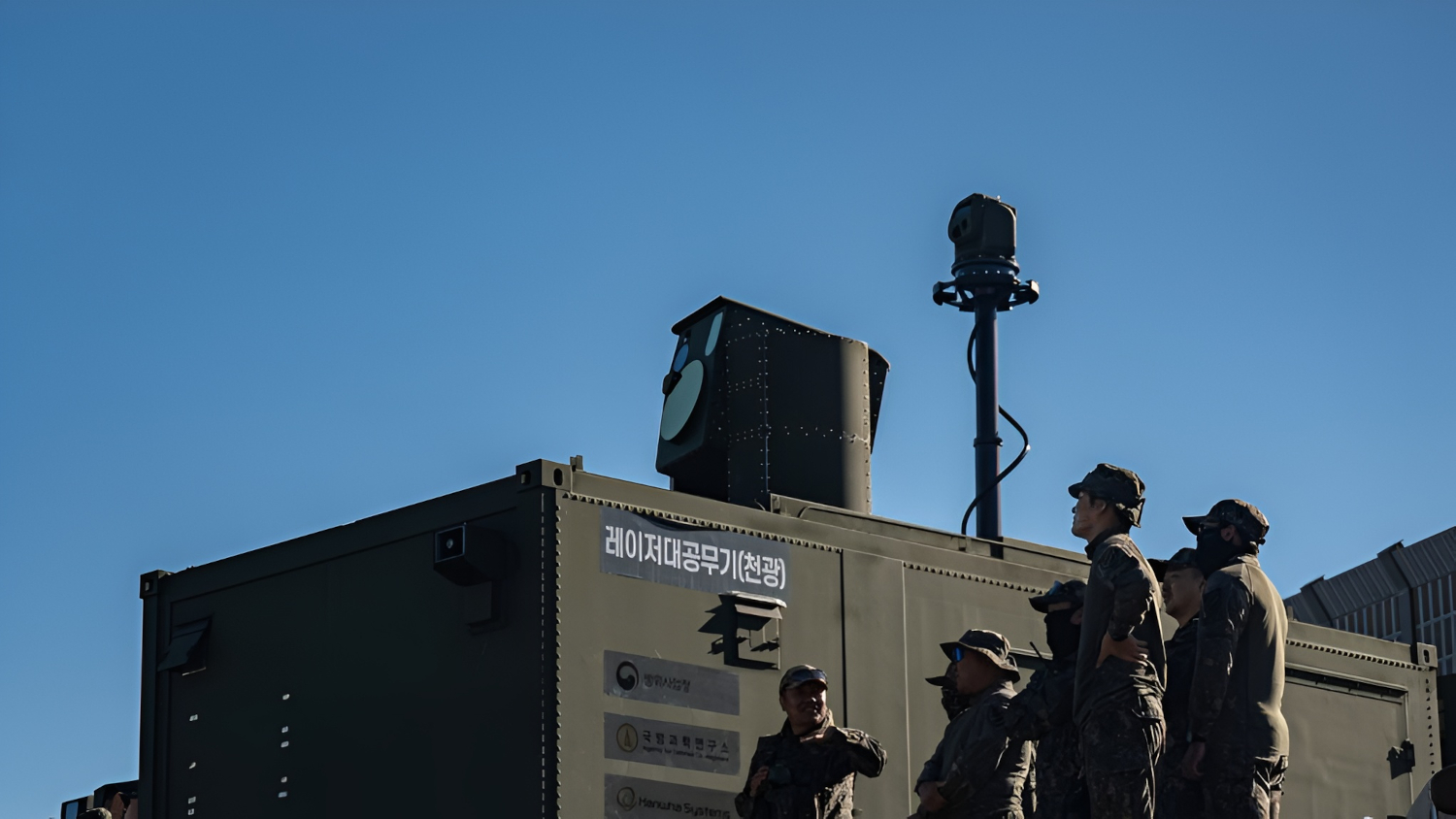
Hanwha Systems’ Cheongwang laser air defense system during the TIGER+ exercise, October 2026.
A Hanwha-reported $1.50-per-engagement laser is now intercepting drones for the Republic of Korea Army. The math is compelling; the full picture is more complicated.
Cheap drones have created an uncomfortable budget problem for defense planners: conventional interceptor missiles cost far more than the threats they destroy. Cheongwang, a ground-based laser air defense system developed by Hanwha Systems with South Korea’s Agency for Defense Development, entered Republic of Korea Army service in December 2024. Hanwha and South Korean industry reporting describe it as the world’s first operationally deployed laser weapon, and the reported engagement cost of roughly US$1.50 per shot is the number driving attention. The caveats that headline obscures are just as important.
What Cheongwang Actually Does
Concentrated laser energy replaces the interceptor missile, but electricity does the heavy lifting.
Hanwha classifies Cheongwang as a Laser Air Defense Weapon Block-I, operating in approximately the 20-kilowatt class. The system directs concentrated laser energy at a drone’s airframe or critical components, heating them until the aircraft fails. No separate interceptor round is consumed per engagement; the effective magazine is electricity, provided power and cooling hold.
At the TIGER+ Future Warfare Integrated Combat Exercise on October 14, 2026, Cheongwang and a separate 30-kilowatt-class mobile laser system jointly intercepted all three target drones, according to Hanwha. Roughly 500 military officials, academics, and industry observers attended. The reports reviewed do not specify which system destroyed each drone, nor do they disclose target types, speeds, ranges, or environmental conditions. The 100% intercept result should therefore be read as a company-reported demonstration outcome, not established battlefield performance.
The $1.50 Number Needs Context
Marginal firing cost and full operating cost are two very different figures.
Hanwha estimates each Cheongwang engagement costs approximately 2,000 South Korean won, or about US$1.50. That figure appears to represent the marginal cost of a single engagement. It does not appear to include electricity generation, cooling infrastructure, maintenance, spare parts, personnel, training, or capital depreciation.
Think of it like a streaming service advertising a per-episode cost while burying the annual subscription price: the headline number is real, and it is genuinely favorable compared to a missile interceptor, but it is not the whole bill. The underlying economic logic still holds when the threat is a cheap commercial drone deployed at scale, because Hanwha’s reported $1.50 engagement cost changes the exchange-ratio math in ways a missile system cannot match. That advantage holds as long as power, cooling, and system availability remain sufficient.
What the System Cannot Do
Physics sets limits that no manufacturer statement changes.
Directed-energy systems require an unobstructed line of sight, reasonably clear atmospheric conditions, precise target tracking, and adequate dwell time on target. Rain, fog, and airborne dust are established constraints for high-energy lasers, though the supplied reporting does not quantify their specific effect on Cheongwang’s performance. A single laser engagement channel generally cannot maintain full-power effects on multiple targets simultaneously.
A coordinated mass drone attack could therefore saturate one Cheongwang installation. Layered defenses combining laser systems, electronic warfare, and conventional interceptors remain a practical response to that vulnerability, as the October demonstration itself reportedly included electronic jamming and armored vehicle support alongside the laser systems.
Hanwha is also developing a more mobile, 30-kilowatt vehicle-mounted laser system, with export markets in view. The United Kingdom’s DragonFire program reflects a parallel international push toward directed-energy air defense, though it follows a separate development path.
Sustained operational data, not demonstration results, will ultimately determine whether Cheongwang becomes a model other militaries follow. The milestone is genuine, and the open questions are equally real.